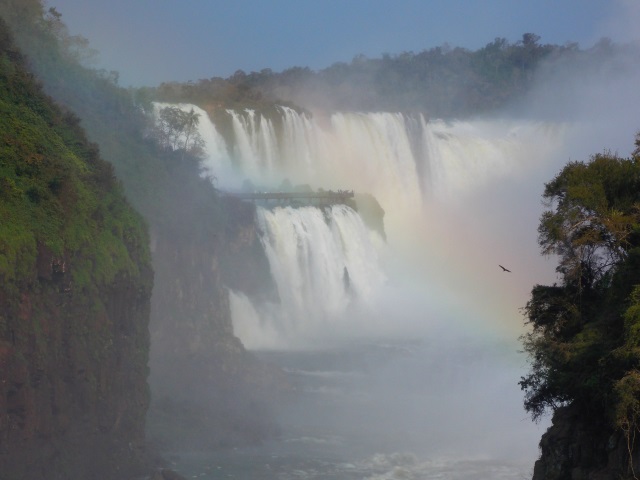
 Just one of the hundreds of beautiful waterfalls at Iguazu. Cintia and I have spent the last few days in Foz do Iguazu at the junction of the Iguazu and Parana Rivers and the borders of Brazil, Argentina and Paraguay. This is an important region for trade between the three countries and a huge tourist destination due to the incredible Iguazu Falls. Listed as one of the New Seven Wonders of Nature it truly is a wonderful experience to visit here. Coming from Australia, where water is such a scarce and precious commodity, it was almost impossible for me to comprehend the amount of water that is charging over these falls every second. It felt like the entire flow of all the rivers in Australia combined. I don’t have the facts and figures at hand but it was very impressive. The raised walkways through the forest were delightful with thousands of butterflies as well as birds, turtles, monkeys and lots of coatis.
We enjoyed a boat ride which took us right underneath two of the smaller falls. It definitely felt like a place that humans and boats are not supposed to go. For a second or two I thought the force of water was going to completely swamp the boat and wash us all overboard into a river that would be almost impossible to survive. But we did survive and it was actually really fun in a death-defying sort of way. We came out excited and completely saturated. To cap off a day of water and more water, we had a huge thunderstorm in Foz last night and our top-floor room sprang a serious leak. Luckily it was away from the bed so we weren’t too worried about it and none of our stuff got wet.
We’re hurrying right now to catch our flights to Buenos Aires so I will leave you with a few more photos from this amazing place. I’ll get back to writing about sustainable buildings next week when we get home.


 A happy man in Brazil… beautiful lady, cold beer, Futbol and endless meat on a stick! I’m back in Brazil now with my lovely partner Cintia and her family. This week we celebrated her father’s 70th birthday in fine Brazilian style. On the actual day we went out to an all-you-can-eat Churrascaria which was amazing. We helped ourselves to the massive salad bar, then an endless stream of waiters came to our table with swords stuck through various forms of BBQed meat which they proceeded to carve directly onto our plates. It was quite difficult to get them to stop. Needless to say we ate way too much deliciousness.
Perhaps my favourite part of the whole trip so far was watching Cintia’s 94 year old Grandmother play croquet with her 90 year old friends. It was a tightly fought contest with lots of viciousness and spite (as befits any good croquet game) and ended perfectly with Cintia’s grandma making the winning shot.
Today we had the big family gathering for Toshio’s 70th at an all-you-can-eat Japanese restaurant. I’m starting to realise this a favourite thing amongst Brazilians, this eat-till-you-explode type of celebration. Not that I’m complaining, the sushi and fish was absolutely delicious and I have conveniently shelved my aversion to over-consumption for a day or two.
Tomorrow we begin the journey home via Iguazu Falls, Buenos Aires and Santiago. First stop at a ranch where Cintia’s uncle breeds a uniquely Brazilian type of horse that reportedly has a wonderful smooth and fast walk that can carry a rider a long way with speed and comfort. Sounds interesting. I’ll know more about it tomorrow.
A Little Reader Feedback
In our Newsletter a couple of weeks ago I wrote a bit about my internal conflict over travelling around the world in jet planes emitting tons of CO2. Ray, a regular reader, made the following comment about this which I thought was worth sharing:
‘Tks for being up front re Flying & Carbon-Earth damage.
In my humble biased outlook I heavily discount all ‘climate
warriors’ that jet-off at every opportunity, especially the
wanky “meeting” trips that could be held on a simple video
link. I am well aware that these ‘trips’ are cover for everything
from new shoes to extra amour side dishes.’
I’ll get back to writing more about sustainable building when I get home. Ciao!
 Wide open spaces in “Big Sky Country” Montana is known locally as “Big Sky Country” and with good reason. It’s a land of open spaces, rolling plains, sunshine and lots of blue sky. I lived here on a ranch on the Tongue River east of Billings for many years. It’s a breathtakingly beautiful and peaceful place…. such a contrast to the noise, pollution, crime and claustrophobia of Sao Paulo which I described in our Newsletter two weeks ago.
It’s wonderful to be back here for a visit and to work with my son, Sam, fixing fences, riding horses and moving cattle. It makes a father’s heart swell with pride to see his son taking his place among the men of the world.
 Sam with his horse “Brumby” by the old barn at Bones Brother’s Ranch in eastern Montana. Sustainable House Day, September 13th
Last year we opened the Greeny Flat for Sustainable House Day 2014. We’re planning to open again this year although we are not listed on the Sustainable House Day Website yet due to technical difficulties. Last year there were three other excellent projects open in our area. They also are not listed yet but if “The Keep” in Buxton and/or Glenn and Lee Robinson’s House in Bundanoon decide to open again this year I HIGHLY recommend a visit to both of them.
I’ll keep you posted once we get our registration sorted out. If you live in other parts of Australia you can find out what homes will be open in your area by visiting the Sustainable House Day Website.
Abbott Cops More Stick
In our Newsletter two weeks ago I wrote about the international criticism that is being directed at Tony Abbott Government for his appalling climate change policies. I’m delighted to report that he continues to cop more of the same. As reported this week on the Ecogeneration.com website, Australia’s clean energy industry has soundly condemned the government’s proposed emission reduction target saying,
‘These targets are vastly inadequate to protect Australians from the impacts of climate change and do not represent a fair contribution to the world effort to bring climate change under control.’
‘Australia has already attracted significant criticism from our trading partners, including China and the US, over concerns we’re free-riding on the backs of other countries’ efforts to tackle climate change. With these targets, we’re a leaner, not a lifter.’
I couldn’t agree more. I’m no political activist, in fact I detest politics and politicians, but I care about the environment and my son’s future. I can’t sit by and watch Abbott’s attempts to destroy the renewable energy industry, promote fossil fuels at all costs and set Australia on a course of local, national and global pollution and consumption without saying something.
NZ Shows The Way
So I was also delighted to read this week that New Zealand is plotting a VERY different course. According to this recent article from the Solar Quotes Blog, the kiwis have announced that they will close their last two coal mines by 2018 and aim to be 90% renewable by 2025.
That’s fantastic and stands in such stark contrast to Tony Abbott saying ‘Coal is the Future’ and ‘I hate renewable energy’. Hopefully some of that thinking will drift westwards over the Tasman before the next election.
‘By announcing that it will support renewable energy in such an emphatic fashion, New Zealand has assumed leadership on renewable energy amongst Pacific nations. This of course in contrast to the Australian policy of deliberately undermining clean energy whether by emasculating the Renewable Energy Target (RET) or gutting clean energy agencies that draw in millions of dollars of financing.’
Finally I can’t resist throwing in another photo from the ranch just for fun.
 Sam leaves the barn after a long, hot ride.
 My son Sam (who turns 21 tomorrow) with his new friend, Oscar. My son, Sam, turns 21 tomorrow! Wow… that is irrefutable proof that I am now, officially, middle-aged (as much as I hate to admit it).
I’ve spent the last week catching up with Sam and the many friends I made in the beautiful and vibrant city of Missoula where I lived for many years before returning to Australia in 2012. I encourage anyone who happens to be passing through Montana to spend some time in Missoula, not just for the natural beauty of its rivers, mountains and forests, but to experience the wonderful community spirit and engagement that makes Missoula a truly unique place in the world. I’ve never been anywhere that has even half the amount of community activity that Missoula has on a daily basis. From farmer’s and craft markets, to free concerts in the park, gallery walks, sporting and recreation events, talks, festivals, music and dancing… there is always something going on here. And not only is it going on but the entire community engages in it as well, so everything feels well-supported and vibrant. It was a great place to live and remains a wonderful place to visit.
Ethical Investment Possibility
Meanwhile, I’ve just received notice of an exciting renewable energy development back home in Australia.
As someone who is constantly on the lookout for socially and environmentally responsible ‘ethical’ investment opportunities, I am excited about the possibility of buying shares in a new, innovative, community-owned renewable energy company called Enova Energy.
Based in the Northern Rivers Region of NSW, Enova will be giving preference to local residents in its initial share offering to be made in September, 2015. However, from August 13th, any Australian resident will have the opportunity to apply to buy shares in the company. Even if you have no interest in investing, it will be interesting to watch Enova develop and to see how it manages to compete with the big energy companies like Origin and AGL. In short, the company aims to:
- Be a locally-owned energy retailer with a strong focus on renewable energy;
- Install and maintain solar power (plus energy storage) systems;
- Assist its local customers with improving energy efficiency and reducing energy costs;
- Use local suppliers and installers wherever possible;
- Return a significant proportion of its profits to the local community in the form of assistance to low-income customers and education about renewable energy to the wider community;
- Pay dividends to its shareholders;
- Encourage and assist other communities to establish their own local energy companies.
The Company Prospectus details an impressive list of experienced managers and directors along with their relevant experience and financial interests in the company. The following italicised quotes are taken directly from the Prospectus outlining the business model and prospects of the company. I have copied these here purely for informational purposes and it is not intended as financial advice. I encourage anyone interested in possibly investing in this socially and environmentally responsible enterprise to read the full Prospectus which can be downloaded at the bottom of the following webpage: http://www.enovaenergy.com.au/investors/
“Investment Overview – Enova Community Energy provides a unique investment opportunity to residents of the Northern Rivers Region of New South Wales and others. We are pioneering a community owned energy retail model that provides a pathway towards offering 100% renewable energy to our residential and small business customers, and ultimately delivering a return to investors. In the Directors’ view our nimble and collaborative locally based social enterprise model is sustainable and can be replicated and scaled across like-minded Australian communities.”
“The Company will be engaged in: a) retailing energy, offering attractively priced GreenPower energy to residential customers, with the objective of delivering 100% renewable energy to our customers; b) installing and maintaining solar technologies including energy storage technology; c) providing tailored energy solutions for residential, business and government customers, individually or in groups; and d) providing education in energy efficiency and assistance in lowering energy costs.”
“We will encourage and facilitate the development of local renewable generation and aim to be a model for other communities in developing a renewable energy future”
“In line with its focus on providing environmental and social benefits to the community, Enova intends to invest an amount equal to the dividends paid to its shareholders in community benefit projects that support the ability of low income residents to participate in energy efficiency and renewable energy services.”
”Offer Price: $1000. Total number of Shares offered under the Offer: 3953. Total number of Shares on issue on Completion of the Offer: 4000. Amount to be raised under the Offer: $3,953,000.”
“Offer open: 13 August 2015. Offer close and Applications due: 11 September 2015 5.00pm[(AEDT)] . Allotment: 14 September 2015. Expected despatch of holding statements: September 2015.”
“How are Enova’s environmental outcomes different to our competitors’ – Enova’s large competitors offer GreenPower – which is made up of high quality, accredited Australian generated renewable energy – as a full price add-on. Enova will offer GreenPower at discounted prices as its core offering.”
“Trading in Enova Shares will be less liquid than shares listed on the ASX. Since shares will not be listed it will not be possible to sell through a broker. We intend to maintain a Community Notice Board on our website where it will be possible to list interested sellers and buyers in order to facilitate contact between them although share prices can not be listed on the Community Notice Board. Shares can then be transferred via the Share Registry. The Registry should be contacted to obtain a transfer form.”
“The shares will not be listed on the ASX or any securities exchange in the short term. The Board will maintain a watching brief and consider listing in the medium to longer term”
“Each applicant is entitled to up to 5 voting shares. If more than 5 Shares are allocated to an applicant, the remainder of the allocated Shares will be non-voting shares as set out in the Constitution. Preference in allocation will be given to investors from the Northern Rivers Region.”
“Any person resident in Australia may apply however preference in allocation will be given to those people resident in the Northern Rivers Region, who is resident within postcodes: 2460 to 2487 inclusive. Applicants will be allocated a maximum number of 5 voting shares. All additional shares sought and allocated will be non-voting shares.”
“The Company also reserves the right to approve a system which allows Shareholders who are customers of Enova to direct the Company to use the dividends to pay their Enova electricity bills.”
“The Directors accept that following the Guidance contained within ASIC Regulatory Guide 170: Prospective Financial Information they are required not to provide forecast future earnings as the Company is in an early stage of development and there are significant uncertainties associated with such forecasting.”
“The payment of a dividend by Enova is at the discretion of the Directors and will be a function of a number of factors … No assurances can be given by any person, including the Directors, about the payment of any dividend and the level of franking on any such dividend. Subject to these considerations the board anticipates a payout ratio of 80% of NPAT (Net Profit After Tax) to be divided equally between shareholders and the NFP (the Not For Profit arm called Enova Community). A payout ratio of 80% equates to a dividend payout of 40% of statutory NPAT.”
“Reaching a point where Enova is financially sustainable and able to commence payment of dividends rests upon a number of assumptions, including the rate at which it can grow its customer base. In this respect, Enova will need to secure 5000 customers, representing around 4% of households in the Northern Rivers Region, by June 2018”
“Our overwhelming point of difference is that we will be local and majority community owned, with a strong commitment to reducing our carbon footprint, supporting local employment and investing profits for community benefit. The initial response to this positioning has been very positive.”
“As a committed local employer, Enova intends to engage with local suppliers and service providers wherever possible in order to maximize economic and social benefits to our region.”
“In addition to attractive FITs, GreenPower options or lower price, Enova also intends to provide energy audits, tariff assessments, and assist customers in assessing and installing solar and other energy saving equipment to help customers lower their energy cost and save on greenhouse gas emission.”
“Initially the installation arm will focus on the traditional, small scale solar PV for homes and shops, large scale PV for factories and commercial premises and solar hot water. Over time we will support other existing and emerging energy management technologies and energy efficiency tools and equipment.”
“There are a number of risks and threats, both specific to Enova, and of a general nature, which may either individually, or in combination, materially and adversely affect the future operating and financial performance of Enova and the value of Shares. Many of these risks are partially or completely outside the control of Enova, its Directors and management. There can be no guarantee that Enova will deliver on its business strategy, or that any forward looking statement contained in this Prospectus will be achieved or realised.”
“There is interest from other communities in establishing a similar structure or in our supporting them using our own systems and operations. We intend to assist such communities to set up similar models by sharing our experience and developing a coalition of likeminded community energy companies that can share costs and systems; spread risk; bulk buy equipment; and trial new and innovative offers.”
I intend to apply for one or more shares although, if all of the shares are taken up by local residents of the Northern Rivers region, I may well miss out on the opportunity. All of the above is for information purposes only and is not intended as financial advice. If you are interested in the prospects of Enova Energy please read the entire Prospectus and consult your own financial advisor before making your own decision to invest. Once again, the full Prospectus can be downloaded at the bottom of the following webpage: http://www.enovaenergy.com.au/investors/
 Cintia takes in the view of Rio from Pao de Acucar Rio de Janeiro is a fascinating city. Some say it’s the most beautiful city in the world but I think Sydney still wins that one for me. Mind you we were only in Rio for one day and it was a bit cloudy so we didn’t get to see it’s full glory. I did get the feeling that there are a thousand interesting places and things to see around the city and surrounding area. It would be easy to spend a month there and only scratch the surface of the place. We did spend a bit more time with Cintia’s family in Sao Paulo which is not likely to make anyone’s list of most beautiful cities in the world. In fact it is huge, polluted, crowded, and not very pretty. What saves it, of course, is that it is populated by Brazilians who, for me, are living up to their reputation of being friendly, fun-loving, warm and welcoming. On the other hand there is a LOT of crime in Sao Paulo to the extent that most people have to barricade themselves into their homes.
 Cintia’s parent’s house in Sao Paulo. High crime rates force home owners to barricade themselves with high walls, steel bars and electric fences. Cintia’s parent’s house has no view of the surrounding neighbourhood, all you can see out the windows is the inside of the high wall surrounding the property with electrified wires running around the top. If it wasn’t for the warmth of the people inside and the perfectly comfortable and pleasant living arrangements you could easily feel like you were living in a maximum security prison. It was enough to make me quite claustrophobic at first and VERY thankful for the privilege we enjoy of living in the Greeny Flat, in such a safe and peaceful part of Australia where we don’t have to put bars on our windows or build walls around ourselves… where we can look out our windows and see the beautiful place that surrounds us and go for a walk in the park in the evening with no fear of being robbed or mugged. We are so lucky and we should never take that for granted.
This, for me, is one of the great things about travelling… it reminds me of how incredibly privileged I am and of how important it is to appreciate my good fortune. This trip has raised some serious internal conflicts for me. I am finding it very hard to justify the fact that we are consuming so much and emitting so much CO2 for our own personal benefit. The fact that we CAN do this is another reminder of just how very lucky we are in this world… the vast majority of the world’s population do not have the means to go jet-setting around the planet. But this, for me at least, carries a heavy burden of responsibility. Just because we can do something doesn’t mean we should. Is our desire to be present at Cintia’s father’s 70th and my son’s 21st birthdays enough to justify the potential damage that we are causing? Clearly not, and yet, here we are… conflicted but determined that, if we’re going to do it we have to make the most of it… appreciate every moment and not spend the whole time feeling guilty about it.
So here’s one more photo from the gorgeous colonial village of Paraty on the coast south of Rio. Founded in 1597 by the Portuguese, the old part of the town has been beautifully preserved and the cobble-stone streets are kept free of cars. It felt very much like a trip back in time and makes me wonder if we’ve really made any advance in town planning or building design in the last 500 years. Paraty will stand out in my memory, not just for its intense beauty but also for the wonderful evening we spent eating, drinking, dancing and listening to music with a room full of happy Brazilians at one of the many charming restaurant/bars in the old village. It was a perfect evening and I felt like I was enjoying the very best of what Brazil has to offer.
 The gorgeous, 500-year-old village of Paraty. News From Oz
Meanwhile I’ve been keeping track of some interesting developments at home. Not only has Tony Abbott come in for some serious international criticism for his policies on renewable energy, but the Labor Party is finally showing some guts and appears to be aiming to make the next election a national referendum on renewable energy policy. This is great news. Personally I think Abbott and his party’s open war on clean and renewable energy development is a national disgrace and a moronic stance for a political party to take. Clearly there is enormous potential for renewable energy to offer a path to a cleaner, healthier future for humanity AND to provide employment and economic development along the way.
According to this recent article from the Sydney Morning Herald, one of Britain’s wealthiest, conservative members of parliament named Richard Benyon has openly attacked Tony Abbott’s climate change policies calling them ‘mystifying’, ‘bewildering’, ‘incomprehensible’ and ‘a distorted vision of what it means to be a conservative’. This raises a very valid point. For a long time I have wondered what it is that so-called ‘conservatives’ like Tony Abbott are actually looking to conserve. It appears to be their own wealth and privilege and certainly not the health of the environment or the future prospects of our children and grandchildren. As Mr Benyon says, ‘true conservative values include… a respect for sound science and economics, a belief in protecting the natural world and a responsibility to do the best for the biggest possible number of one’s citizens’.
Mr Abbott has also been the subject of stinging criticism from within Australia. As reported in this Energy Matters newsletter, South Australian Climate Change Minister Ian Hunter has said that
“…. we will be calling on the Federal Government to end its ideological opposition to renewable energy and commit to supporting these projects that reduce the devastating impacts of climate change… The message being sent to renewable energy investors by our Federal Government is look elsewhere – don’t spend your money in Australia and don’t create jobs here – we think that is grossly irresponsible.”
Meanwhile, as reported by the ABC, Federal Opposition Leader Bill Shorten has announced the Labor Party’s renewable energy policy heading into the next election and it includes very ambitious targets. They are calling for 50 percent of Australia’s electricity to be from renewable sources by 2030. This would be a big step in the right direction from where we are now and is setting the next election up to be a national referendum on renewable energy. ‘There couldn’t be a clearer choice between Abbott’s Liberals and the Labor Party I lead’, Mr Shorten said. ‘You do no favours for the people of Australia, no favours to your own families and successive generations by saying we can’t do anything about climate change.’
It’s great to see a major Australian political party actually make a stand FOR something and not just react against whatever the other party has to say. I hope it pays off for them at the next election because I do believe that acting decisively to curb climate change will not only benefit the planet and everyone on it but also has the potential to stimulate a lot of economic activity at home in Australia. Kane Thornton, CEC CEO, is quoted in this ecogeneration article as saying…
‘The Australian Labor Party must be congratulated for taking such strong leadership and recognising the enormous role that renewable energy can play in Australia’s future, both in terms of dealing with the challenge of climate change and creating economic opportunities’.
I just hope that energy conservation is a major component of any future Australian energy policy and that the shift to renewables is applied to all forms of energy consumption and not just to electricity generation. A huge amount of natural gas is used for heating and cooking in Australian homes and most of our transportation is powered by either petrol of diesel engines. So while the Labor policy is a great start, there is still a very long way to go towards a truly renewable energy future.
 Nice Weather for Inuits. After last week’s Newsletter entitled ‘Nice Weather for Eskimos’ I was gently reminded by one of our Canadian readers that they’re not called Eskimos any more. The correct term for the indigenous people of the far north of North America is Inuit. Thanks for the reminder and I apologise if I offended anyone. Meanwhile it seems I spoke too soon when I said that the weather had been a tad chilly. On Friday morning we woke to find snow on the Greeny Flat which was an exciting event for Cintia who was raised in Brazil and had only seen snow once before in her life during a trip to Japan. After the twenty years I spent shovelling snow for six months of the year in Montana, it wasn’t quite such a novelty for me although I was reminded of how snow can make the most ordinary things strangely beautiful. I’ve posted the rest of the photos I took in our Gallery here. We only had 10mm or so of snow but there was much more in Berrima… enough to cause the Hume Motorway to be closed in both directions for a number of hours.
All of the above made me feel a little better about heading off on our trip to Brazil. In fact I’m writing this Newsletter from the guest bedroom of Cintia’s parent’s house in Sao Paulo. Her father’s 70th birthday is coming up so we’ve come over for that and I will also be heading up to Montana for my son, Sam’s, 21st.
I’m fully aware of the irony of building an energy positive house and then taking a plane trip half-way around the world. We’re probably generating as much carbon on this trip as we have saved in a year of living in the Greeny Flat. I haven’t done the calculations to find out. I thought about purchasing carbon offsets through the Alternative Technology Association’s Community Climate Chest but I find the whole concept of buying carbon offsets quite challenging. If we did purchase carbon offsets for this trip, it doesn’t make the carbon we are generating on this trip go away. It just means that the money is used to help reduce future carbon emissions. My feeling is that those future carbon emissions should be happening anyway not because we’re choosing to take a carbon-intensive trip.
Perhaps the most effective thing about carbon offsets is the increase in the price. I think it was going to cost me about $500 to buy the offsets (I may still do it). That’s enough to help make me stop and think before taking the next carbon-intensive trip. Once again, I’d like to think that I would stop and think before doing that anyway, not just because of what it takes out of my wallet but because of the wider environmental impact of my choices.
Anyway, here I am in Brazil… feeling a bit guilty about it, but keen to enjoy it as much as possible. Having made the decision to come, the very least I can do is to make the most of it. We just arrived a couple of hours ago so I have nothing to report yet but keep an eye on future Newsletters for updates.
Australia Falling Further Behind On Renewables
The titles of two separate articles from the Energy Matters Blog sum up the sorry tale of the the Abbott Government doing everything possible to ruin renewable energy investment in Australia while the rest of the world, even the USA, is making great progress. Click on the links below if you’d like to read the full articles but the headlines pretty well sum it up. My great hope is that the Australian public will appreciate the utter stupidity of Abbott’s promotion of fossil fuel energy over renewables and not only vote against him at the next election, but vote resounding in favour of a renewable and sustainable future.
Kiwi Grows a Church
 This beautiful, living church was grown in NZ by Bryan Cox in just four years. I usually write these Newsletters about Green Buildings but this one takes it to a whole other level. As reported on the Bored Panda website, Kiwi Bryan Cox grew this lovely living church in just four years. He built a steel frame and then trained trees to grow over it and create a delightful interior space. There’s not much in the way of insulation or water-proofing but on a nice day I’m sure it would be delightful to be in. You can see some more pictures on the Bored Panda Blog here.
For now the jetlag has got the better of me and I’m going to have to get some sleep. More from Brazil next week.
The perfect winter weather for a Passive Solar House like the Greeny Flat is when you have clear sunny days and cloudy nights. Sun during the day warms the Thermal Mass of the floor slab which stores the heat and keeps the house warm through the night. When it’s cloudy at night the outdoor air temperature tends to stay much warmer than when it’s clear. The clouds act like a blanket that helps to keep the earth warm, and when the outdoor air is warmer the house stays warmer inside.
This is exactly what we have NOT been having here over the last couple of weeks. If anything, it’s been tending towards the complete opposite with cloudy days followed by clear, cold nights. We’ve had a lot of frosty mornings which wouldn’t normally bother us but, because the days have been cloudy, the house has not had much chance to warm up during the day so it’s gradually been getting colder and colder. For example, on a nice sunny day, even if the outdoor temperature only gets up to say 14degC the interior will usually warm up to 21 or 22degC. Then it will drop down to maybe 15 or 16degC overnight even if it gets below zero outside.
Today, with only partial sunshine, we only managed to claw our way up to 17degC inside and it’s predicted to get down well below zero tonight. So lately we’ve been resorting to turning on a little fan heater from time to time to help take the chill off the air. Not that I’m complaining… after twenty years in Montana where it regularly got below minus twenty or colder during the winter, anything feels pretty good to me. I especially love the clear, crisp, frosty mornings that we’ve been having and, because our house is small, well insulated and fairly air-tight, it doesn’t take much additional heat to keep it comfortable, even on the coldest days.
Environmental Footprints
In your ‘average’ inefficient home, the operational energy used for heating, cooling and hot water is often by-far the biggest portion of the overall environmental impact of the building over its life, especially in very hot or very cold places like Montana. But in an energy-positive house like the Greeny Flat, which actually makes more energy than it uses, the operational energy is no longer a factor and other things become bigger issues.
For example, the ‘embodied energy’ (i.e. the energy required to manufacture and transport the materials used to construct the building) becomes a much bigger portion of our environmental footprint. It would be possible to do a full ‘life-cycle analysis’ to quantify exactly what the various environmental effects of our choices might be over the life of the house (or any other product or system) but that is the stuff of phd’s. I haven’t done the calculations and I don’t care to, but we did make a concerted effort to limit the embodied energy in the materials chosen for the Greeny Flat. That is one of the reasons why we chose to use timber frames and plywood linings, because they have lower embodied energy than steel and gyprock.
Almost every decision is a compromise between competing priorities. For example, we could have used timber weatherboards for the exterior cladding which may have had a lower embodied energy than the galvanised steel that we used. However the goals of low-maintenance, durability and fire resistance took precedence in that case so we chose to use the steel. The most important thing that any of us can do to limit the embodied energy in a building is to Keep It Small and Simple (K.I.S.S.). A small, simple structure will generally have much less embodied energy than a large and complex one.
Our transportation choices also become a much larger factor in our overall environmental impact once we have limited our home energy use. Another huge issue is the energy and resources required to grow, process, transport, sell, and cook our food. That is the subject of an excellent book by Michael Mobbs called ‘Sustainable Food’ which I highly recommend (even though we still have a long way to go down that path ourselves). For today I would like to focus more on the transportation side of things.
More About Sustainable Transportation
In last week’s Newsletter I wrote about solar trains, planes and automobiles and regular readers of this Newsletter will know that we often highlight developments towards more sustainable transportation options. Before I go on, I want to make the very important point that the most sustainable forms of transportation are walking and biking. As such, the most important thing we can do as a society is to design our towns and cities in such a way that people can walk or bike to just about everything they need. On an individual level, we can choose to live (and to build) in a place that already allows for this to happen. For example, as we discuss in depth on this page of our website, the site for the Greeny Flat was deliberately chosen because it is within easy walking distance of Mittagong town centre, shops, recreation, parks, libraries, etc, etc… and importantly, a railway station so that, if we need to go further afield, we can hop on a train to get there. In all honesty, it would be quite easy to live here without a car if we needed to, as long as we could continue to work from home or find work nearby.
 Cintia’s car – hit by a ute that didn’t get far We took one step closer to that ideal recently when an unfortunate young gentleman accidentally rammed his ute into the back of Cintia’s car that was parked in the street outside. Even though the car was perfectly drivable, the damage was too expensive to fix and the car was written off by the insurance company. So we’re going to try living with just our feet, our two bikes, and my little van for a while and see how it goes. I’m thinking that it might be a good time to get an electric assisted bicycle like my friend Glenn’s. I love riding my bike but if I had to go to a meeting in Bowral I would be fairly soaked in sweat by the time I got over Mt Gibraltar. An electric assisted bike would get me there a lot quicker and smelling a lot nicer. I would also be able to charge the battery with some of our excess solar power during the day.
 Glenn Robinson with his electric-assisted cargo bike in front of his energy positive house. If it turns out that we really need a second car we will seriously consider getting a electric one… perhaps a second-hand Nissan Leaf or similar. A Tesla Model S would be quite nice but I can’t see the sense in owning a car that costs about twice as much as our house. So for now an electric boosted bike looks like a good option.
Solar Impulse Flies For Five Days Straight
 The Solar Impulse lands in Hawaii (with help from a couple of bicycles) after five days and nights in the air. As reported in this BBC Article, the Swiss designed “Solar Impulse” zero-fuel plane touched down yesterday in Hawaii after a record-shattering 118 hours of non-stop flight from Japan. The previous record for a solo un-refueled flight was only 76 hours and the Solar Impulse also broke records for the longest distance covered and longest time in the air for a solar powered plane.
It’s amazing to think that this plane, which has a 72m wingspan covered with 17,000 solar cells, is capable of generating enough power to not only stay in the air during the day, but also to charge its batteries with enough power to keep it aloft for the entire night as well. Theoretically it could fly forever except that, because it has a such a huge wingspan (longer than a Jumbo Jet’s), flies so slowly (top speed 140km/h) and is so light (only 2,300kg), it is highly vulnerable to bad weather and turbulence. In fact it had to wait in Japan for a month before a window of good weather opened up to allow it to continue on it’s round-the-world journey which began in Abu Dhabi on March 9th.
She’s not a beautiful craft and, judging by the photo above from the BBC Article, the landing speed is slow enough to allow the ground crew to keep up on bicycles. It reminds me of an old joke about a Texan bragging to an Irishman that he could get on a train in Houston, ride the train all day and all the next night and all the following day, get off in El Paso and he’d still be in Texas. To which the Irishman replies, “to be sure and we have some slow trains in Ireland too.”
Nevertheless, this is a remarkable achievement from the Solar Impulse team. As co-founder Bertrand Piccard said upon the plane’s arrival in Hawaii…
‘Andre’s flight was longer than all the other single-seater flights that had fuel. That’s an incredible message. Now you can fly longer with no fuel than you can with fuel. So, what Andre has done is not only a historic first for aviation, it’s a historic first for renewable energies. And this is why we are doing this project.’
Indian Railways Experimenting with Solar Power
Indian Railways has begun trialing railway carriages with solar panels mounted on the roof to run the interior lighting and air-conditioning. According to this article from cleantechnica.com this work is usually done by a diesel generator and “a train using solar power can reduce diesel consumption by up to 90,000 litres per year and also bring down the carbon dioxide emission by over 200 tonnes.” … Not bad!
It’s not nearly as impressive an achievement as that of the Solar Impulse but it does help to make for a great headline for this week’s Newsletter. Plus, since trains are powered by electricity in the form of a diesel electric motor, it seems to me that, if every locomotive and train car was covered with solar panels, the electricity could be directed to powering the train and not just its lights and air-conditioning. On a global scale this could lead to a massive reduction in fossil fuel use and carbon dioxide emissions from trains.
Dutch Solar Powered ‘Family Car’
 The Dutch Eindhoven University of Technology’s Stella-Lux ‘Energy Positive Family Car’ is capable of making more energy than is required to run it and will be here in Australia in October for the World Solar Challenge I absolutely love the idea of a car that can generate more energy than it uses. One of our original goals for the Greeny Flat was to make a house that could do the same. It’s clearly MUCH easier to be energy positive with a house than with a car by virtue of the fact that we have a large roof area for solar panels and no weight restrictions. One of the main reasons the Stella Lux looks so odd is that it is designed to be both highly-aerodynamic AND to provide maximum roof area for solar panels.
My favourite thing about the Stella Lux is that, according to the Gizmag article, the team’s goal ‘is to show that such a car can also be sexy and user-friendly.’
‘Sexy’ is not the first word that comes to my mind when I look at the photo above… oh well, I always thought the Dutch were a bit different, and good on them for getting us a step closer to having our own energy positive car one day to go with our energy positive house.
It would be fun to go to Adelaide in October for the finish of the World Solar Challenge… I just wish I had an energy positive car to get me there.
 Andy explains the Greeny Flat to the Southern Highlands Sustainable Lifestyle Organisation on Sunday Today we had a very enjoyable visit from the Southern Highlands Sustainable Lifestyle Organisation. It is always a pleasure showing the Greeny Flat to people who are interested and knowledgeable in the field of energy efficient and sustainable building. Quite a few members of this group already live off the grid and grow much, if not all of, their own food. There were also a number of enthusiastic young men and women who are gathering information with a view to creating their own sustainable life in the near future. There were Wwoofers from Queensland, Germany and the USA, homeowners, farmers and gardeners. It was a beautiful, warm, sunny day and we had a very lively and stimulating discussion sitting around our little patio. I’d like to thank the group for coming and also to invite other groups or individuals who are interested to come and see the Greeny Flat for themselves.
For more information about the Southern Highlands Sustainable Lifestyle Organisation contact Judith Collins via earthkeepers.com.au.
Wave Energy Makes Waves
Western Australian company, Carnegie Wave Energy has reached a world-first milestone by achieving 10,000 hours of continuous operation of their Ceto 5 units. Harnessing wave energy seems like such an obvious renewable energy solution but decades of research and development around the world have mostly succeeded in proving that it is extremely difficult to build a machine that can survive the rigours of salt water corrosion and constant pounding by the swells. Carnegie anchors their units below the surface of the waves where there is still plenty of wave motion but much less chop and turbulence. They use the submerged off-shore units to pump high-pressure salt water to an on-shore electricity generator. The pressure can also be used to force the salt water through a reverse osmosis membrane for desalination. For islands and other locations surrounded by wave energy and short of fresh water this technology looks like a promising way to provide both renewable energy and desalinated fresh water.
Click here to read an article about Carnegie’s record from Eco-generation.
It will be interesting to see how the Carnegie experimental plant holds up to the monster swell that is currently pounding the WA coast and making a lot of surfers very happy. Click here to read about the big swell that has WA surfers excited.
Meanwhile, here are a couple of articles about ocean-going craft that use the up-and-down motion created by the waves to generate forward motion of the vessel.
The Wave-glider
Whale Tales Improve Ship Efficiency
Disclosure: I own shares in Carnegie Wave Energy mostly as a way to support their research and development but also in the hope that eventually their technology may prove to be a viable business venture.
The Rest of Last Week’s Newsletter
About half of last week’s Newsletter did not appear in the email we sent out to subscribers (although it does appear here on the website). So, for those who didn’t see it, the rest of this week’s is a repeat of the rest of last week’s.
The Pope Acknowledges Climate Change but Ignores Population
In an action that will no doubt see him excommunicated from Tony Abbott’s Christmas Card List, Pope Francis has come out strongly in support of action to curb climate change. As noted in this report from ABC News, the Pope’s call for ‘decisive action’ has been hailed by supporters as ‘a potential game-changer in the debate over what causes global warming and how to reverse it.’
Unfortunately, like the rest of the world’s leaders, the Pope has shied away from any discussion of how population growth might be contributing to environmental destruction. Instead he lays the blame at the feet of inequality and over-consumption. Certainly if we are to seriously tackle climate change we have to deal with those glaring issues but surely we also have to acknowledge what this article from The Guardian calls the ‘two whopping Elephants in the Basilica‘ those being the status of women in the world and the growth of population. As long as we are being led by economists and religious leaders who believe that the survival of their institutions depends on growth in population we are all in trouble. When was the last time you heard a politician or a preacher say that we need to have fewer people on the planet? I’m guessing never.
Until we get serious action on the population issue we will only be dealing with part of the environmental problem. And unless we get much smarter, more courageous leadership and voluntarily make the necessary changes, those changes will likely be made for us in ways that we won’t like one little bit. Populations will be reduced… economic growth will be curbed… as Swami Beyondananda so wisely said, ‘There will be peace on earth, I’m just not sure that humans will be here to see it’.
The Swami also said, ‘the best way to illuminate the darkness is to make light of it‘…. good reminder.
Abbott Under Pressure
In what I see as good news, Tony Abbott is apparently coming under increasing pressure to pull his head out of the sand and do something about climate change. As reported in this article from The Conversation, ‘Australia as been singled out as a climate free-rider by an international panel led by former UN Secretary-General Kofi Annan‘. …
But that’s more than enough about politics and religion…. here’s something much more interesting and positive.
 This little vehicle is powered by evaporation Turning Evaporation into Motion
According to this Gizmag article, scientists at Columbia University have developed a way of using bacterial spores to harness the power of evaporation and turn it into motion. Basically, spores expand in humid air and contract in dry air so, if you stick the spores onto some tape and then repeatedly expose the tape to wet, then dry air you can create a sort of ‘evaporation-driven piston’. By harnessing the repeated expansion and contraction of the tape you can turn evaporation into motion. The motion can then be used to power a generator or propel a vehicle. It’s a fascinating concept which so far has only been applied on a very small scale. It will be interesting to see if it can be scaled up into some sort of useful renewable energy source.
I wonder if we’ll ever find ourselves debating the status of spores in the world. Are spores living creatures? Do they have feelings? Is it wrong to stick them to a piece of tape and harness their swelling and shrinking for our own energy-craving benefit? Stand up for spore’s rights now before it’s too late!
 The Moto Pogo one-wheeled electric transport device Another One!
In last week’s Newsletter I featured the amazing Ryno uni-cycle/Segway type thingy… I don’t know what to call it… you can’t call it an electric bike because ‘bicycle’ implies that it has two wheels… anyway it looks like a really fun way to get around. And now I find out there’s another one. This one is called the ‘Moto Pogo’ and is under development in Canada. Apparently a Kickstarter pledge of CAD$2,200 will get you one which will go 25km/h for about 30km. Not as far or as fast as the Ryno but about half the price. I wonder how long before we start seeing these in Australia. They will certainly turn heads when we do. You can see it in action on YouTube at the following link…
https://www.youtube.com/watch?v=yhK01QnKd4M
Today is a cheerful day for anyone in the Southern Hemisphere who pays attention to the movement of the sun. It marks the point in the year when the sun is lowest in the sky. When you live in a Passive Solar House you tend to notice these things. It’s a happy day because it’s also the shortest day of the year. From now until Christmas the days will get longer and longer. Unfortunately they won’t start to get warmer and warmer for quite a while yet but at least we’ve got more sunshine to look forward to.
Sustainable Ozzie Prefab ‘Ecoshelta’
 The ‘West End Beach House’. Just one of many possible variations to the ‘Ecoshelta’ prefabricated sustainable home concept. This week I came across an interesting Australian prefabricated home concept called ‘Ecoshelta’. Developed by architect Stephen Sainsbury, Ecoshelta homes are designed and built in modular pods that can be combined in an infinite number of ways to create buildings that minimise waste, are designed to fit into standard containers for transportation, and are very quick to erect on site. They utilise an advanced aluminium alloy frame with interchangeable infill panels which allows for customisation to particular site conditions. Below are some excerpts from their website…
‘Ecoshelta e.Pods and Bigpods are high quality, high tech, sustainable, architect designed, prefabricated, modular buildings.
They are extendable, demountable, relocatable, robust and long lived….state of the art, practical and environmentally responsible buildings.
The system with suitable options can be used across the continent from the alpine south to the cyclones of the tropical north.
The practice aim is to achieve the highest possible aesthetic return for the lowest achievable ecological impact.’
Costs are estimated on their website as being anywhere from $55,000 for a single ‘pod’ fully fitted-out up to $340,000 for a full, six-pod house.
My first concern from looking at the photos on their website was the amount of potential air-leakage through the large number of sliding doors and windows. In the colder parts of the country you would have to be careful not to end up with too much air leakage but I guess you could choose to use more insulated panels and fixed windows and fewer sliding panels for better air-sealing. I was also worried that there could be excessive heat loss through the aluminium frame so I emailed Mr Sainsbury to ask him about this and received the following response…
‘We are an Australian based company and most of our buildings go to warmer climate areas. We have an alpine package of extras with extra insulation seals and double and triple glazing options available. The package also has a thermal break internal skin insert elements for the alloy exposed areas if really required. Our Marine grade structural high density high strength aluminium custom formed profiles are all hollow sections. Certainly an issue in places like Canberra and the western slopes and alpine Tasmania.
Roof we can do up to R7, and high infra red reflectivity zincalume and aluminium with twin skinning natural Venturi effect ventilation for hot climates.
Walls native R3.5 composite panel and extra layers for the alpine kit. 13mm HD plasterboard for internal thermal mass at low cost and phase change salt pod virtual thermal mass panel inserts for high cost alternatives.
Floor insulation native R3.5 composite panels with bamboo flooring over.’
So it sounds like they’re generally more suited to warmer parts of the country but that they can be adapted to cope with colder climates. There are a lot of potential benefits to a prefabricated building system and there are quite a few companies making prefab homes in Australia. Most of them, including the Ecoshelta, seemed to be aimed at the higher end of the market which is interesting because, in America, it’s the other way around and prefab homes are generally the cheapest and nastiest option available. Hopefully here it will work like Tesla’s marketing plan which started out making electric cars for the high end and is working towards making a lower cost option available to a much broader market. It would be nice to think that, some day, everyone will be able to afford a quality home with excellent environmental credentials that can be erected on site in just a few days, adapted very easily, and eventually taken away and used somewhere else.
The Pope Acknowledges Climate Change but Ignores Population
In an action that will no doubt see him excommunicated from Tony Abbott’s Christmas Card List, Pope Francis has come out strongly in support of action to curb climate change. As noted in this report from ABC News, the Pope’s call for ‘decisive action’ has been hailed by supporters as ‘a potential game-changer in the debate over what causes global warming and how to reverse it.’
Unfortunately, like the rest of the world’s leaders, the Pope has shied away from any discussion of how population growth might be contributing to environmental destruction. Instead he lays the blame at the feet of inequality and over-consumption. Certainly if we are to seriously tackle climate change we have to deal with those glaring issues but surely we also have to acknowledge what this article from The Guardian calls the ‘two whopping Elephants in the Basilica‘ those being the status of women in the world and the growth of population. As long as we are being led by economists and religious leaders who believe that the survival of their institutions depends on growth in population we are all in trouble. When was the last time you heard a politician or a preacher say that we need to have fewer people on the planet? I’m guessing never.
Until we get serious action on the population issue we will only be dealing with part of the environmental problem. And unless we get much smarter, more courageous leadership and voluntarily make the necessary changes, my guess is that the changes will be made for us in ways that we won’t like one little bit. Populations will be reduced… economic growth will be curbed… as Swami Beyondananda so wisely said, ‘There will be peace on earth, I’m just not sure that humans will be here to see it’.
The Swami also said, ‘the best way to illuminate the darkness is to make light of it‘…. good reminder.
Abbott Under Pressure
In what I see as good news, Tony Abbott is apparently coming under increasing pressure to pull his head out of the sand and do something about climate change. As reported in this article from The Conversation, ‘Australia as been singled out as a climate free-rider by an international panel led by former UN Secretary-General Kofi Annan‘. …
But that’s more than enough about politics and religion…. here’s something much more interesting and positive.
This little vehicle is powered by evaporation Turning Evaporation into Motion
According to this Gizmag article, scientists at Columbia University have developed a way of using bacterial spores to harness the power of evaporation and turn it into motion. Basically, spores expand in humid air and contract in dry air so, if you stick the spores onto some tape and then repeatedly expose the tape to wet, then dry air you can create a sort of ‘evaporation-driven piston’. By harnessing the repeated expansion and contraction of the tape you can turn evaporation into motion. The motion can then be used to power a generator or propel a vehicle. It’s a fascinating concept which so far has only been applied on a very small scale. It will be interesting to see if it can be scaled up into some sort of useful renewable energy source.
I wonder if we’ll ever find ourselves debating the status of spores in the world. Are spores living creatures? Do they have feelings? Is it wrong to stick them to a piece of tape and harness their swelling and shrinking for our own energy-craving benefit? Stand up for spore’s rights now before it’s too late!
The Moto Pogo one-wheeled electric transport device Another One!
In last week’s Newsletter I featured the amazing Ryno uni-cycle/Segway type thingy… I don’t know what to call it… you can’t call it an electric bike because ‘bicycle’ implies that it has two wheels… anyway it looks like a really fun way to get around. And now I find out there’s another one. This one is called the ‘Moto Pogo’ and is under development in Canada. Apparently a Kickstarter pledge of CAD$2,200 will get you one which will go 25km/h for about 30km. Not as far or as fast as the Ryno but about half the price. I wonder how long before we start seeing these in Australia. They will certainly turn heads when we do. You can see it on YouTube at the following link…
https://www.youtube.com/watch?v=yhK01QnKd4M
|
We will not share your information with anyone else and you can unsubscribe at any time.
Recent Newsletters
-
Apr 6, 2024: Open for Sustainable House Day
-
Apr 1, 2022: These floods are no joke
-
Mar 4, 2022: Disasters of Our Own Design
-
Nov 12, 2021: Free Zoom Screening of ‘Now’ Movie on Sunday
-
Nov 5, 2021: The Times They Are A-Changing
-
Oct 14, 2021: Sustainable House Day is Back… virtually
-
Sep 24, 2021: Two Years In the Cottage
-
Jun 25, 2021: Cheap and Simple EV
-
May 14, 2021: 3D Printed Earth Home
-
Feb 26, 2021: Doing Something About It
-
Feb 12, 2021: Barangarooted
-
Jan 29, 2021: Our House on the ABC
-
Jan 8, 2021: Electric Vehicle Madness
-
Dec 12, 2020: Water Works and Solar Cars
-
Nov 13, 2020: Arts Trail Open House
-
Oct 2, 2020: Another Year of Living Positively
-
Sept 18, 2020: Virtual Sustainable House Day on Sunday
-
Sept 11, 2020: Back in Mittagong
-
Aug 28, 2020: One More Week in Port Macquarie
-
August 21, 2020: Progress Report
-
August 14, 2020: This week’s progress report
-
August 7, 2020: Port Project Photos
-
July 17, 2020: Port Macquarie Project Progress
-
June 26, 2020: All Electric Workhorses.
-
June 19, 2020: Port Macquarie Project
-
June 5, 2020: Mount Gibraltar Stone Stairway
-
May 22, 2020: Morrison Wants To Give $11M To A Coal Baron
-
April 22, 2020: Happy Earth Day
-
Mar 13, 2020: Coronavirus makes me feel lucky
-
Feb 20, 2020: Kitchen finished
-
Jan 31, 2020: How To Build a Fire-proof House
-
Jan 24, 2020: Back To Work
-
Jan 3, 2020: Childhood Beach Devastated By Fire
-
Nov 22, 2019: Energy Positive Success
-
Nov 1, 2019: Art Studio Trail This Weekend
-
Oct 18, 2019: Solar Monitoring and Upcoming Events
-
Oct 11, 2019: Queen St Renovations
-
Sept 28, 2019: Greta vs Growth
-
Sept 6, 2019: Sustainable House Day 2019 next weekend.
-
Aug 30, 2019: Solar Installed
-
Aug 23rd, 2019: Solar System Ordered and Other Notable Stuff
-
Aug 16, 2019: Two Projects Finished and Sustainable House Day Coming Up.
-
July 12, 2019: The Beauty of Bamboo
-
July 5, 2019: Back To Russell Island
-
June 28, 2019: Kitchen Upgrade
-
June 21, 2019: What’s Your 2040?
-
May 24, 2019: Public Meeting in Bowral on Friday 31st of May
-
April 26, 2019: Reader Feedback on Granny Flat Economics
-
April 12, 2019: The Economics of Granny Flats
-
Feb 20, 2019: Russell Island Home Tour
-
Feb 8, 2019: Russell Island Nearly Finished
-
Jan 25, 2019: Progress and Other Good Stuff
-
Jan 18, 2019: New Leaf and Progress Photos
-
Jan 4, 2019: Doors and Architraves
-
Dec 28, 2018: Russell Island house progress.
-
Dec 12, 2018: Back on Russell Island
-
Nov 16, 2018: Greeny Flat For Rent
-
Nov 9, 2018: A Tale of Two Houses
-
Oct 2018: Is The Housing Market Starting to See the Light?
-
Sept 16, 2018: Greeny Flat Testimonial.
-
Sept 7, 2018: Lighter Roofs and Cheaper PHEVs
-
August 31, 2018: Windows and Cladding
-
August 17, 2018: Adamant About Eaves
-
August 3rd, 2018: Raising the Roof
-
July 27, 2018: Progress Photos
-
July 13, 2018: Project Progress
-
July 7, 2018: Affordable Housing Project in QLD
-
May 11, 2018: DIY Retrofit Double-Glazing
-
May 4th, 2018: Greeny Flat Available to Rent – Jun/Jul/Aug
-
April 20, 2018: Why you MUST monitor your solar system.
-
April 6, 2018: 4th Earth Day Party – April 22
-
March 30, 2018: It’s a Great Time For Solar
-
March 23, 2018: Beware of Tradies In Your Attic
-
March 16, 2018: More Sustainable Subdivisions
-
March 2, 2018: More Solar For Landlords and Renters
-
Feb 23, 2018: The Reroofing Begins
-
Feb 16, 2018: Record Year for Rooftop Solar
-
Feb 9, 2018: Cooking With Compost
-
Feb 2, 2018: Waste-to-Energy Systems
-
Jan 16, 2018: Should I Replace My Tile Roof
-
Dec 12, 2018: More About Keeping Cool
-
Jan 5, 2018: Keeping Your Cool
-
Dec 29, 2017: Happy New Year
-
Dec 22, 2017: Upside-down Season
-
Dec 8, 2017: Bitcoin Climate Disruption
-
Dec 1, 2017: The Coming Disruption
-
Nov 24, 2017: Suncrowd Review – 0 Stars
-
Nov 17, 2017: Tesla Tiny House Here Next Week
-
Nov 2, 2017: Montana Off-grid Eco Tiny House
-
Oct 27, 2017: Glorious Rain and Good Results
-
Oct 20, 2017: Cattle… Good or Bad?
-
Oct 13, 2017: The Snow Shows Where the Heat Goes
-
Sept 6, 2017: Tesla Tiny House coming to Bowral
-
Sept 29, 2017: Home Solar and Double-dipping on Carbon Emissions
-
Sept 22, 2017: Time to Load Up On Solar
-
Sept 15, 2017: Sustainable House Day This Sunday.
-
Sept 8, 2017: Project Progress, Yellowstone, Etc
-
August 31, 2017: Day Tripping in Montana
-
August 25, 2016: Electric Vehicle Update
-
August 18, 2017: State of The States
-
August 11, 2017: Cool Stuff
-
August 4, 2017: Going to Montana
-
July 28, 2017: Episode 13 – West Side Shade Awning and Deck
-
July 21, 2017: Now That’s True Sustainability!
-
July 14, 2017: How To Choose The Best Electricity Retailer
-
July 7, 2017: A Year of PHEVing It.
-
June 30, 2017: Case Study – Holiday House Energy Upgrade
-
June 23, 2017: In The News This Week
-
June 16, 2017: Grow Your Bricks and Monitor Your Energy
-
June 9, 2016: A New Ethical Energy Retailer
-
June 2, 2017: Dark Days and Bright Spots
-
May 19, 2017: Things That Caught My Eye
-
May 12, 2017: The Sublime and the Ridiculous
-
May 4, 2017: Episode 12 – Replacing the Sewer Lines
-
April 28, 2017: Doing the Dirty Work
-
April 21, 2017: Ban the Bag
-
April 14, 2017: One Down, One Billion to Go.
-
April 7, 2017: 3RD EARTH DAY PARTY – April 22
-
March 30, 2017: Electric Shocks
-
March 17, 2017: Big Changes Coming
-
March3, 2017: Massive Erections
-
Feb 24, 2017: PHEV Love
-
Feb 2, 2017: Every Home Needs This!
-
Feb 3, 2017: Episode 11 – How To Make a Solar Air Heating Wall
-
Jan 20, 2017: Episode 10 – Why Build a Solar Air Heating Wall?
-
Jan 13, 2017: Agents of Change and a New Local Brew
-
Jan 6, 2017: Starfish and the Cost of Australia’s Poor Quality Houses
-
Dec 23, 2016: Episode 9 – What’s a Trombe Wall?
-
Dec 16, 2016: Episode 8 – Retrofitting Passive Solar
-
Dec 11, 2016: Episode 7 – New Windows in Old Walls
-
Nov 25, 2016: Repower Excitement and Episode 6
-
Nov 18, 2016: Community Renewable Energy Investment Opportunity
-
Nov 4, 2016: Window Replacement and Tesla’s New Battery
-
Oct 28, 2016: Suncrowd! What a Buzz!
-
Oct 20, 2016: Episode 4 and Catchpower Answers
-
Oct 14, 2016: Episode 3 – Borers, Rot and Underfloor Ventilation
-
Oct 7, 2016: Episode 2 and SunCrowd Invitation
-
Sept 30, 2016: Home Energy Retrofit Video 1
-
Sept 23, 2016: Catch Power – So What’s The Catch?
-
Sept 16, 2016: What To Do at the End of the 60c Feed-in Tariff
-
Sept 9, 2016: Happy Sustainable House Day!
-
Sept 2, 2016: The Beginning of the End of Solar Subsidies in NSW
-
August 25th, 2016: Lessons from an Infrared Camera
-
Aug 19, 2016: Open Source Tiny Homes
-
August 12, 2016: Sustainable House Day 2016
-
Aug 4, 2016: Solar Bulk-buy with SunCrowd
-
July 29, 2016: ‘Free’ Power with Repower
-
July 21, 2016: Fibro Cottage Energy Retrofit
-
July 15, 2016: Science With a Conscience
-
July 8, 2016: Election Day – Droning On
-
June 25, 2016: ‘Renewable Electricity’ is NOT ‘Renewable Energy’
-
June 19, 2016: The Power of TV and The Rise of The Machines
-
June 12, 2016: Magnetite, Drones and Climate Action
-
June 4, 2016: Stools to Fuels
-
May 29th, 2016: The Future of Energy?
-
May 21, 2016: Concrete Alternatives and PCM’s
-
May 15, 2016: First the Good News
-
May 8, 2016: Underslab Insulation
-
May 1, 2016: Counting Comfort and Costs
-
April 24, 2016: Celebrating Two Years of Energy Positive Living
-
April 17, 2016: Gimme Three Reasons
-
Apr 10, 2016: Second Earth Day Party, 4-7pm April 22nd.
-
April 3, 2016: Home Battery Updates
-
Mar 26, 2016: An Electric Transportation Revolution
-
Mar 18, 2016: Mould and Other Fun Stuff
-
Mar 12, 2016: Reader Feedback and Lithium Issues
-
Mar 6, 2016: Beware of ‘Standard Practices’
-
Feb 28, 2016: Fossil Fools
-
Feb 20, 2016: Grow, Cook, Eat – Offgrid Power – and Welsh Cars
-
Feb 14th, 2016: Gotta Love These Little Houses
-
Feb 7, 2016: Renewable Energy Prepares For Take Off
-
Jan 24, 2016: PHEV Goes Bush
-
Jan 17, 2016: 1.5L/100km
-
Jan 10, 2016: How To Reduce Our Carbon Footprint
-
Jan 3, 2016: PHEV Goes Camping
-
Dec 27, 2015: Electric Driving Less Than Half The Cost of Petrol
-
Dec 20, 2015: Our First Week With an Electric Vehicle
-
Dec 13, 2015: Putting My Money Where My Mouth Is.
-
Dec 13, 2015: Paris Talks Waffle?
-
Nov 29, 2015: Walking for Climate Action and Driving Electric Vehicles
-
Nov 15, 2015: Battery Storage Options
-
Oct 8, 2015: The Big Disconnect?
-
Nov 11, 2015: 7,377,870,064 Elephants in the Room
-
Oct 25, 2015: Pros and Cons of Granny Flats
-
Oct 16, 2015: Greeny Flat Wins Green Globe Award!
-
Oct 11, 2015: What’s Wrong With This Picture?
-
Sep 27, 2015: Build Tight, Vent Right
-
Sep 20, 2015: Driving Sustainability
-
Sept 12, 2015: Greeny Flat Named 2015 Green Globe Awards Finalist
-
Sept 6, 2015: Sustainable House Day
-
August 27, 2015: Water, Water Everywhere!
-
August 23, 2015: Back in Brazil
-
August 14, 2015: Ranch Life and Sustainable House Day
-
August 7, 2015: Greetings From Montana
-
August 8, 2015: Renewable Choice for Oz Voters
-
July18, 2015: Whoops, I Spoke Too Soon
-
Jul 12, 2015: Nice Weather for Eskimos
-
Jul 5, 2015: Solar Planes, Trains and Automobiles
-
Jun 28, 2015: Greeny Flat Welcomes Sustainable Lifestyle
-
Jun 21, 2015: Happy Winter Solstice!
-
Jun 14, 2015: Test Drive the Greeny Flat
-
Jun 7, 2015: Visit to a Local Food Forest
-
May 31, 2015: Exciting Times!
-
May 24, 2015: The Heat Goes On
-
May 17, 2015: DIY Solar Air Heater Prototype
-
May 10, 2015: K.I.S.S. My House
-
May 3rd, 2015: Tesla Reinvents Electicity
-
Apr 26, 2015: Party Pics and Random Bits.
-
Apr 22, 2015: Experiment Declared Resounding Success!
-
Apr 19, 2015: Greeny Flat’s 1st Earth Day Party this week
-
Apr 12, 2015: Sand Wars, Floating Solar Farms and other Fun Stuff.
-
Apr 5, 2015: Invitation to a Party
-
Apr 4, 2015: UK’s First Carbon Neutral Town
-
Mar 21, 2015: Latest Results and Reader Feedback
-
Mar 16, 2015: Our Double-glazed Windows
-
Mar 8, 2015: Form Follows Function
-
Mar 8, 2015: Reader Feedback
-
Mar 1, 2015: Some Fun Stuff
-
Feb 22, 2015: Proof Positive
-
Feb 15, 2015: Case Studies – Heat Doesn’t Rise
-
Feb 8, 2015: In all sorts of hot water
-
Feb 2, 2015: Rethinking the way we design and build
-
Jan 25, 2015: Latest Results and Electric Vehicles.
-
Jan 20, 2015: The GreenPower plot thickens
-
Jan 18, 2015: Switching to Green Power
-
Jan 11, 2015: Our surface-mounted electrical system
-
Jan 4, 2015: Our Solar Power System
-
Dec 28, 2014: Sandwiches for Cathedrals
-
Dec 24, 2014: December Results
-
Dec 16, 2014: Eco-home Display Village Concept
-
Dec 14, 2014: All New Homes to be Energy Positive by 2016.
-
Dec 7, 2014: $41 Energy Bill for last three months
-
Nov 25, 2014: Think light for a cooler roof
-
Nov 22, 2014: Staying cool in the heat
-
Nov 9, 2014: The benefits of a small home.
-
Oct 26, 2014: Last Sunday the Greeny Flat made 4 TIMES as much energy as it used!
-
Oct 12, 2014: Lessons learned so far
-
Oct 10, 2014: Why an all electric house?
-
Sept 22, 2014: Great Day for Renewable Energy
-
Sept 21, 2014: Greeny Flat Cost Analysis
-
Sept 11, 2014: $10.63 worth of energy in 3 months.
-
August 30, 2014: Greeny Flat open for Sustainable House Day
-
August 22, 2014: Four months and going strong.
-
July 22, 2014: Three month’s results… All Positive!
-
July 4, 2014: Energy Independence Day!
-
June 11, 2014: Cintia’s winter
-
May 27, 2014: Greeny Flat on ABC
-
May 27, 2014: Cool Fridge Wins Energy Star Wars
-
May 23, 2014: Testing the air-tightness
-
May 19, 2014: First month’s results… VERY promising!
-
Apr 22, 2014: Earth Day marks the start of one year of monitoring
-
Mar 24, 2014: start of a big week
-
Mar 7, 2014: BASIX is a JOKE!
-
Mar 6, 2014: starting on the kitchen
-
Mar 1, 2014: Pumps and Solar Hot Water: decisions, Decision, DECISIONS!
-
Feb 24, 2014: Greeny Flat in the news
-
Feb 20, 2014: surface mounted electrical system
-
Feb 19, 2014: end in sight for the construction phase.
|
