As mentioned in last week’s Newsletter, we’ve now moved into the main house next to the Greeny Flat in order to complete the interior renovations. Long-time readers will know that we’ve been working on all the exterior energy retrofit work for nearly three years now in between other projects. Here’s a link to a series of videos we made of that process. I still have a few to add but these cover most of it. The next step will be to install a solar power system on the roof.
Computer rendering of the completed house showing solar panels on the East roof.
For a couple of reasons we’ve decided to go with an ‘Enphase’ micro-inverter system. Due to a ruling by Council’s heritage advisor we were unable to put the panels on the North-facing roof. So we’re putting them on the East and West sides instead. This is a good way to get more generation in the early morning and late afternoon and micro-inverters help to maximise the panel production at low sun angles. They are also essential if you have partial shading of the roof which is not an issue for us. More importantly, however, the Enphase system provides excellent monitoring of the system including keeping track of the production from each panel individually. This means that if there is ever a problem with the system we will know exactly which panel is the culprit. Personally, I think good monitoring is the most important part of any solar power system. Also, with micro-inverters, if one panel has a problem, e.g. has a big bird poo on it or is really dirty, it won’t take down the production of all the other panels as it would in a ‘string’ inverter system. Finally, microinverters convert the DC power from the panels straight into 240V AC which is much safer. They are quite a bit more expensive but I believe they will more than pay for themselves over the life of the system.
I’ll post some photos once the system is installed. Meanwhile here are a couple of articles about solar power systems that you might find useful and/or interesting.
What’s The Best Energy Retailer For Solar Owners?
According to this article from Solar Quotes, currently the cheapest energy retailer for solar owners in NSW is Origin Energy. But does that make them the best choice? Personally I think there are other considerations, at least as important as cost, to take into account when making the decision. I like and use Energy Locals because of their stated goals of ‘Cheaper Energy, Great Service, Carbon Offsets and Zero Hassle’. I have been with them for a couple of years now and I have found them to be great to deal with, fairly priced and they supply 100% carbon offsets (Green Power). So for me they tick all three of the triple-bottom-line boxes… they are ethically, economically and environmentally friendly. They might not be the very cheapest but they suit me just fine and I highly recommend them. I would much rather pay my hard-earned money to them than to one of Australia’s biggest polluters (e.g. Origin or AGL).
Batteries Still Don’t Pay For Themselves
I’ve said it before and I’ll say it again… a solar power system is a great investment for any homeowner but batteries are not. In case you’ve been caught up in the hype around home batteries, here’s another article for you to read that confirms that solar is great, solar + batteries is not.
Batteries might not be the best addition to a home just yet but they are proving to be perfect for cars. Sales of BEVs (Battery Electric Vehicles) are ramping up quickly, in fact according to this article the Tesla Model 3 is already outselling all of its petrol-powered equivalents combined! That’s pretty impressive given that it’s only been on the market for two years. But then, according to this other article from cleantechnica.com, the Model 3 is ‘the Ultimate Driving Machine’. Here’s a quote…
‘It’s hard to comprehend that a single car can excel in so many ways. It’s the ultimate driving machine, it’s the safest car you can buy, it has the best infotainment tech, and it has a total cost of ownership more similar to a Honda Accord or Toyota Camry than a BMW 3 Series. But that’s the story.’
… and Driverless!
The driverless, electric RACQ Smart Shuttle… coming to an island near us.
I was surprised to read this week that the first trial of a driverless electric bus in Queensland will be running for six months starting in November on Karragarra Island. Karragarra is right next to Russell Island where we have been building our house. In many ways it’s the perfect place to test a driverless bus. It only has a few roads, not many cars or pedestrians and no public transport apart from the ferry to get you to and from the mainland. I hope we get a chance to try it out next time we’re up that way.
I expect it won’t be too long before we’re all so used to riding in driverless electric vehicles it will be as normal as using a smart phone.
It’s been an intensely busy few weeks for us both here at the Greeny Flat and up in Queensland. A week ago today we put the finishing touches on the house we’ve been building on Russell Island. Then we jumped in the PHEV and headed south again to finish some upgrades to the interior of the Greeny Flat.
We’ve already posted a video of the finished interior of the Russell Island house. You can find that here. A lot of the work we did on the last trip was on the exterior. Things like building fences, driveways and garden beds along with some finishing touches to the interior like putting in shelves and shower screens. I’ve just uploaded another short video to YouTube showing the finished exterior and you can find it below.
Meanwhile, back in Mittagong, the tenants have just moved out of the main house next to the Greeny Flat so we will taking the opportunity to complete the renovations to the interior of that house. There are plenty of videos on YouTube showing the Energy Retrofit work that we have already done on the exterior of the house and I will be posting some more as we progress with the interior.
While we’re doing that some friends will be renting the Greeny Flat so this week we’ve been pushing to complete some upgrades to the interior and get the place ready to rent. There are plenty of photos of the exterior on this website already and I’ve also just uploaded a short video showing the finished interior which you can find below.
We’re really happy with how it has turned out and if you would like to come and see it for yourself we’ll be open again for Sustainable House Day on Sunday, September 15th from 10am-4pm.
This week Cintia and I have been putting the finishing touches on the house we’re building on Russell Island. It’s great fun seeing it all come together after so much planning and hard work. We’re particularly happy with our choice of colours and materials… I say colours but basically everything is white with wood accents.
On the outside we used ‘Surfmist’ coloured steel and FSC certified Merbau wood. On the inside we used low-VOC paints by Taubmans with no tint at all, just the ‘Brilliant White’ that comes straight out of the can, along with bamboo floors, counters and shelving. One of the advantages of using this ‘colour’ is that it should be easy to match in the future if we need to do touch-ups or repaint anything.
This week we’ve been installing laminated bamboo panels for all the shelves in the closets and we’re really happy with how it looks. These are the same bamboo panels we used for the kitchen countertops.
Our kitchen complete with laminated bamboo countertops.
On our first trip up here to start the building, almost exactly a year ago, we found these panels on special at Bunnings for $79 for a 600mm x 2200mm panel. So we bought as many as the PHEV could carry. Bamboo is a wonderful material. It grows very quickly and can be harvested without killing the plant so it is more sustainable than a lot of timber. The downside of this is that most of the bamboo available for sale in Australia is grown in either China or Vietnam and has to be transported a long way. As with every decision on a building project, there are compromises to be made, but this material is strong and durable, cost-effective, renewable and we love the way it looks so we’re happy with the choice.
Laminated bamboo panels used for shelving in our hall closet.
The cross-laminated panels are made from small strips of bamboo glued together with the grain in the surface running perpendicular to the grain in the middle. This makes for a very strong sheet of ‘wood’ with a beautiful pattern on the edges.
We’ve used the same panels in every room in the house for shelves and built-in desk tops and it looks fantastic with the white walls and ceilings and the bamboo floor. It’s a very clean, simple and cohesive combination. Here’s how the walk-in wardrobe in the master bedroom turned out.
The same bamboo panels used for shelving in the walk-in wardrobe.
It’s great to be living in the house and getting to know what works and what doesn’t. So far there are very few things that we think we would change if we were starting again. We have a couple more days of work on the inside then we’ll start on the fences, driveway and landscaping outside. We’ll keep you posted.
The Year of Less
One of the email newsletter I receive mentioned a book called ‘The Year of Less’ which sounded interesting so I have ordered it from the Russell Island library. I’ll write more about it after I have read it but here is the summary on Amazon in case you’re interested…
In her late twenties, Cait Flanders found herself stuck in the consumerism cycle that grips so many of us: earn more, buy more, want more, rinse, repeat. Even after she worked her way out of nearly $30,000 of consumer debt, her old habits took hold again. When she realized that nothing she was doing or buying was making her happy–only keeping her from meeting her goals–she decided to set herself a challenge: she would not shop for an entire year.
The Year of Less documents Cait’s life for twelve months during which she bought only consumables: groceries, toiletries, gas for her car. Along the way, she challenged herself to consume less of many other things besides shopping. She de-cluttered her apartment and got rid of 70 percent of her belongings; learned how to fix things rather than throw them away; researched the zero-waste movement; and completed a television ban. At every stage, she learned that the less she consumed, the more fulfilled she felt.
The challenge became a lifeline when, in the course of the year, Cait found herself in situations that turned her life upside down. In the face of hardship, she realized why she had always turned to shopping, alcohol, and food–and what it had cost her. Unable to reach for any of her usual vices, she changed habits she’d spent years perfecting and discovered what truly mattered to her.
I find it interesting that I came across this book just shortly after I had been invited to write an article for the Southern Highland News which included the following suggestions for things we can all do to help create a better future…
Less is more – the easiest thing we can all do is simply to consume less. I know this goes against the global mantra of growth, Growth, GROWTH!, but isn’t that what got us into this mess in the first place? For example we can:
Find ways to use less energy (there are lots of tips on the internet);
Make our homes more energy efficient or, better yet, downsize to a smaller one;
Drive less (walk or bike more and enjoy the benefits of being outside getting exercise);
Travel less (we live in a wonderful part of the world, do we really need to be constantly taking trips to other places?);
Eat less (and maybe get healthier in the process);
Buy less new stuff, send less old stuff to landfill.
Turn off our TVs and devices and have positive interactions with the people and the world around us.
It sounds like Cait Flanders has done exactly what I was suggesting and found that life was much more fulfilling and enriching in the process. So I’m keen to read her story and I’ll report back when I have.
Anyone who’s been following our Newsletter for more than six months will know that Cintia and I have been building a house on Russell Island in Queensland. It was the price of land and the proximity to Brisbane that led us here in the first place and we’ve found it to be a peaceful and laid-back place to live over the last year-and-a-half that we’ve been working (on and off) on this project.
For new readers you can catch up on the progress by reviewing our past Newsletters here (scroll down to view all our previous Newsletters in full or use the headings down the RHS to choose the ones you want to read) and you can find a quick video tour of the house here. That video was taken back in February when we had just completed our final inspection. Since then we’ve been off on various other adventures and have only just made it back to Russell Island to put the finishing touches on the house.
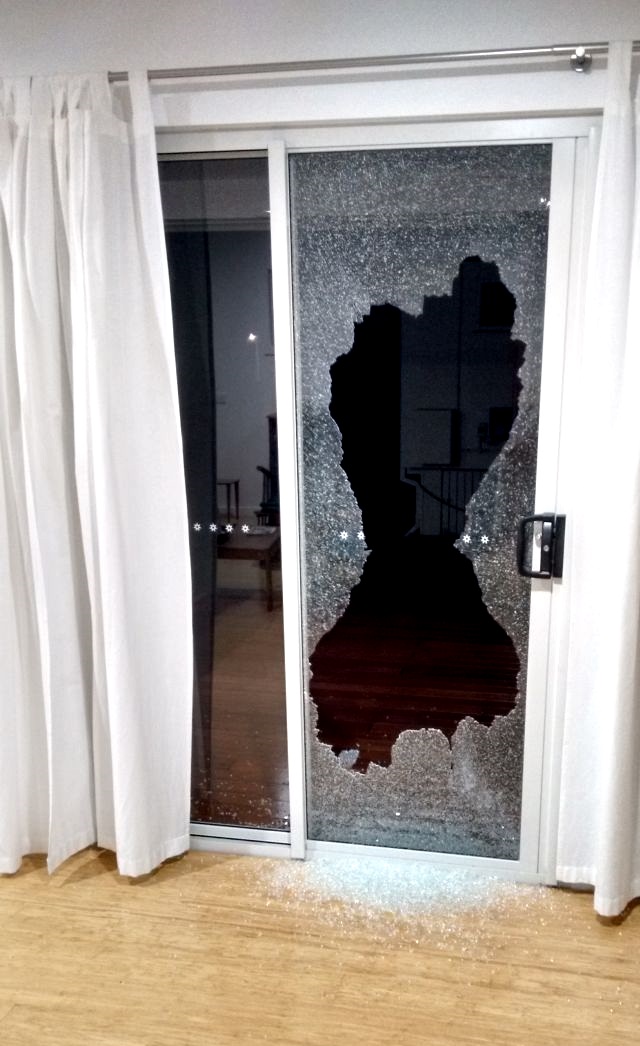
We got back last night and were a bit surprised to find one of the panes of our sliding glass door had been smashed. Our first thought was ‘AHHG, WE’VE BEEN ROBBED!!!’
Not exactly the view you want to come home to.
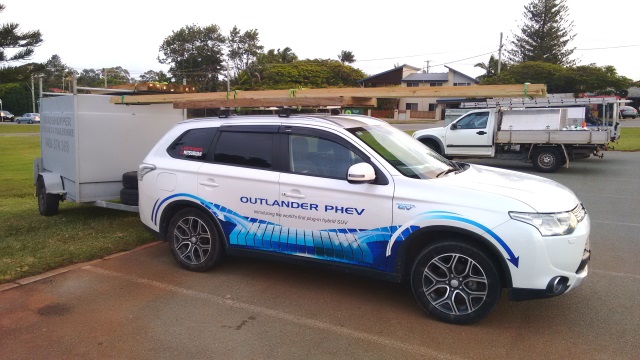
But, on closer inspection, it turned out that a rock from the neighbour’s lawnmower had done the job and nothing was disturbed or missing in the house. PHEW!… These things can be a bit of a nuisance when you live on an island that’s only accessible by boat but luckily we had left the PHEV on the mainland with a plan to return today to pick up the materials we need to build our fence. So I was able to take the door frame (minus the broken glass) over on the passenger ferry this morning, get the glass fixed, load up with fence materials this afternoon and bring everything back on the car ferry this evening (along with plenty of groceries for the next couple of weeks).
As I write this I’m sitting in the PHEV on the car barge on the way back to Russell Island. The house is basically finished but there are a few details left to take care of such as the fence, the driveway, insect screens, blinds, closet shelves, etc. So we’ll have plenty of work to do for the next few weeks. I’ll keep you posted on how it all goes.
Batteries Don’t Make Economic Sense
Meanwhile, here’s a reminder from a recent Solar Quotes article for anyone thinking about buying a battery to go with their solar power system that batteries are not a good investment. Solar is… batteries aren’t. Here’s a quote from the article…
.. and in plenty of other articles that batteries won’t save any normal household money unless they are in South Australia with that state’s huge subsidy — and even then the circumstances have to be right for a household to come out ahead.
I have also mentioned here home batteries don’t yet provide an environmental benefit, so unless there are special circumstances (like our friends who run their pottery kiln on solar and battery power) you are not being green by getting one.’
There are other reasons why you might want to buy a home battery but be VERY careful and do some thorough research if you want your battery to:
Save you money,
Reduce your environmental footprint or
Give you backup power if there’s a blackout (some will but most won’t).
The time will come when solar batteries offer an excellent ROI, a true environmental benefit and exceptional backup power and you can be sure that both the Greeny Flat and Solar Quotes teams when shout it from the rooftops when that time comes. For now it’s generally best to stick with solar and forget the battery.
When we first built the Greeny Flat we weren’t exactly sure how we wanted to finish the base cabinets for the kitchen. So we finished the upper cabinets and put some temporary cabinets under the counter top. We used a mixed bunch of oddments picked up from second-hand shops including a couple of old filing cabinets. Then we hung a curtain across the front and made some benches out of off-cuts of plywood. This is how it looked when we first moved in…
Our original, temporary kitchen
This worked okay as a temporary solution but now it’s time now to put in some proper base cabinets and better counter tops. The plywood ones were okay but for some reason the finish that we put on them turned to a sticky goo, particularly on either side of the stove. I don’t remember exactly what we used to finish them but it was some sort of water-based clear coat and the resulting sticky goo has proved to be almost impossible to remove.
It’s always an interesting question what to use for kitchen benchtops. There are so many options from real stone, fake stone, concrete and tile to timber, metal or laminate. Each one has pros and cons. Stone is natural, durable and beautiful but expensive and often transported a very long distance. Concrete is durable but can stain easily and has a high embodied energy. Laminate is inexpensive but made with lots of chemicals and is generally durable but easily damaged by heat. Metal can be highly durable but not everyone enjoys a commercial kitchen look. Timber is beautiful but only as durable as the finish you put on it.
We are an independent, not-for-profit, non-governmental organisation that works to promote the environmentally appropriate, socially beneficial, and economically viable management of the world’s forests.
So FSC-certification is a pretty good indication that the wood used was sustainably and responsibly grown and harvested. The added benefit of finger-jointing is that it allows for the production of long and wide pieces of wood made from a lot of small off-cuts of timber. In the past, large pieces of wood were often cut out of huge, old-growth trees and a lot of the off-cuts would have been wasted. Finger-jointing means you can use off-cut pieces of wood from smaller trees so it’s more sustainable.
One of our new counter pieces made from finger-jointed, FSC-certified pine.
I happen to also really like the look of finger-jointed pine and to top it off, we were able to make all three of our counter pieces from one panel that cost $99. So it ticked all the boxes for us… Sustainable, Affordable and Beautiful.
Not wanting to risk the sticky-goo situation again, we finished the new counters with five coats of an oil-based clear finish. I generally try to stay away from any oil-based products because they’re nasty chemicals which can lead to poor indoor air quality. A natural oil or wax finish would have been better from that perspective but they need a certain amount of regular maintenance and the Greeny Flat is designed as a rental property so needs to be fairly bullet-proof.
As with every decision in every building project there are compromises that have to be made and we’re pretty happy with the choices we’ve made for this one. Here’s a photo of the base cabinets in place and the counters finished.
Our new cabinets and counters in place
We’re heading back to Queensland in a couple of days to put the finishing touches on our house at Russell Island. So we’ll have to finish the doors and drawer fronts when we get back.
Happy Winter Solstice Australia! (or for our readers in the Northern Hemisphere – Happy Summer Solstice!)
If you’re thinking of building a house, renovating or adding to the one you have (or putting solar panels on your roof) this weekend is a great opportunity to check how much sun you will get at the worst time of year. In case you don’t know, the winter solstice is the time of year when the sun is travelling at its lowest arc in the sky. So it’s a good idea to take some photos of the site where you’re planning to build, renovate or add solar panels at different times of the day during this weekend because that will tell you where you will get sun in the middle of winter when you want it most. If you have an existing house and there’s part of your north-facing wall that gets lots of sun this weekend, you might want to consider adding a window to that spot in order to let the sun into your house so it can help with winter heating. Just make sure it has enough of a roof overhang to ensure that the high summer sun is kept out… this is all covered in our section on Passive Solar Design which you can access by clicking here.
2040 The Movie
This week I’ve had quite a few people ask me if I’ve seen the movie “2040” by Damon Gameau and the answer is, yes, I have seen it and yes, I did like it. It is Mr Gameau’s attempt to present a positive vision of the future based on technology that already exists today. I’ve been saying for a long time that, in order to create a future that we want to live in, we have to be able to imagine it first.
Most of the information we get about the future is dismal at best and terrifying at worst. Just think about every movie you’ve ever seen that was set in the future… a few that spring to my mind are The Matrix Series (although you could argue that they are set in the present), The Terminator Series, Elysium, Wall-E, I Am Legend, Edge of Tomorrow, Independence Day, Book of Eli, Armageddon, Deep Impact, Interstella, Mad Max, Avatar, The Maze Runner, The Hunger Games Series, The Divergent Series, etc, etc, etc… they all present a really depressing version of what life on Earth could be like in the future. I can’t think of ONE movie that gives us a positive view of the future.
And it’s not just movies… every TV show that is set in the future and every prediction that we are fed by the media is bleak and hopeless. How many times have you heard something along the lines of … ‘by 2040 there will be 11 billion people on the planet, global temperatures will have risen by 4 degrees, the climate will be out of control and half of the species on Earth will be extinct.’ It’s all so pessimistic and the big question it raises for me is, ‘If we can’t even imagine a wonderful future for us and our children and grandchildren, how can we possibly hope to create it?’
So as far as I’m concerned, ‘2040’ is a great start. I didn’t agree with everything it presented and I think it missed some things that I would like to see, but that’s exactly the point… it’s a great place to start the conversation. If you haven’t seen it yet I recommend that you go and give some thought to what your own version of a beautiful future would look like, or as Damon Gameau puts it…
What’s Your 2040?
I honestly think that helping to create a positive vision for the future is some of the most important work that we can all do. It also helps to give us hope. When we feel optimistic we are inspired to act to start creating that beautiful thing we have imagined. It can be difficult in the face of all of the doom, gloom and negativity that we are fed by the media so a great place to start is to turn off the television put down the ‘smart’-phone and use the time instead to start imagining a better world.
With apologies to our readers who don’t live in the Southern Highlands, I need to write a bit more about our local council’s proposal to take a lot of money from the Environment Levy and give it to a proposed Regional Art Gallery.
The Environment Levy is something that is charged to all ratepayers in Wingecarribee Shire with the express intention that the money ‘will only be used for environmental works which are additional to Council’s statutory environmental obligations’.
There seems to be a lot of room for interpretation as to exactly what Council’s ‘statutory environmental obligations’ might be but one thing is certain… an art gallery is not an environmental work in any way, shape or form.
So What Do We Do About It?
Sign the petition that is currently being circulated and encourage your associates to do the same. You can click here to download a copy of the petition, get as many concerned citizens to sign it as possible and bring it to the public meeting on Friday (see below).
Make a submission in response to Council’s call for public comments on their Draft Operational Plan and Budget 2019-20 stating that you object to Environment Levy funds being used for anything other than suitable environmental works. Submissions are due by Monday the 27th of May. Click here to access Council’s web-page with information on how to make a submission.
Come along and bring your friends to a public meeting to be held at Bowral Memorial Hall on Friday, 31st of May at 6:00pm.
Below is some more information provided by Clive West who is spearheading this community effort to make sure that our Environment Levy is used for environmental works now and in the future.
Friday 31 May is when we’ve booked the Bowral Memorial Hall for our second public meeting on the issue of the use of the Environment Levy funds to pay for the operation of the regional gallery. This time we have more time to let people know, so please circulate this widely. Southern Highlands News has been notified and requested to publicise it.
It’s a big hall and we need to fill it !
The petitions can be returned to me at the pubic meeting next Friday, or dropped off at the Berrima Post Office (our postmistress, Bronwyn, is aware of the petition and supports it)
Thanks for supporting this effort and I hope to see you at the meeting on Friday.
Boredom Warning: anyone who does not have a financial interest in real estate may find the following incredibly boring!
In our last Newsletter, I wrote a short article about the financial benefits of Granny Flats versus Single-family houses.
In response I received the following feedback from a reader named Trevor:
‘Reading this article I realise you have not sought financial advice. Your example of the house in Russel Island does not take into account a depreciation schedule which depreciates the building costs each year on your tax and also all the interest on the home loan can be offset against your income. These things along with all costs associated with the property would make the property negatively geared (probably around $20000) and result in a very large tax refund.This would make the overall property returns much higher than you quoted. This would also apply to the granny flat if it was rented. With the right financial advice rental properties can be a great investment and completely cost neutral to the owner with the use of gearing.’
Trevor makes some good points about depreciation and negative gearing that are well worth considering depending on your own goals and financial situation. However, in my own defence, he is incorrect in saying that I have not sought financial advice. I have, but I readily admit that I am no financial expert and I am keen to learn more about the ins and outs of property investment.
Regarding depreciation… as I understand it (and I invite Trevor or any reader to correct me if I’m wrong here), depreciation can be used to increase the amount of deductions an investor can claim against rental income, thereby reducing the short-term profit (and the taxable income) from an investment property. However it will also reduce the Cost Base of the property which means the investor will have to pay more in Capital Gains Tax (CGT) if and when they sell the property.
Since the CGT payable is reduced by 50% if you have owned a property for more than 12 months, you’re probably better off claiming depreciation and paying less income tax now rather than not claiming the depreciation and hoping for less CGT in the future. If anyone can tell me for certain I would greatly appreciate it.
Regarding negative gearing… in order to benefit from negative gearing an investor needs to:
Be willing and able to borrow money in order to claim the mortgage interest as a tax deduction
Be happy to make a loss on their property investment in order to use that loss to reduce their taxable income from other sources (and thereby reduce their income tax payable)
Have a tax burden that they want to reduce (otherwise they have nothing to claim the loss against).
For many (if not most) property investors in Australia, all of the above will apply and negative gearing may well be worth considering. However for my wife and I things are a bit different. We are not willing to borrow money from a bank and we certainly don’t want to make a loss on our property investments just to reduce our income tax (which is not that high).
I would very much like to hear from any readers who are experts in the property investment field as to exactly how depreciation and negative gearing can affect the net rental returns for both houses and granny flats. I’m pretty sure that the answer will be that granny flats still offer a much better ROI than single-family houses or apartments because the fundamental advantage of a granny flat remains the same… i.e. the land is already paid for.
p.s. I’d also be interested to know how CGT is calculated on a granny flat if someone owns their own home, builds a granny flat on the same property, rents it out, then eventually sells the property.
People have various reasons for wanting to build a granny flat. Some families need to care for an aging relative. Others need a separate and private space for a teenager or young adult. Still others might be planning for a time after their kids have flown the nest and thinking about down-sizing. Today I’d like to focus on the economics of building a granny flat as a financial investment because the fact is, in places like the Southern Highlands of NSW (Greeny Flat country) where land is expensive and rents are high, a granny flat can offer exceptional security and Return on Investment (ROI).
A new granny flat under construction in the Southern Highlands.
Regular readers will know that Cintia and I have spent quite a bit of time over the last year up at Russell Island in Queensland building a house on some very cheap land that we found only 35km from Brisbane CBD (new or occasional readers are welcome to view all our previous Newsletters describing that project [among many other things] by clicking here or on the Newsletter tab at the top of the page). We would have liked to buy or build something in the Southern Highlands but simply couldn’t afford the price of land. So we bought on Russell Island and completed the 3 bedroom/2 bath house a little over a month ago. At this point we have invested a total of approximately $185,000 and a lot of time into the project. If we had bought a similar, new house in a similar location we would likely have paid about $275,000 (including stamp duty and closing costs) and if we were to rent it out we would likely get about $270 p.w ($14,040 p.a). This would give us a gross rental return of 5.1%.
However, we wouldn’t receive the gross return… we would have to pay rates ($2,800 p.a), landlords insurance ($1,200 p.a), property management fees (approx. $1,500 p.a.) and maintenance costs (estimated at $1,000 p.a). That would reduce our income to about $7540 p.a. and our net ROI to about 2.7%. That’s still not bad in our current low-interest environment. We could get a similar return from a RAMS Online Saver account however the house on Russell Island has the potential for capital gain (as well as the risk of capital loss) whereas a bank deposit does not.
In the Southern Highlands of NSW, we would be lucky to find an older investment property for $500,000 and to rent it for $450 p.w. That would give a gross rental return of 4.6% and a net ROI of about 3.2%. That’s still not bad if you’ve got half a million bucks to invest and it too offers the potential for capital gain over the long term.
But let’s have a look at how a granny flat would perform in the Highlands. For this exercise we’ll assume that you could build a 60sqm, two-bedroom granny flat for $160,000 and rent it out for $350 p.w. (reasonable estimates for this region). That would give a gross rental return of 11%.
Gross Rental Return of 11%
Seems too good to be true doesn’t it? And it gets better because, with a granny flat built on the same property as a primary residence, you don’t have to pay extra rates, so the ongoing costs are less than they are for a single dwelling. Also, for many people, they wouldn’t need to pay a property manager to manage the rental because it is right there in their back yard. This means the annual costs could just include insurance (approx $1000 p.a.) and some maintenance (estimated at $1000 p.a.). In that case the net ROI comes out at 10%.
Net ROI of 10%
So why is the ROI on a granny flat SO much better than for a house? It’s because the land is already paid for and because the ongoing costs are significantly lower. So, in places like the Southern Highlands where land prices and rents are high, a granny flat can offer a remarkably good ROI for an investment that is very secure. A new, well-built and insured granny flat in your own backyard is about as secure as an investment can get. And with a potential 10% ROI it’s no wonder that there is a boom in granny flat construction going on around the greater Sydney region.
Another Energy-positive, Low-maintenance Granny Flat Going Up
The photo at the beginning of this newsletter is of another new granny flat currently under construction near the Greeny Flat. This is one that I designed for a friend of mine. It has the same footprint as the Greeny Flat but slightly higher walls and ceilings in order to provide a large loft storage area. It has a similar passive solar design with large, north-facing windows and the correct eave overhand to shade the north-facing windows in summer while allowing the low winter sun to fully enter and warm the dwelling.
The new granny flat under construction. This view is from the North-west showing some of the Passive Solar Design features.
The roof and wall cladding is Colorbond steel in a ‘CustomOrb’ profile. In this case the client chose to use ‘Shale Grey’ for the roof and window frames (I’m a big believer in using light colours for roofs and windows because it helps to reduce heat gain in summer and thermal stresses in the building components) and ‘Woodland Grey’ for the walls. In the heat of Queensland you wouldn’t want to use a fairly dark wall colour but in the cool of the Highlands it should function well and I think it looks great.
This granny flat also includes a large verandah on the south side and a carport on the west. Apart from offering a sheltered place to park the car and to enter the granny flat under cover, the carport on the west side will also provide excellent shade for the west wall which could have been a big heat source in the summer with the high walls and dark cladding.
The carport on the west and the big verandah on the south will provide lots of summer shade and shelter from the rain. This view is from the South-west.
Add to that good insulation, air-sealing, thermal mass, double-glazing and a solar power system and I am very confident that this granny flat will be well-and-truly energy positive like the Greeny Flat. It’s also designed and built to be fire resistant as there is a BAL29 rating for part of this property. All told I this is shaping up to be a very successful owner-built project and a good example of how building a granny flat can be a sound financial decision. I’ll report back after it’s finished.
Hello again. This will be a very brief Newsletter this week just to let you know that we have posted a little video home tour of our Russell Island project on YouTube at the following link.
We had our final inspection last week and, as far as we know, it’s all passed and good to go bar a bit of paperwork. Let’s hope so anyway because we moved in today!