In last week’s Newsletter we critiqued an article from Domain.com.au about ‘Tips and Tricks to Keep Your House Cool the Natural Way’ and we offered a few suggestions of our own. In response I received the following comments from a long-time reader and valued supporter named Marcus who wrote:
Dear Andy,
A good summary of much that can help in the heat, but a painful reminder of the fact that many of our houses are just not built ‘the right way’. I have a few points.
1. Blinds – Not everyone would like the double cell ones, and I find that single ones with light coloured curtains closed behind are quite effective. Like you we choose not to live in the dark. 2. uPVC window frames. I think the evidence from other (sunny) countries is pretty convincing. uPVC is very stable in the long term and beats thermal break aluminium – looks good as you can get it in white and wood effect and is easy to clean, unlike aluminium which tends to look dull and ‘pitted’ with time. My only issue is that the frames tend to be thicker, which means less glass area. 3. Fans. We use fans to remove hot air from the apex of our living room and first floor landing (Both can get very hot as the roofs are not well insulated). This hot air is delivered to the ‘whirly gig’ attic fans and thence to atmosphere. This would probably be even more effective if we had powered (solar or mains) fans in the roof. 4. Roof insulation. Obviously you can add more insulation material to attic floors. Our problem is the ‘cathedral’ ceiling, which suffers from being under quite dark tiles and not much insulation. I don’t have an IR camera, but I expect it would be a horrifying as your photo. You could add thick insulation between the trusses, but this would destroy the look of the room. Do you know of any materials which offer significant insulation, but would leave the trusses exposed?
Keep up the good work.
Marcus makes some good points and is absolutely right that many Australian homes are not built the ‘right way’ for our hot and sunny climate. As I mentioned in last week’s article, a brick veneer house with a dark tile roof is about the most inappropriate way to build for Australian conditions and yet that is exactly how the majority of new homes are still being built. Heavy masonry materials like brick and tile soak up heat throughout the day, store that heat around the outside of the home and then radiate the heat into the house until long into the night. This causes the house to stay hot and the a/c to work overtime. Combine this with your typically awful Australian insulation job (and the fact that no thought is given to air sealing) and you get a house that either gets unbearably hot (and stays hot for most of the night) or uses a heap of electricity to run the air-conditioning far more than is necessary.
I would just like to add a couple of things to go along with Marcus’s comments.
On the subject of uPVC windows, I know some people (like Marcus) who are very happy with their uPVC windows. But I also know an equal number of people who are not so happy. I think the key with uPVC is to keep the size of each pane of glass relatively small. I’ve seen brand new, imported, European uPVC frames that have sagged in the middle when they have particularly wide, horizontal sashes. I’ve also seen uPVC soften slightly in extreme heat causing frames to sag, usually when the sashes are large and heavy. Marcus is right that uPVC will transfer much less heat in and out of the building than aluminium so their energy performance is better, I just suggest that if you use them you keep your window sash sizes smaller to hopefully avoid the sagging issues.
This is clearly an extreme case of uPVC window sagging but it shows what can happen.
Regarding the use of exhaust fans to cool your house… yes Marcus is right that they can be very effective at expelling hot air but it is very important to know what the temperature both inside and outside the house is when you turn them on. Whenever you blow air out of a house, you suck an equal amount of air in from outside. So if the outside air is hotter than inside, you will simply be sucking in hotter air than what you are blowing out. This is why I think it is essential for every house to have an indoor and outdoor thermometer so you know when to turn on fans and open windows (i.e. when the outside air is cooler than inside) and when to leave them off or closed (i.e. when the outside air is hotter than inside). In fact I wrote a Newsletter article about this exact subject back in February last year titled ‘Every Home Needs This‘.
And finally, to answer Marcus’s question about improving roof insulation in a cathedral (sloped or raked) ceiling…
Cathedral ceilings are extremely difficult to build well and to insulate properly and even more difficult to retrofit to a high performance standard. As Marcus points out, he could add a lot of insulation to the underside of the existing ceiling but it would ruin the look of the exposed ‘trusses’. So the answer would be to try to add the most insulation between the rafters with the least amount of depth. The two insulation products that have the highest R-value per inch (25mm) are two kinds of rigid foam. One is called Extruded Polystyrene and the other is called Polyisocyanurate. With both of these products you get about R2.4 insulation in only 50mm of foam (as opposed to about 100mm of fibreglass batt). So Marcus, if there’s room to add 50mm of depth to your ceiling this would be the way to go however then you’ve got the problem of having to cover the underside of the insulation with gyprock or T&G or some other product and this can turn a ceiling insulation job into a major construction project.
This is one of the reasons why I generally prefer a trussed roof with a flat ceiling and an attic space rather than a cathedral ceiling. When you have an roof space you have the ability to get up there in the future and make changes to things like the insulation or the electrical wiring which you can’t do with a cathedral ceiling.
Thanks Marcus for adding those thoughts. We always welcome any feedback and comments.
Thank you very much to all of you who sent such nice thoughts to Cintia and I for our marriage and for the New Year. We’ve had a nice break and a bit of time at the beach. Now we’re ready to get back into the swing of things for 2018.
This coming Sunday is forecast to be scorching hot so I thought we’d start the year with some thoughts on how to keep your house cool during the summer. A good place to start is this article from Domain.com.au
(Source: Domain)
The article lists nine ‘Tips and Tricks to Keep Your House Cool the Natural Way’. I’ll let you read it for yourself but I’d like to add the following comments and qualifications to what the author wrote.
Item 1: Create Shade
The more you can shade the paved areas around your house the cooler you’ll be. Heavy materials like paving, concrete, bitumen and stone will soak up heat from the sun during the day and stay warm long into the night. This is true of brick walls and tile roofs too (which is why I don’t use them). The more you can keep these areas cool during the day, the more you’ll stay comfortable through the night. Personally I prefer to use shade cloths, awnings and blinds rather than relying on deciduous trees or vines for shading for two reasons. It gives me more control over when I let heat into the house and when I keep it out. Also, in winter, even though the vines or trees might have lost their leaves, the bare branches can still provide a significant amount of shade that reduces the amount of solar heat gain when you need it most. If you live in a really hot climate this is not really a problem and deciduous trees can be an excellent option because they can shade the roof and walls of the house too (especially on the west). A light-coloured Colorbond roof also really helps to reflect a lot of the heat from the sun and won’t get nearly as hot as a dark-coloured roof. If your house has a dark-coloured roof you will find it much harder to keep it cool inside.
Item 2: Improve Your Eaves
Having the right amount of roof overhang on the north side of your home is a vital part of good Passive Solar Design however, it is important to understand that correct eave overhang sizing is only effective at controlling summer sun on the north side of the house. It can help a bit on the east and west but won’t stop the low morning and afternoon sun from making things pretty toasty. That is why a good Passive Solar Home will be oriented with the long side of the house facing north. This provides maximum shading in summer, maximum solar gain in winter and minimum exposure to the hot, low afternoon sun from the west.
Item 3: Let it in/Shut it out
The article correctly says… ‘On hot summer days, get into the habit of shutting up during the day – all doors, blinds, curtains – and then opening everything up in the evening to vent the house with evening breezes.’ This is exactly how we operate the Greeny Flat in summer with the help of our indoor and outdoor thermometer. As soon as the outdoor temperature drops below the indoor temperature we know it’s time to open up and start cooling her down. BUT there is one very important exception to this rule. It will only work if your house is reasonably well insulated (and air-sealed) and has the right shading on the windows, otherwise, when you close everything up during the heat of the day, the house could easily get hotter than the outdoors. If you have poor insulation or big windows with no shading the heat from outside will build up inside until it becomes unbearably hot and stuffy.
Item 4: Create Flow
Good cross-flow ventilation is very important for cooling the house down once you do open it up (or if you live near the coast you might keep it open during the day to catch the cooling sea breezes). This can be tricky in existing houses, especially in bedrooms that only have one window. The difficult thing with bedrooms is that, if there are more than one or two people in the house, you are likely to keep the bedroom doors closed throughout the night. This can block any sort of cross-ventilation if the bedroom only has one window. Ideally each bedroom should have two windows located as far from each other as possible and near opposite corners. This allows for good cross-ventilation, even if the door is closed. The following diagram shows how we planned for cross-ventilation in the Greeny Flat.
Note how the bedrooms have two windows near opposite corners of the rooms.
Item 5: Go for glazing
Here the article talks about the benefit of double-glazing for reducing heat gain. When it says ‘check the rating’ it’s referring to the U-value and the Solar Heat Gain Coefficient (SHGC). The lower the U-value, the better the window will be at insulating the house from summer heat. And the lower the SHGC, the better the windows will be at reflecting heat away from the house.
What the article doesn’t mention is Low-E coatings on the glass. Low-E coatings help reduce summer heat gain by reducing the U-value and lowering the SHGC. This is great for east, west and south-facing windows and for poorly shaded north-facing windows (or all windows if you live in a really hot climate). HOWEVER, if you live in a cool-to-cold climate and you have the right amount of roof overhang then you don’t want Low-E coatings on your north-facing windows because they will limit the amount of heat gain you get from the low-angled sun in winter. (Read through our Passive Solar Design guidelines for more information).
Regarding window frame materials, other factors to consider are:
With timber windows there are ongoing maintenance requirements plus the possibility of the frames warping or shrinking which can create air leaks.
With PVC windows there are longevity and durability concerns in my opinion (fibreglass is a much more durable option).
As the article says, you can get ‘Thermally Broken’ Aluminium frames but they are likely to be very expensive and watch out for companies that simply coat the inside of the frame with PVC and call it ‘Thermally Broken’… it’s not.
For all those reasons we decided to go with standard aluminium frames but double-glazed windows for the Greeny Flat. We knew we were compromising on the energy performance but we really wanted the low-maintenance, longevity and cost-effectiveness that aluminium provides. And we’re very happy with the result.
Item 6: Treat Windows Well
For window treatments at the Greeny Flat we chose double-cell cellular blinds from Kresta. These are not full block-out blinds as suggested in the article but we like the filtered light that comes through them, especially since we generally keep the blinds closed during the day in summer and the house would be very dark if we had block-out blinds.
Our insulating cellular blinds with top-down-bottom-up feature are very good for controlling sun, light, views and privacy.
The article suggests external blinds and these can be a very effective way of keeping heat out in summer but they tend to be very expensive and they don’t generally do much for keeping heat in in the winter time.
Item 7: Think Thermal Mass
The article is correct that Thermal Mass can be very effective at helping to keep a home cool in summer. HOWEVER it fails to explain some VERY important points about how to make this work.
The first is that, in order to be effective at helping to maintain a comfortable temperature inside a house both summer and winter, Thermal Mass MUST BE INSIDE THE INSULATION LAYER! This is why brick veneer walls and tiles roofs are SUCH a bad idea. They put Thermal Mass in the wrong place where it will soak up heat all day long and then hold that heat and radiate it in towards the interior for most of the night. This is why we used light-coloured corrugated metal for the roof and wall cladding on the Greeny Flat. The light colour helps to reflect the heat and the light-weight (opposite of Thermal Mass) means that, as soon as the sun stops shining on it, it cools down. I would go so far as to say that a brick veneer house with a dark tile roof (like almost all new homes I see in greenfield subdivisions these days) are about the worst thing you could do in our hot, sunny climate.
Instead the Thermal Mass should be inside the building. For us it takes the form of our concrete floor slab but it doesn’t just work magically by itself. We have to operate the house correctly to take advantage of it. In summer this means that we have to open the house up at night in order to let the floor slab cool down. Then it can help to maintain a cool temperature during the day. If we didn’t do that the house would just continue to get a bit warmer every day until it was unbearable. So it is very important that Thermal Mass is a) in the right place and b) operated effectively otherwise it can’t do its job correctly.
Item 8: Be Fan Savvy
Using ceiling fans is not exactly a ‘natural’ method of keeping cool but it certainly uses MUCH less energy than running an air-conditioner. Just bear in mind that a ceiling fan doesn’t actually lower the air temperature, it just makes you feel cooler by moving air across your skin which helps your sweat to evaporate more effectively.
Item 9: Insulate Well
I would have listed insulation as item 3, right after orienting your house correctly and providing the right amount of roof overhang but, obviously, good insulation is essential for keeping out summer heat as well as keeping in winter heat. I looked at a house which had no insulation in the ceiling with my infrared camera just a few days ago and the whole ceiling was glowing like a radiator and sitting at about 42degC. In fact, an uninsulated ceiling is exactly like a huge radiator beaming heat into your house all day long.
An uninsulated ceiling glowing like a radiator.
Other Items
The article contains a pretty good list and here are a few other things to consider:
Solar panels on your roof can actually help keep the building cool by shading the roof.
A solar power system also gives you the option to run a high-efficiency reverse cycle air-conditioning system during the day (when it will be using power directly from the solar system) to pre-cool the house (or pre-cool it in winter). That way the house is already cool when you come home and you don’t have to run the a/c at peak times (i.e. in the evening) when it will cost you a lot more and put extra strain on the grid.
Also think about when and where you run electrical or gas appliances. Lights, fridges, computers, TV’s, microwaves, stoves, and cooktops all give off heat into your house. On really hot summer days we try to do all our cooking outdoors and run other appliances as little as possible in order to help keep the house cool.
We also limit our use of kitchen or bathroom exhaust fans which blow air out of the house and, in the process, suck hot outside air in through leaks in the building fabric. Remember too that a dryer (assuming it is properly ducted to the outdoors) also acts like an exhaust fan blowing air out of the house and therefore sucking hot air in.
You can use evaporation to help cool the area around your house in the evening. If you wait until the sun goes down and then water the grass and plants around your home (it also helps to spray a bit on any paved areas that might have been in the sun) the natural effect of that water evaporating will cool the air around your house but obviously you need to be conscious about not wasting water. We only use this technique on the very hottest days and we’re very careful about how much water we use.
Happy New Year to all our readers and thanks a million for your support and encouragement over the last 12 months. It makes all our efforts worthwhile.
A lot has happened here but the big news for the year was that Cintia and I got hitched.
Our humble little wedding on the beach at Port Macquarie
I’m very lucky and deeply honoured that Cintia has chosen to share her life with me.
So Happy New Year from us both and here’s hoping that 2018 brings justice, peace, prosperity and sustainability to the world we live in. We’ll be trying to do our part to help make that happen and we hope you’ll join us.
Happy Summer Solstice everyone… except, of course, our readers in the Northern Hemisphere who are celebrating their Winter Solstice today.
Winter Solstice seems like more of a reason to celebrate. It is the shortest day and the darkest time of the year. After the Winter Solstice the days start to get longer and there’s warmth and light ahead. As you probably know, the whole celebration of Christmas is built on a pagan ritual of sun worship. Three days after the shortest day of the year (when the sun is lowest in the sky) it starts to rise again and a new year is born. For ancient people huddling through a European winter, this was a very significant time of the year and a great cause for celebration.
Here in Australia though, it doesn’t make any sense. It’s usually hot as hell at this time of year, yet those of us with a European background try to celebrate Christmas as though we were still living in Europe. Our homes and streets are decorated with plastic ‘snowflakes’, flashing ‘icicles’ and inflatable ‘snowmen’. We grow pine trees in plantations (because they don’t grow here naturally) and then cut them down for the sole purpose of hanging Christmas decorations on them. And how about the songs??? They’re all about dashing through the snow in a one-horse open sleigh with Frosty the Snowman walking in a winter wonderland and dreaming of a White Christmas.
Is this mass delusion or collective denial?
A few days ago Cintia and I were in an open-air shopping mall in Batemans Bay. Everyone was walking around in t-shirts and thongs (‘flip-flops’ for our American readers not what you think of as a ‘thong’) and chatting about how warm it was. Then I noticed what looked like snow falling into the courtyard of the mall. This took me by surprise so I investigated and discovered that there was a machine on the roof grinding up ice and blowing tiny flakes of ‘snow’ down onto the scantily-clad consumers below. But the ones I really feel sorry for during an Aussie Christmas are the old guys dressed up as Santa Clause. Can you imagine how hot they must be? Generally they’re a little overweight to start with and then they dress up in fur-lined jackets with extra padding, don thick beards and warm winter hats before parading around the shopping centres carrying a sack full of goodies and stopping to let a bunch of sweaty kids sit on their laps while photographers aim studio lights at them. It’s amazing they don’t all pass out from heat exhaustion.
How does this make sense? (Image source: Mashable)
Yep, its a strange time of year down under… and we don’t even have the Winter Solstice as an underlying reason to celebrate. Here it’s Summer Solstice which means the days now start to get shorter and darker… in the words of John Snow… ‘Winter is coming!’
Still, no-one’s complaining, it’s warm and sunny, our beaches are beautiful and we’re incredibly luckily to live in this wonderful part of the world. Thankfully my own family got over the European Christmas thing many years ago. These days we like to get together, eat salad and summer pudding, drink chilled wine and laze around in the shade. The cultural cringe going on around us might be a bit surreal but I’ll take this over a White Christmas any day.
World’s First Solar Train Comes to Byron Bay
The Byron Bay Railroad Company’s new Solar Train (Source: New Atlas)
Here’s a nice holiday article from New Atlas about the world’s first solar-powered train. ‘With enough capacity for 100 seated passengers, the train shuttles passengers between two newly constructed stations connecting the CBD of coastal town Byron Bay with a nearby arts precinct and luxury resort.’
‘The train rooftops have been fitted with custom-built curved solar panels to charge the onboard batteries, which also draw on a regenerative braking system said to recapture around 25 percent of energy the train uses to accelerate. The batteries can also be charged at the platform thanks to a large rooftop solar array on the storage shed. Failing that, it can draw power from the grid, which the company says is sourced from a local green energy provider.’
Now doesn’t that seem like the way of the future? And perhaps the coolest thing about the train is that ‘the two railcars used in the innovative rail service were originally constructed in 1949 … with the same aluminum fuselage construction used for aircraft bombers, making them lighter than what we today consider ‘light rail’.’
So here we have a business venture that combines modern technology, creative repurposing and historical preservation in a way that improves it’s community and is easy on the environment. What’s not to love about that?
Happy Holidays everyone, whatever the temperature and however you choose to celebrate.
Is Bitcoin adding to Global Warming? (Image Source: news.bitcoin.com)
In last week’s Newsletter I mentioned a Guardian article which claims that processing of Bitcoin transactions now requires more energy than the entire country of Ireland. My friend Kevin responded with a link to this article from Grist which makes the following predictions (emphasis mine)…
‘…at bitcoin’s current growth rate, the electricity demanded by the cryptocurrency network will start to outstrip what’s available, requiring new energy-generating plants. And with the climate conscious racing to replace fossil fuel-base plants with renewable energy sources, new stress on the grid means more facilities using dirty technologies. By July 2019, the bitcoin network will require more electricity than the entire United States currently uses. By February 2020, it will use as much electricity as the entire world does today.
This is an unsustainable trajectory. It simply can’t continue.’
Now there’s an understatement for you… to suggest that doubling the world’s energy use in the next two years is unsustainable… how dare they?
But wait, as usual it seems the issue is much more complicated than that. According to this article from Mashable…
‘…things aren’t that simple. We don’t know, exactly, how power-hungry Bitcoin really is. And whatever the figure is, Bitcoin certainly doesn’t need that much energy to run. Furthermore, energy consumption issues can potentially be fixed with a future upgrade of the Bitcoin software, which is easier than, say, reducing the energy footprint of Ireland. Finally, there are other cryptocurrencies out there working on a solution to this problem.’
The article goes on the state that… ‘Bitcoin isn’t exactly doing its job the way its creator, Satoshi Nakamoto, had intended. Due to its price rise, not many owners actually use their bitcoins to purchase goods; instead, everyone is either hoarding it or speculating with it.
This means that talking about the energy cost of one Bitcoin transaction is misleading…. In fact, you could theoretically run Bitcoin’s entire network on a dozen 10-year old PCs.’
According to this article, Bitcoin will have to adapt or die as other cryptocurrencies are developed that don’t require so much energy to process transactions… ‘Ethereum, the second largest cryptocurrency right now… uses roughly three times less energy than Bitcoin; and yet there are twice as many transactions per day on Ethereum’s network.’
Another of our readers, Nick, posted the following comment… ‘Don’t confuse the mining of bitcoins with the transactions of them. Mining a bit coin is computationally expensive because it creates a new bitcoin (i.e. like making gold with a computer program) but the transactions are simple and cheap – if you think about it, no one would spend millions of dollars on a ten thousand dollar transaction’. So Nick, I guess I am confusing the two because, as I understand it, Bitcoin ‘miners’ receive Bitcoin as payment for using their vast computing power to process Bitcoin transactions, so it seems to me that the two are inseparable in terms of the energy they require. Perhaps you can explain it to me if that is incorrect.
Nevertheless, as I’m writing this I see that Bitcoin today passed US$20,000 per ‘coin’. Is it just me or does this strike anyone else as completely INSANE! Bitcoin has no use and no yield. It can’t be used to buy anything and it doesn’t pay any interest or rent or dividend. The only way to make a return on your investment is to buy it and hope that the price goes up when more people buy it. That seems like the classic definition of a Ponzi scheme to me where… ‘the operator generates returns for older investors through revenue paid by new investors, rather than from legitimate business activities’.
The fact is that, currently there isn’t much you can do with a Bitcoin. According to this article from The Telegraph…‘Bitcoin has proven itself to be a completely useless currency’. Bitcoin propoennts counter this by saying that the mainstream press, governments and big financial institutions are opposed to cryptocurrencies because of their power to disrupt the status quo. Personally I think these advocates are living in la-la land. They claim that the great benefit of ‘cryptos’ is that governments can’t control them and you can make your financial transactions in private without requiring a big bank to process them. If they seriously think banks and governments the world over are going to allow that situation to continue then they need their heads examined. Instead I predict that, as soon as the technology is developed to the point of being actually useful, the banks and bureaucrats will take it over and ban any transactions outside of a system that they control.
Meanwhile people the world over are investing huge sums of money and vast amounts of energy into something that is almost completely useless (a bit like our state government proposing to spend billions of taxpayer dollars on new sports stadia… click here if you would like to sign a petition opposing this). I suppose, in that sense, Bitcoin is the perfect sign of the times.
When you have an hour to spare I strongly encourage you to watch the following video presented by Stanford University Futurist, Tony Seba, about the impending disruption of the transport and energy sectors. Here are just some of the information it presents:
Electric Vehicles (EV’s) have 100X fewer parts than Infernal Combustion Engine Vehicles (ICEV’s)
EV’s can last 5 to 10 times longer than ICEV’s (e.g. Tesla is saying they will put a 1 million mile warranty on their new electric truck)
By 2025 every new vehicle will be electric (for purely economic reasons)
EV’s will reach Level 5 Autonomy (i.e. requiring no human input) by 2019
By 2021 it will be 10X cheaper to use an autonomous ride-share EV than to own a car
This means that used ICEV’s will likely have negative value (i.e. you’ll have to pay someone to take it off your hands)
By 2030, 95% of passenger miles will be by autonomous ride-share EV’s
This means there will be 80% fewer cars on the road and no need for parking lots
The parking space that will be freed up in Los Angeles alone is enough to build 3 new San Fransisco’s
And by 2030 solar will account for 100% of the world’s energy generation. To back up that last point, Seba notes that Tucson Electric has recently signed a PPA (Power Purchase Agreement) for electricity from a utility-scale solar plus battery storage system for 4.5c/kWh which is cheaper than any other form of energy.
I have no idea if Tony Seba will be proven right but he makes a very compelling (and entertaining) argument that is based entirely on economics… not politics or environmentalism or climate change or anything other than economic rationalism. Whether his predictions prove accurate or not, it’s worth watching just to start thinking about how quickly things might be changing. Have a look and leave a comment to let us know what you think about the future he is predicting.
Bitcoin Energy Nightmare
Bitcoin is a MASSIVE energy consumer (source BTC Manager)
Speaking of disruptions, I expect you’re all aware of Bitcoin by now. It has gone from under US$1000 at the start of the year to over US$10,000 a few days ago. This has created a huge amount of hype over cryptocurrencies and blockchain technology.
What you may not have read is this article from Yahoo Finance which claims that Bitcoin ‘Mining’ (the business of processing all the data required for Bitcoin transactions) uses more power than 159 countries. Or this article from The Guardian that says Bitcoin transactions consumed ‘more electricity in a year than the whole of Ireland’. In other words ‘each individual bitcoin transaction uses almost 300KWh of electricity’. That’s enough electricity to power the Greeny Flat for about two months from one, single Bitcoin transaction.
These are shocking statistics, especially because Bitcoin is still very new and can’t actually be used for anything yet. Plus it is just one of thousands of so-called ‘Cryptocurrencies’ and thousands more ‘Blockchain Technologies’ that are being developed around the world. I haven’t seen any figures on what the total energy consumption for all this number-crunching amounts to but you can rest assured (or more likely lie awake in fear) that whatever it is now will be nothing compared to what it’s going to be in the future.
I wonder if Tony Seba’s prediction of 100% solar energy by 2030 will hold true if global electricity consumption doubles simply due to processing blockchain calculations?
I also wonder (and I’ve mentioned this before) what sort of mess we’ll be in if we do go 100% solar and then suffer a massive volcanic eruption that blankets the world in ash for a year or two… ahhh! More sleepless nights!
One Promising Australian Blockchain Technology
According to this article from Energy Matters…‘The Australian Government and industry partners will contribute $8.26 million to a project trialing the use of blockchain-powered renewable energy and water systems in the City of Fremantle.’
The ‘Blockchain’ part of this trial is from an Australian startup called Power Ledger which is a peer-to-peer, blockchain-based energy trading platform, where renewable energy can be sold between buyers and sellers without a middleman.
This article from Huffington Post gives a more detailed explanation of how it all works. Let’s just hope that it encourages more renewable energy development than it requires to process its own transactions.
Suncrowd Update
In last week’s Newsletter I gave a scathing review of the Suncrowd Solar Bulk Buy program along with an apology for my part in helping persuade people to join it. I requested that anyone else who had problems with either Suncrowd or Sunny Afternoons leave a comment so that all know how many others are in the same boat.
Well I did receive one comment from a customer in Berrima who had a nasty experience and one email from a friend on the coast. So it seems that, for most Suncrowd customers (at least the ones who read this Newsletter), the lengthy delays and lame excuses are not too much of a concern. If that’s true then I’m gad that most people are satisfied. If not, please go to last week’s Newsletter and leave a comment to let me and other readers know how the experience has been for you.
For anyone interested, I just received the latest update from Sunny Afternoons which claims that 71% of the approximately 320 installs have been completed which means there are still 92 systems left to be installed a full year after most people paid their initial deposit. This still looks like a very dismal performance to me but they seem happy with it. Here’s a link to the update in case you haven’t seen it.
Please allow me to begin this week’s Newsletter with an apology for my part in helping to organise the Suncrowd events that were held in our region a year ago and for helping to persuade people that this Community Solar Bulk Buy program was a good idea. It certainly seemed like one at the time but, I’m very sorry to say, has proved to be a bitter disappointment for many people, myself included.
The Suncrowd crew might look happy but many of their customers are not… THUMBS DOWN FOLKS.
A lucky few of the people who signed up to buy rooftop solar systems and/or batteries through the Suncrowd program did actually get what they wanted for a very good price and installed in a timely manner. Unfortunately they seem to be the exception rather than the rule. I’ve heard many more complaints from people who paid their deposit then waited many months without hearing a word from Suncrowd or their contracted installer, Sunny Afternoons. When rare communications were forthcoming they tended to be a list of excuses for why things were going so slowly with much of the blame being put on Tesla for being slow delivering their promised Powerwall 2 battery. Customers were advised not to expect any indication of when their installation might take place and that calling to enquire about it would only slow the process more. Eventually installations did start to trickle through but I’ve heard from a number of people that there were issues with their installation or they didn’t get what they asked for or that what they had been advised to purchase was not appropriate to their situation.
The final straw which prompted me to write this review came about a week ago when I heard from one of my very best friends (who signed up for a Suncrowd system on my recommendation) that, after a YEAR of waiting and getting no indication of when their system would be installed, they finally gave up and asked for their money back. They were told that they could get a refund of their deposit MINUS a 25% cancellation fee. I cannot believe the gall of this mob! To take someone’s money, make them wait a year with no result (or even an indication of when to expect one) then somehow feel like it’s fair to keep a quarter of the deposit…. it leaves me speechless with disgust…. especially because my friend’s system was a simple rooftop solar installation, no battery, no Reposit power, no justification for any of the excuses that were trotted out as to why people were having to wait so long.
Unfortunately my friends are not alone. I’ve heard from a number of other people, both prior to last week and since then, that they are either not happy with the service they received from Suncrowd and Sunny Afternoons or that they simply didn’t receive any service at all.
What we don’t know (because neither Suncrowd nor Sunny Afternoons have given us any useful information) is exactly how many of their customers (victims?) are dissatisfied with the program and we don’t know how many systems are still left to be installed. If you are one of those people please leave a comment at the end of this article. This is an outrage and I think something needs to be done about it. I’m not sure what that is yet but I will start by compiling information from people who feel they have been treated unfairly. I have made enquiries with the Energy Ombudsman who palmed me off onto Fair Trading who palmed me off onto the ACCC (gotta love Australian bureaucracy) so I’m getting the run-around but I will keep trying. Meanwhile please let me (and our readers) know what your experience has been with Suncrowd. I hope it has been better than my friend’s.
To be fair, I and the other people who agreed to help organise our local events, had every reason to believe that this would be a good thing for our community. Suncrowd had completed an apparently very successful community bulk buy campaign in Newcastle when they approached us wanting to do the same here. Unfortunately our campaign hasn’t turned out so successfully for a number of the participants. Once again I sincerely apologise for my part in this mess and will endeavour to do what I can to rectify it.
Brighter Notes
Tesla Tiny House Packs Them In
Cintia and I in front of the Tesla Tiny house while Matt Simms from Simmark enthrals the crowd (except, apparently, the guy in the yellow shirt).
As mentioned in last week’s Newsletter, we had a visit from the Tesla Tiny House which is currently touring the country stirring up interest in solar, batteries and electric cars. Two events were organised for our region, one at Silos Estate Winery in Berry and one at the Bradman Oval in Bowral. These were organised and promoted by Simmark (a local solar, electrical, heating/cooling and security contractor) who kindly invited me to be there to answer people’s questions about Energy Positive Homes and Passive Solar Design. Hundreds of people came to both venues including school groups, families, home owners and retirees interested in learning more about small houses and renewable energy systems. For me it was like being a pig in mud so thanks to Simmark for asking me to be involved. It was encouraging to see so much interest in the things I’ve been banging on about for so long.
Off-Grid… No Thanks
One of those things I’ve been banging on about for years is that, rather than going off-grid, we’re all better off if we stay connected to the electricity grid so that we can all share our renewable energy. So it’s nice to see this article from ABC News that says the exactly same thing and gives detailed reasons for it.
Elon and Tesla Promise Outrageous Electric Trucks and Cars
If you’re interested in the potential of electric vehicles you’ll want to watch the video below (if you haven’t seen it already) showing Elon Musk launching Tesla’s new Semi Truck and Roadster. He’s talking about a huge truck with a better aerodynamic drag coefficient than a Bugatti sports car, 800km range and a promised 1 Million Mile Warranty PLUS a car that can go 0-100km/h in 1.9 seconds (making it the fastest production car ever made) AND with room for four people, luggage and a range of 1000 kilometres.
Neither of these EV’s is in production yet and, given Tesla’s track record for under-delivering on it’s promises, might not be available for quite some time but they seem to signal the death knell for the Infernal Combustion Engine (ICE). It’s going to be very interesting to see whether Tesla can crawl out from under the mountain of debt they have accumulated and go on to transform the world as promised or if they go broke in the attempt. Someone told me yesterday that Tesla lost $10,000 a MINUTE last year. I wish them the best of luck staying in front of the Chinese EV manufacturers and, hopefully staying in business.
By the way, if you’re interested in EV’s there’s an excellent Australian-based source of information called myelectriccar.com.au.
I signed up for their monthly Newsletter which is full of the latest news about electric cars from around the world. Their last edition included an article which confirms that, even if charged from the dirtiest coal-powered electricity grid, EV’s produce about 25% less greenhouse gas emissions that petrol cars. But PLEASE do me a favour, if you ever hear anyone describe an EV as ‘Zero Emissions’, stop them and ask them where the power comes from to charge it. If it’s not charged with renewable energy it’s nowhere near ‘zero emissions’. And remember that, even if it is charged with 100% renewable energy (like mine usually is) there are emissions involved in the making of the car, it’s battery and the renewable energy system that is charging it. So no vehicle is ever going to be truly ‘zero emissions’ but EV’s are definitely a whole lot better than ICE vehicles.
ANU Breaks Record for Solar Cell Efficiency
According to another article from ABC News, scientists at ANU have obtained a 26% efficiency record for lower-cost solar cells that use Perovskite combined with silicon.
‘Until now efficiencies of this kind have only been achieved using high cost materials normally used on satellites,’ said Mr Duong, a PhD student. ‘We are now a step closer to a low cost alternative.’
Silicon solar cell technology is about 90 per cent of the solar market, but scientists around the world are working to find a way to make them more efficient, affordable, stable and reliable.
It seems we can expect to see the price of solar (and batteries) continue to get more and more affordable for the foreseeable future. Strange that our government seems unable to see it but I think this revolution is going to continue just fine with the COALition party’s support.
That’s all for this week. Thanks for reading. Cintia and I are off to Bong Bong Picnic Races and it’s shaping up to be a beautiful day!
I’ve been all over South-eastern NSW in the last couple of weeks performing Energy Audits and Assessments on homes and small businesses from Jindabyne to Maitland. Out of the twenty or so buildings I’ve investigated more than half were built in the early 80’s and have little or no insulation. Very few were correctly oriented to take advantage of Passive Solar Design and most had loads of room for improvement which makes my job very rewarding.
Every building I inspect has different issues and a unique ‘personality’ and I enjoy getting to know each one and what its strong points and needs are. I hope to have time over the coming weeks to write case studies of some of these Energy Assessments. In the meantime, if you’re interested, you can find one recent report I did for a house down the south coast by clicking here.
The Tesla Tiny House is coming to Berry and Bowral, towed by a Model X electric car.
As we’ve mentioned previously, the Tesla Tiny House is coming to our area thanks to the efforts of local solar and energy efficiency company, Simmark.
I have been invited to attend the two events next week in order to speak to some school groups about the benefits of small, Passive Solar, energy positive and affordable homes like the Greeny Flat and to be on hand to answer people’s questions. There will also be a local builder at the events for those who want to go down that path.
Here are the locations, dates and times that the event will be open to the public.
Silos Estate, Berry. Tuesday Nov 21st, 4-7pm
Bradman Oval, Bowral. Wednesday Nov 22nd, 4-7pm
You can find more detailed information including maps to the sites on the Simmark website here.
I hope to see you there and we’re all hoping the weather cooperates.
(p.s. Just to set realistic expectations, the Tesla Tiny House is not a fully functioning dwelling. It is more of a display space for showcasing Tesla’s solar, battery and EV technology. If you want to see a fully-functioning small (but not tiny) house you can come and visit the Greeny Flat on one of our open days.)
I’m happy to report that I’m now back home at the Greeny Flat with my beloved Cintia. I had a great trip and a wonderful time with my son, Sam. We managed to make a lot of improvements to his house including adding about a foot of insulation to his attic on the day before I left. There’s still plenty for him to do but for now the house is much nicer, healthier, safer, more comfortable and significantly more energy efficient than it was when we started. So I feel like the trip was worth the time, effort, expense and carbon emissions it took to get there and back.
While I was there in Missoula I had the chance to catch up with an old friend, Kevin, who has built a wonderful little energy efficient mountain cabin for himself and his wife, Tina.
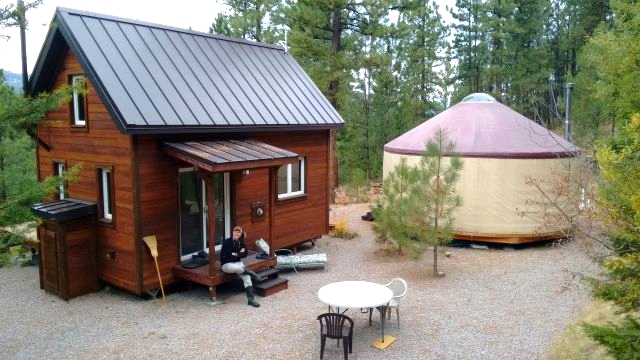
Kevin outside his off-grid eco tiny house next to the yurt he and Tina lived in for a number of years while they built the house
This was a particularly great pleasure for me because I first met Kevin when he enrolled in a ‘Green Building’ class I was teaching at the University of Montana. For his main project for the semester Kevin designed a little off-grid, self-sufficient cabin that he hoped to build for himself one day in the mountains somewhere near Missoula. At the time he didn’t have land but he certainly had the dream.
A couple of years later he had bought his little piece of the forest and came to me for advice on the design and energy efficiency details of the cabin you see in the photo above. Then he and Tina bought the yurt which they erected on top of an insulated SIPS panel floor structure to serve as a place to live while they built the house.
Inside Kevin and Tina’s lovely yurt
I love yurts… they are such beautiful, minimalist structures. The criss-crossed slats you see in the photo above are the entire wall framing and are attached to a wire ‘ring’ around the top of the wall which supports the roof rafters.
The entire structure of a yurt is made up of small pieces of wood cleverly attached with steel fasteners and wire
The rafters, in turn, support a circular skylight in the centre of the roof which bathes the whole interior in beautiful light and provides a view of the sky.
It’s a gorgeous space to be in… for a while. But Tina and Kevin lived in this through three or four Montana winters when temperatures would get down below minus 20deg. Thankfully their yurt is somewhat insulated and can be kept very warm with a wood stove. But they didn’t have running water, their kitchen was a gas stove on a trolley and their toilet was a hole in the ground. (Tina said it wasn’t as bad as when she lived in Alaska and had to take a heated cushion with her to the outhouse to prevent her bum from freezing to the seat).
These are some tough people but still, I’m sure you can imagine how happy they are to have finally moved in to their cozy little cabin.
Tina’s new bathroom complete with hot and cold running water, shower, sink, gas water heater and composting toilet
The cabin could be described (very fashionably) as an Off-Grid Eco Tiny House. It has a footprint of 240sf (about 24sqm… which makes our 57sqm Greeny Flat seem like a palace) with a loft/bedroom over half of the ground floor. The floor and roof are built with SIPS panels (8 inches of foam with OSB glued to both sides) while the walls are timber framed, six inches thick and with an additional four inches of rockwool insulation wrapped around the entire outside. In retrospect Kevin says he should have used SIPS panels for the walls as well. They’re expensive to buy but would have saved him a lot of trouble and time for an equivalent level of insulation. The windows are UPVC frames and I can’t remember if they were double or triple glazed.
In general this tiny house is super insulated and very well air sealed which means they have to be careful to ventilate it correctly in the winter time. The cost for materials was about $60,000 (plus a LOT of hard work) and they’re very happy with how it turned out.
It’s hard to photograph such a small space but the series of photos that follow give a pretty good idea of what it’s like inside. I’m very grateful to Kevin and Tina for inviting me up to see the finished product. It’s very much their baby and I feel like I’ve been involved since the conception in my Green Building class. But if this is Kevin and Tina’s baby which they’ve raised from the ground up, it’s now fully mature and ready to take care of its parents (as children tend to do).
The cabin is primarily heated by this tiny wood stove in the full-height living room
The kitchen isn’t quite finished yet but Tina wasn’t keen to spend another winter in the yurt while Kevin completes the cabinetry so they moved in anyway
A loft above the kitchen and bathroom serves as the bedroom
There’s a nice view of the forest from the bedroom window
A 1.5kW solar and battery system supplies all of their electrical needs including pumping water up to a holding tank at the top of the hill. They use propane (LPG) for heating water, cooking and keeping the house from freezing when they’re not home
In Montana water tanks have to be buried or they freeze solid and the water line (which gravity feeds from here down to the house) has to be at least six feet below ground
The ultimate luxury is their ‘Cowboy Hot Tub’ consisting of a horse trough, wrapped in insulation and heated by a tiny little wood chip heater
Congratulations Kevin and Tina for pursuing your dream and creating a little mountain paradise of your very own. Next time I visit I look forward to staying in the yurt and lying (or squatting) in the hot tub with Cintia and a glass of Pinot Noir while gazing at the stars through the trees…. I can hardly wait.
Our rain gauge this morning after a long dry spell.
I’m still pretty jet-lagged after arriving back in Sydney the day before yesterday but I’m very happy to report that I seem to have brought some rain with me. It’s been a long dry spell here (and in Montana too) with our weather station only recording a total of 41mm over the last four months. So we were thrilled to hear rain on the roof all night last night and to wake this morning to find over 35mm in the rain gauge. That’s on top of the 20mm we had yesterday so we’ve had over 55mm in the last two days, our tanks are full again and all our plants are breathing a big sigh of relief.
I also had time this morning to check our monitoring equipment to see how the Greeny Flat has been performing while I was away. I was particularly interested to see what difference the solar air heater (circled in blue above) made to our indoor temperature and humidity while we were gone.
Long-time readers will recall that I have written about our experiments with making a DIY solar air heater a number of times. In this Newsletter from May 2015 I described the thinking behind our Solar Air Heater prototype and in this Newsletter I showed some early results from trials of the system. Fast-forward two years and, just before we left on our trip to states, we decided to make the prototype into a permanent part of the Greeny Flat. This meant cutting holes in walls to allow us to duct the incoming heated fresh air across to the back bedroom on the south side of the house (this bedroom doesn’t get any sun and it’s been nice to have the added warmth in there in winter).
The quiet fan is mounted inside an insulated box placed on top of our bedroom closet.
We also added a new, quiet fan which we mounted inside an insulated box (for sound proofing), wired it into the house power and connected it to a thermostat controller.
The thermostat controller measures the temperature inside the solar air heating panel on the north wall of the house and switches on the fan when the temperature reaches the set point.
As you can see from the photo above, this new and improved system was delivering 57.1degC on a day when it was only 16.3degC outside. In other words, the Solar Air Heater was adding 40.8degC to the incoming fresh air.
This photo of our weather monitor was taken at the same time. The outside air temperature is circled.
Needless to say I was very happy with this addition to the energy efficiency, comfort and indoor air quality of the Greeny Flat while we were here in the home. But I was also interested to see what effect it would have while we were away in winter.
One of the few drawbacks of our Passive Solar house is that it works best when we are here to operate the windows and blinds correctly… as the saying goes, ‘Passive House, Active Owner’. In winter this means opening our insulating blinds during the day to let the low winter sun stream in and warm the floor slab then closing them at night to help keep the warmth inside. It’s also up to us to run our ventilation fans as much as needed in order to keep the indoor humidity down to a reasonable level (around 50%), to reduce condensation potential and maintain good indoor air quality. But when we’re not here to open the blinds during the day or run the vent fans the temperature will go down and the humidity will go up.
This was proven true two years ago when we were away for the whole month of August. According to our weather monitoring system, the outdoor temperature for that month averaged 8.5degC and the outdoor humidity averaged 67.7%. Meanwhile the indoor temperature averaged 14.4degC and the humidity 56.7%… that was without the solar air heater operating.
As it happened, we were away again for the whole month of August on our latest trip. But this time we were able to leave the solar air heater turned on. Because it is set up on a thermostat, whenever the temperature inside the heater panel gets above 40degC the fan automatically switches on and blows warm air into the house. So, even though we weren’t there to operate the blinds or the vent fans, the house was still getting some added heat and fresh air.
The results speak for themselves. During this most recent August while we were away, the outdoor temperature averaged 8.7degC and the humidity 70.8% (almost identical to August 2015) however the indoor temperature averaged 16.2degC and the indoor humidity 47.4%. This means that the Solar Air Heater by itself raised our indoor air temperature by an average of about 2degC and reduced our indoor humidity level by about 10%.
Personally I think that’s a fantastic result.
Reader Responses to ‘Cattle, Good or Bad’
In last week’s Newsletter from the ranch in Montana I attempted to address a reader named Leon’s concerns about the harm that animal agriculture is doing to the global environment. During the last week I have received a number of responses including the following from Leon…
Hi Andy,
Thanks for taking it on-board, appreciated! My partner and I are both vegan, climate is only one part; cruelty, exploitation and our health are another part too. Here are some links:
Hi Andy, Thanks for another interesting Newsletter. You’ve raised what can become a very heated debate by those who see domestic grazing animals as a huge cause of green house gases and those who defend the practice. A recent very thoughtful book on this issue by an Australian farmer and academic, Charles Massy, called “The Call of the Reed Warbler” is worth reading before rushing to make too many judgements on this issue. The experience and work of another author, Allan Savory, is also worth investigating. His work is also discussed in Charles Massy’s book. Always look forward to reading your words and hope you get as much enjoyment setting your thoughts to paper as we readers do reading them. All the best, Doug
And this from Chris
All ruminants break down complex carbohydrates into fatty acids, then rebuild them into physiologically useful chemicals. It’s the rumen that does the heavy liting, digesting lignins and things that you and I cannot.
Other critters do it in different ways. Horses have a very large caecum – up to 6 feet of it and up to a foot in diameter. Much bigger than your appendix (if you still have one). But it seems less effective than the multi-stomach system of ruminants – consider how much fibre remains in horse faeces compared to bovine.
The breakdown of complex carbs is done by a myriad of bacteria, protozoa and aided by regurgitation and repeated cheweing (chewing the cud). And ruminants belch up the excessive gas, mainly methane.
I’m sure you’re aware of what happens if they can’t – they bloat. Bloat occurs when the stomach outlet is underwater (cow lying on its side) or when the rumen content is a stable foam from which the methane cannot escape. The usual condition is a liquid in lower parts with a gas phase above.
Most common cause is when cattle eat green clover. Most common treatment is to inject a surfactant into the rumen to break down the foam. Or stab a hole in the left flank to let it out. Very messy.
Agvet companies, including SmithKline spent years trying to develop chemcials that would reduce methane production on the rumen. If it was retained in the biological system of the cow, it would be as energy and might be converted into fat, improving the feed conversion. It was only modestly successful.
Clearly this is a tricky subject and I leave you to draw your own conclusions.