By now you should all know that Sunday, Sept 11 is Sustainable House Day (SHD). But just in case you’ve been naughty and haven’t been reading our Newsletters, SHD is a FREE, annual, national event in which sustainable homes across Australia open their doors to interested visitors. To find out if there are open houses in your area simply go to sustainablehouseday.com and click on “Find Houses”. If there are homes you want to visit you will need to register as a visitor (click on “Get Involved” and the rest is self explanatory) then you will be able to see the actual addresses of the homes under the “Find Houses” tab. I hope to see as many of you as possible of Sunday and there are two other excellent projects in our local area so why not make a day of it?
Latest on The End of the FITs, Meter Changeovers, Battery and Energy Management Systems
As discussed in last week’s Newsletter, the subsidies for home solar power systems are starting to roll back beginning at the end of this year when the high Feed-in Tariffs (FITs) will finish and the installation rebate will begin a five year phase-out. As you know, I have been investigating the best options for home-owners who are coming off the high FITs and needing to change over from Gross Metering to Net Metering. Today I’m happy to announce that, for anyone living in the South-east region of NSW, there is a huge community bulk buy program getting underway called SunCrowd and we are getting involved. There will be two information sessions in our local area (the Southern Highlands) on the evenings of October 26th and November 15th so mark your calendars. If you live elsewhere in the SE you can register your interest on the SunCrowd website and you will be informed of upcoming events in your area.
While you’re on the SunCrowd website you can also request a free guide to solar and storage called ‘How to Unlock Your Clean Energy Future’ (simply scroll down on the home page and click on the ‘Get It Now’ button). I have just requested it myself but I haven’t had a chance to read it yet. This is all very new, SunCrowd has run a trial bulk-buy program in Newcastle recently which saw 187 customers sign up for solar and/or battery systems and immediately made SunCrowd the largest seller of home energy storage systems in Australia. My friend Miles and I had a phone conversation with the SunCrowd team yesterday and have agreed to help organise the event in our area. Over the next few weeks I will be providing more information about how you can get involved. In the meantime I would encourage any readers in SE NSW who are considering their options regarding solar, batteries, meter changeovers and energy monitoring/management to not rush into any decisions before attending one of SunCrowd‘s FREE events. The purpose of these gatherings will be to thoroughly inform the attendees of their options to enable people to make a clear decision about what to do.
What I can tell you is that my research is pointing to a couple of fairly clear winners in the search for the best options for home owners. I’m not quite ready to share the results yet (still some final research to do) but I will be revealing all soon. Stay tuned…
We Are SO Lucky To Live In Australia
I’ll finish this week with some photos from our trip to Brisbane last week. I’ll let the images and captions tell the story, suffice to say, it was a nice break and a wonderful reminder of how incredibly lucky to live in this beautiful, uncrowded and peaceful country.
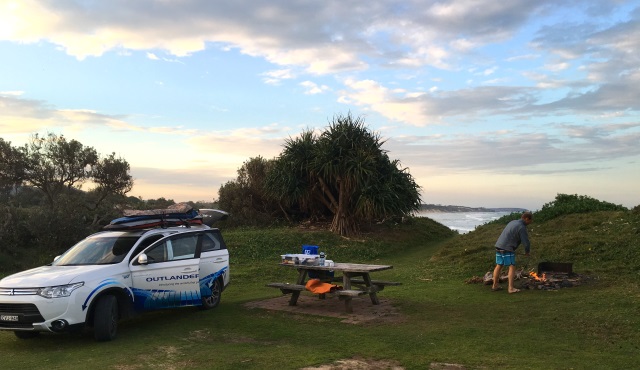
Where else in the world can you drive 20km off a major highway and find a deserted campsite with a view like this?
Our PHEV (Plug-in Hybrid Electric Vehicle) performed exceptionally well as both transportation and accommodation for the trip. Fully loaded and with three surfboards on the roof it still managed 7.76 L/100km without any charging whatsoever.
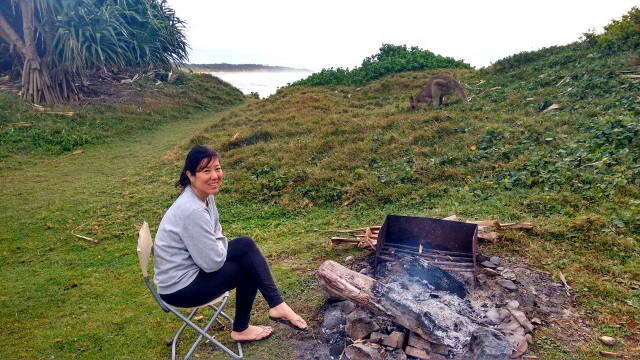
Cintia and friend enjoying the morning. The kangaroos in this national park near Broome’s Head are completely unaffected by human presence so we were able to observe their natural behaviour at very close quarters.
I was singularly unimpressed by ‘The Farm’ at Byron Bay. After hearing all the hype about the 500,000 visitors it had in its first year I was keen to see what the fuss was all about. What I saw was an overpriced hangout for the rich and gullible. I was completely put off when the first thing I saw (after the carpark packed with BMW SUVs) was a totally uninsulated building with a reverse cycle air-conditioning system. That told me pretty much everything I needed to know about ‘The Farm’.
We also visited a number of Intentional Communities and EcoVillages like this one near Currumbin as well as a new one starting up at Narara near Gosford and an old one near Coff’s Harbour. I had been to the Currumbin one many years ago when it was just starting so I was keen to see how it had developed. It was very pleasant… much nicer than the many new, McMansion subdivisions we passed… but it had the air of catering fairly exclusively to the wealthy and privileged. We weren’t able to find any residents to ask what it’s like to live there so we might have got the wrong impression.
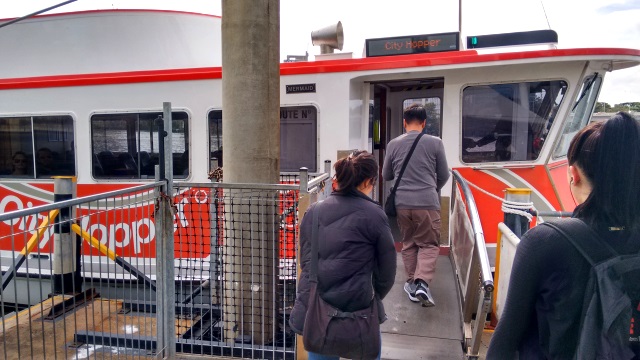
One of the many highlights of the trip was a very brief visit to Brisbane. With only a few hours to spend there we were advised to take a free ferry trip on the City Hopper. This proved to be a wonderful way to get a feel for the city during an hour and a half round trip.
The City of Brisbane has done a fabulous job of redeveloping the river frontage as a delightful place for people. Walk/Cycleways follow the river bank for many kilometers on both sides of the river and appear to be well-loved and used constantly.
Due to murky water and sharks, the river itself is not a good place to swim so they have built a very nice man-made beach on the river’s edge. Apparently it gets PACKED on a sunny day.
Not far from the beach is this gorgeous Nepalese Pagoda that was built for the Brisbane Expo in 1988. Every inch of it is beautifully hand-carved and it has been lovingly preserved. It makes for a peaceful retreat from the city activity.
And next to that is a charming rainforest walk.
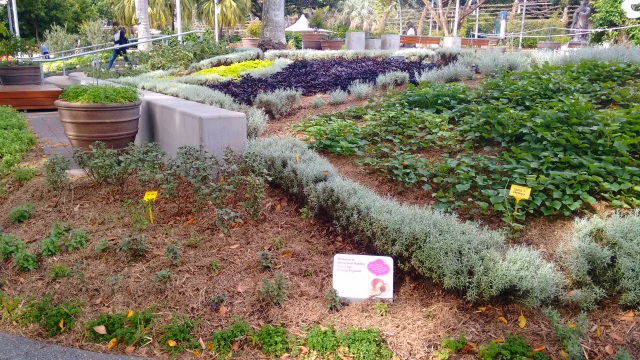
A bit further along the South Bank is an interactive culinary herb garden cared for by a group calling itself ‘Epicurious’.
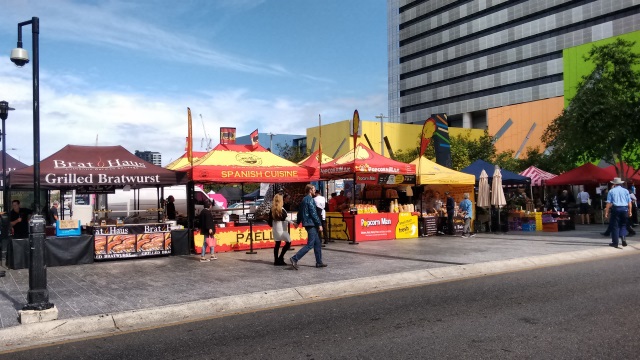
Which whet our appetites for this fabulous street food market that happens every Wednesday right in the heart of Brisbane. All of which combined to make our few hours in Brisbane both interesting and exciting.
All told it was an excellent trip and we can highly recommend a visit to Brisbane and Broome’s Head. But, as most of you probably know, the whole coast between Melbourne and Brisbane is incredibly beautiful and remarkably unspoilt, especially if you can manage a visit outside of the school holidays. We really are the lucky country!
Back to more serious things next week. Thanks for your interest. Andy
Cintia and I are currently on a fact-finding and sun-seeking mission between Sydney and Brisbane so this Newsletter will be brief as I am writing it from the road.
Last night’s campsite near Broom’s Head… another perfect deserted beach… ho hum.
FIT’s and REC’s
As most of you are probably aware, the days of high Feed-in-tarrifs (FIT’s) and big subsidies for home solar systems are winding down in NSW. Early adopters of PV power were treated to FIT’s (the amount you get paid for sending your solar power to the grid) as high as 60c/kWh. This meant that, even though the price of a solar system was very high, it would pay itself off in about five or six years. The effect of this was to stimulate the solar industry, encourage research and development of cheaper options and ultimately to bring the cost of solar down to the very low prices we enjoy today. For example, when my sister installed her 3kW system about seven years ago it cost her $22,000 and when we installed out 3kW system on the Greeny Flat about two years ago it cost $4,500. In both cases the upfront cost was reduced by a rebate payment through a government scheme known as Renewable Energy Certificates of REC’s.
To the horror of many people interested in Renewable Energy, both the high FIT’s and the REC’s are about to start phasing out. As far as I am concerned they have done their job and done it exceptionally well. Australia has one of the highest rates of solar uptake in the world and because of the massive progress we have seen in solar system efficiency, reliability and cost reductions, we don’t need the subsidies any more. Solar power makes perfect economic sense even without them. However it makes even better economic sense with them which is not for very long.
At the end of this year the high FIT’s will end and the REC’s will begin to phase out over a five year period. So, if you’re considering buying a solar system or adding to your existing system there’s a good argument for doing so while the full REC rebate is still in place. But you’d better hurry because the system has to be installed and operating before the end of the calendar year in order to qualify for the full rebate. And, if you are currently getting one of the high FIT payments you need to make sure you understand how any changes to your system will affect your FIT.
Gross and Net Metering
Also, if you are currently receiving a high FIT, you need to be aware that you are going to have to change your meter. The high FIT’s were paid under a system known as Gross Metering whereby every kWh of energy your solar system made was sent straight to the grid and you got paid for it. When you come off the high FIT you will convert to the new system, like we have at the Greeny Flat, called Net Metering whereby the solar power is sent to your house first and only if there is any excess power will it be sent to the grid. You still get paid a bit for the power sent to the grid but these days it’s generally only in the range of 6-10c/kWh. You will want to do careful research into which retailer will give you the best deal. We are with Click Energy because they offer a 10c FIT but we know a LOT of people who have recently switched to Powershop.
Regardless of who you choose as your retailer, you will need to have your meter changed over to a Net Meter. I am currently researching the best option for the changeover and will report on that soon. I believe that Powershop and some other retailers will give you a ‘free’ Net Meter if you change over to them but I think you will want to consider a Smart Meter.
The Benefits of Smart Meters
I believe that in the very near future we will all be interacting with the energy grid and our electricity retailers in a VERY different way than we do today. In a short time I think we will all become energy traders connected to a smart grid via a smart meter and with a smart Energy Management System (EMS) controlling how we send and receive energy to and from the grid.
Imagine you have a house with a solar power system, battery storage, an electric vehicle and a smart EMS controller that is connected to smart appliances like your reverse cycle A/C, water heater or clothes washer. When the price of energy is low (which will likely be when all of the solar power systems are putting energy into the grid during the day) the EMS will be able to switch on things like your home heating system, water heater and car or home battery charger to take advantage of any excess power you have from your solar system or simply buying cheap energy from the grid and storing it in a battery for later use or sale back to the grid. At the times when the price of power is the highest (likely early in the morning and evening when people are cooking breakfast or dinner and the sun isn’t shining) your EMS will be able to send power from your home or car batteries to the grid and sell it for a very good price, at the same time it will be able to turn off the high energy using equipment (like space and water heaters, car chargers etc) so that you’re not paying a high price to do things that can be put off until the price is low again.
Apart from saving you money on the power you import from the grid and making you more money for the power you export to the grid this ‘Smart Grid’ system offers huge environmental benefits to everyone when compared to the current system. The current system relies primarily on coal-fired power plants which cannot be turned up or down. They have one speed… full bore… and they therefore have to be sized to meet the maximum expected load on the grid. Because we currently have a dumb grid, there is very little ability to manage the spikes and troughs in the energy grid. So if there is a sudden spike in energy demand the only real control they have is to adjust the price of energy up. This causes certain very energy-intensive industries (such as aluminium smelting or cement making) to turn off their equipment until the price comes down again and has worked (mostly) to keep the grid running until now.
However, as more and more solar and wind power comes on line we are introducing another major variable into the mix. Not only is the demand unpredictable, now the supply is becoming increasingly variable as well (although reasonably predictable due to improved weather forecasting). By building a ‘Smart Grid’ we will be in a much better position to manage the energy demand to match the energy supply. Everyone will benefit both economically and environmentally… except perhaps investors in the coal industry.
As mentioned above, I am currently researching the best options for ‘smart meters’ and Energy Management Systems. It seems to me that, with the end of the high FIT’s and the beginning of the end of the REC’s, this is the perfect time to start the process of building the Smart Grid of the future. Unfortunately this opportunity seems to have escaped the politicians and power company executives but I will let you know what I learn and what I consider will be the best way to future-proof your energy system.
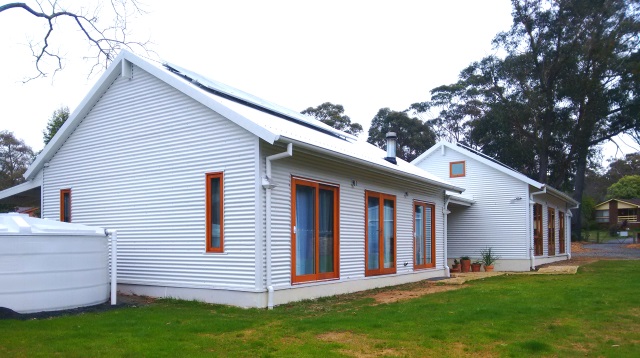
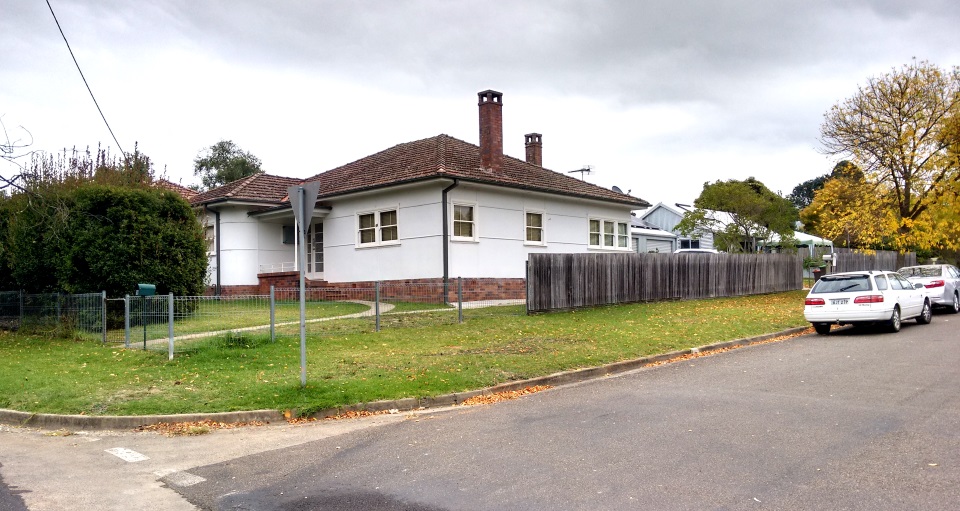
In our Newsletter back on March 6th entitled ‘Beware of Standard Practices’, I described some of the challenges we were having getting the builder to properly insulate and air-seal a house that I designed for a friend of mine near Mittagong. The house is finished now and it has turned out really well. It is basically two open-plan versions of the Greeny Flat that my friend will use, one for their house and one for their yoga studio. Here’s a recent picture of the finished project (there’s still more landscaping to do).
My friend’s new house as seen from the NE.
In order to allay any concerns that my friend might have about the quality of the insulation (as described in the Newsletter mentioned above) I offered to examine the house with an infrared (IR) camera to make sure it was at least as good as the Greeny Flat. For three years when I lived in Montana I had the job of performing energy audits on houses including IR testing so I know my way around an Infrared Camera. The trouble is that the one I used in the states cost about US$5,000. Luckily, another good friend of mine recently bought a $400 FLIR Infrared Camera attachment that simply plugs into his iphone and he offered to lend it to me. I was pretty keen to give it a try so I borrowed it, along with Cintia’s iphone, on a nice cold morning at the beginning of this week.
Infrared Camera Testing Basics
IR testing works best when there is maximum difference between the indoor and outdoor temperatures. This is when you can most readily see where heat is being lost so a cold morning is a good time for IR work. In the following images, warmer surfaces appears lighter and cooler surfaces appear darker. So, for images taken inside the buildings, lighter is good anddarker is bad (in terms of heat loss) because it shows cold areas where heat is being lost to the outside. For images taken from the outside the opposite is true… lighter areas generally show where heat is being lost to the outside. However there are some traps to watch out for… for one thing, reflective surfaces like glass or metal can be tricky because they sometimes reflect the heat signature of something other than their own surface. Also, as you’ll see below, some of the warm surfaces on the outside of the buildings had nothing to do with heat loss from the inside. This is where some experience with an IR camera can be useful, otherwise the results can be very confusing. So what did we find?
The roof panels of the Greeny Flat as seen from inside using an Infrared (IR) Camera.
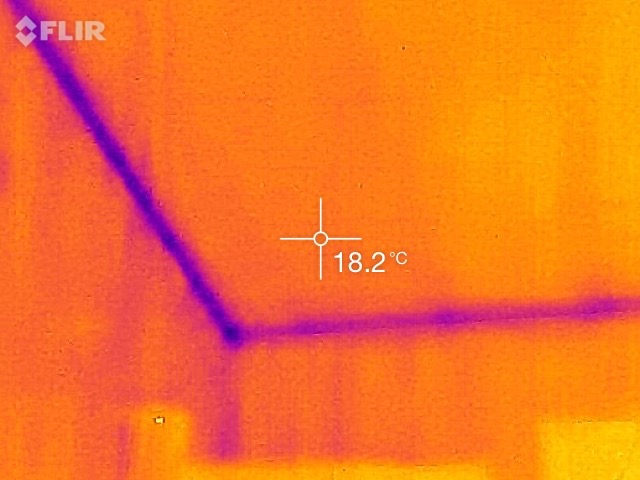
One of our main areas of concern was the quality of insulation in the SIPS roof panels of the new house (see this Newsletter for more information on SIPS panels and this Newsletter for the reasons why we were concerned with the new ones). To summarise, there were gaps between the new panels that looked like they might allow heat to escape. So I started by taking the image above of the Greeny Flat roof which didn’t have gaps between the panels and compared it to the following image of the new roof.
The roof of the new house as seen from inside.
To start with it is important to disregard the difference in colour between the two images above. This is due to the fact that I was using a certain setting on the camera that adjusts the colour according to the warmest and coldest surfaces in the image. The important things to note are that, a) the temperature of the two ceilings is almost exactly the same and b) there are no dark lines in the middle of the new house’s roof. If there was heat loss at the joins between panels we would be seeing dark lines running up the ceiling at each of the panel joints and we are not. This is great news. So what are the dark lines around the edges? These appear in both the Greeny Flat roof and the new roof and they are due to the nature of SIPS panels.
SIPS Panel Basics
As you can see in this previous Newsletter about them, SIPS panels are structural panels consisting (in our case) of an interior skin of flat metal glued to 150mm of polystyrene foam glued to a corrugated metal exterior skin. So the underside is made of a sheet of flat metal that crosses over the exterior walls from inside to outside. This allows heat to conduct through the metal from inside to outside and there’s really nothing you can do about it if you use SIPS panels. I have heard of people cutting a groove in the lower skin of the panels where it sits on the exterior walls but to my mind this would completely compromise the structural integrity of the panels and is a VERY bad idea. So, if you use SIPS panels (and I still think they are almost the only way to go for Cathedral ceilings for reasons outlined here) you just have to accept that there will be a small amount of heat loss around the edges of the roof. When you compare it to how much heat is being lost through the double-glazed windows in the IR image of the Greeny Flat above, I think you’ll agree that it is not a major concern.
Window Basics
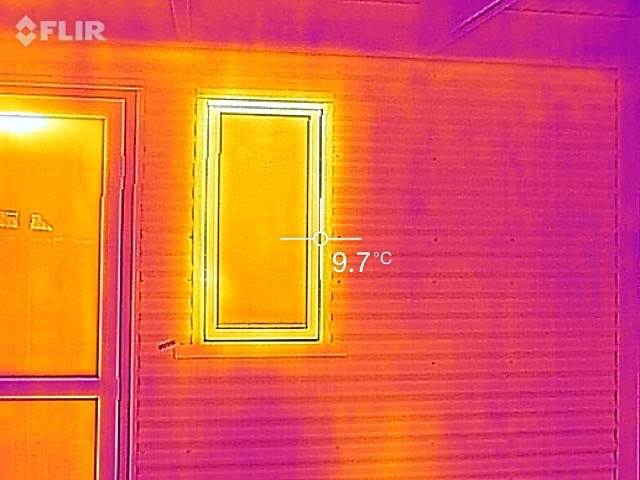
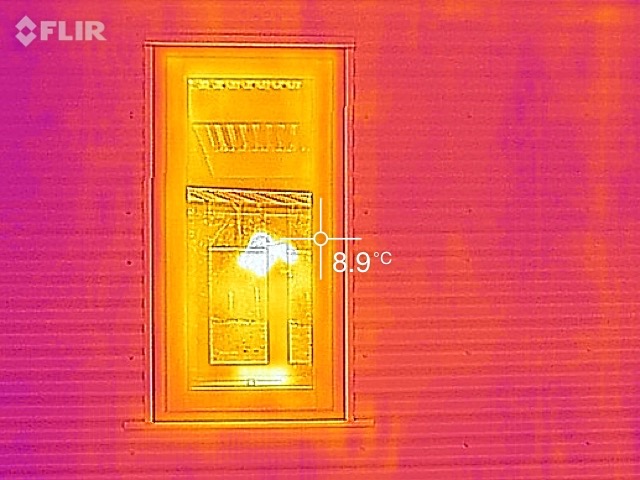
In the Greeny Flat we used double-glazed windows with aluminium frames (not thermally broken because those were too expensive). In the new house we used mostly wood-framed, double glazed windows except in the wet areas where we used aluminium frames for durability. It is interesting to note how much more heat can be seen escaping via the aluminium frames than the wood frames in the two images below.
IR image of an aluminium-framed, double-glazed window
IR image of a wood-framed, double-glazed window on the same building. Note the reflection of the author in the glass. This is why you have to be careful taking IR images of reflective surfaces.
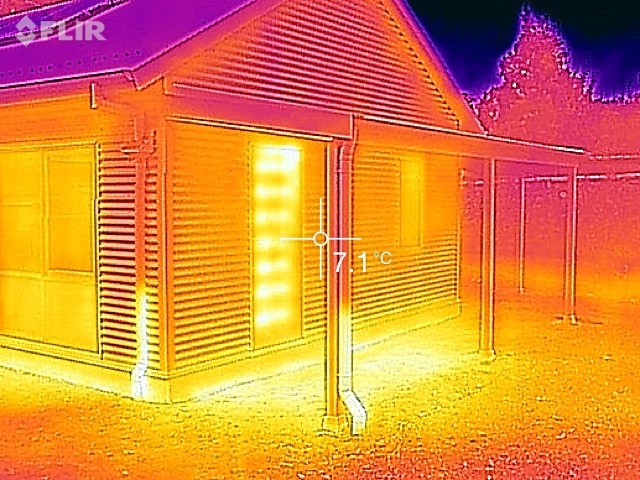
It’s also very interesting to notice how much more heat is being lost through the single glazed panels of the front door of the new house compared to the double glazed windows on either side of it (see below).
Double glazed windows on either side of the single glazed front door.
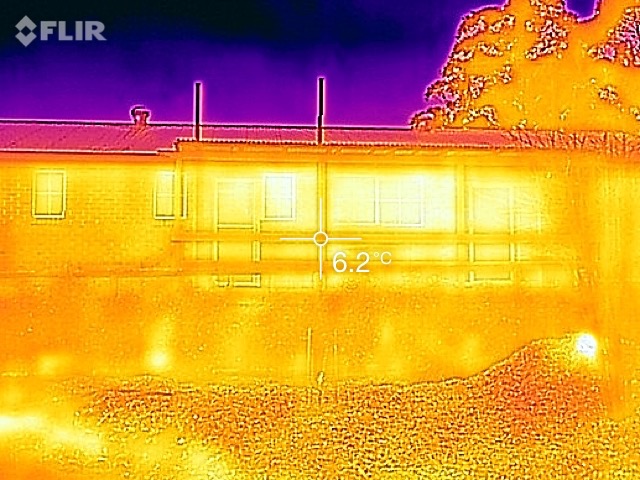
The other thing that amazed me when I first saw the image above was that I could see exactly the height of water in the downpipes. But I’ll come back to that. First I want to complete the discussion of windows by showing you what the single-glazed windows on the neighbour’s house looked like that morning.
IR image showing heat loss through single-glazed windows… don’t let anyone tell you that double-glazing doesn’t make a difference.
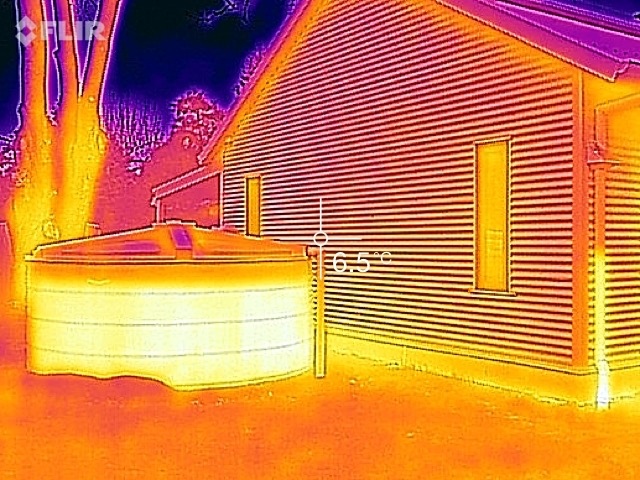
Back to the downpipes… the new house has what’s called a ‘charged’ downpipe system. This means that the downpipes are partially full of water all the time. It was really surprising to me to see how much warmer the water in the pipes was than the rest of the exterior of the building. This is due to fact that water has a lot of thermal mass. It is a good conductor and holder of heat. Check out the following image that shows the water in the rainwater tank too. For this reason, an IR camera can be a very useful tool for finding water leaks and moisture problems in buildings.
IR image showing the level of water in a rainwater tank.
Thermal Mass Basics
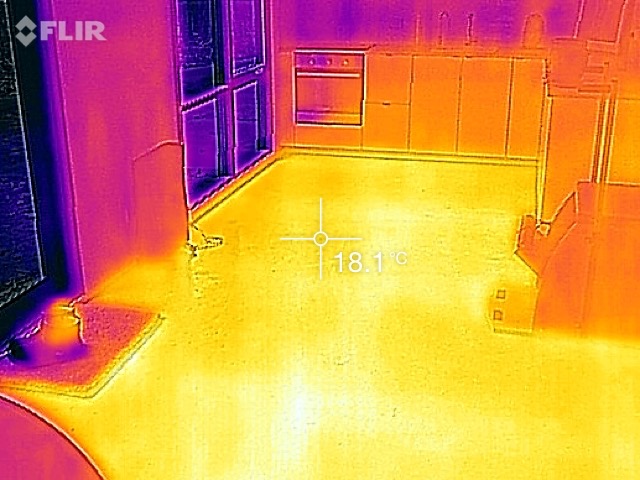
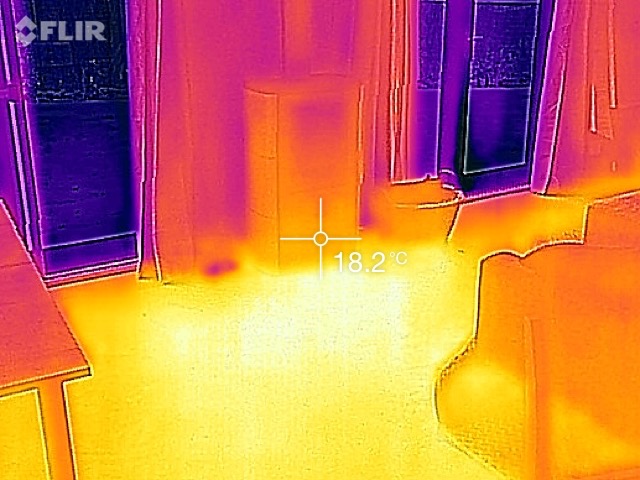
Now we come to my favourite images, the ones that show the Thermal Mass at work. Readers familiar with this website will know that, in a Passive Solar Designed house, the Thermal Mass (in this case the concrete floor slab) acts like a heat store, absorbing heat from the sun during the day and radiating it into the house through the night to keep the place cosy and warm. Keep in mind that these images were taken on a morning when it was about 4degC outside and before the sun came out for the day. So the warmth you are seeing was absorbed the previous day and stored right through a fairly cold night.
IR image of the Thermal Mass floor of the Greeny Flat.
In the image of the Greeny Flat floor above you can see that the warmest part of the floor, where the sun was shining on it the previous day is still radiating 21degC the following morning. You can also see how the slab gets colder towards the outside edge because we did not insulate the edge of the slab nor did we put any insulation under the slab. Compare this to the floor of the new studio in the following image.
Infrared Camera image of the thermal mass in the new, waffle-pod-slab studio floor.
In the image of the studio floor above you can see that the edge of the slab is not significantly colder than the rest of the floor. This is because we insulated the edge of the slabs in both the new house and studio. However, if you look very closely you can also see a pattern of large, cooler squares showing through the slab. This is due to the insulated ‘waffle pods’ that were placed under the floor when the slab was poured. There is a lot of debate as to whether or not it is better to insulate under floor slabs (as discussed in this previous Newsletter) in this climate. If I were building in Montana or putting any form of heat pipes or wires into a floor slab then I would definitely insulate underneath it. However in most of Australia’s mild climate regions I don’t think it’s necessary, in fact I think it might be better to have the thermal mass of the slab connected to the thermal mass of the earth beneath it but I have no scientific evidence to back that up. I find it interesting that you can see the waffle pods in the IR image above.
IR image of the new house showing the heat stored in the floor from the fireplace.
In the image of the new house above you can’t see the waffle pods underneath because the stored heat from the wood stove is making the floor glow like a bed of coals. I generally don’t recommend wood stoves unless, as in this case, it has its own air intake. This stove in the new house has a pipe the brings fresh air from outside directly into the combustion chamber. Without this pipe the fire would suck all the warm air out of the house. With the pipe in place the fire does a great job of radiating heat to warm the house, including the floor slab which stores some of the heat overnight as you can see above.
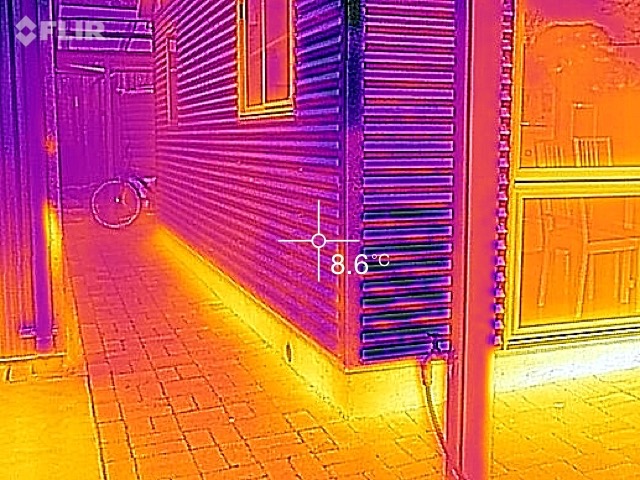
IR image showing an insulated slab edge.
The image above shows the insulated slab edge of the new studio. Notice the line of heat escaping below the bottom of the insulation? This is due to the fact that the landscaping and paving hasn’t been completed yet. Once completed the paving will be quite a bit higher than the existing ground level and most of that heat loss will be buried underground. Compare this to the edge of the floor slab in the Greeny Flat below.
IR image showing an uninsulated slab edge.
In the Greeny Flat we did not insulate the slab edges (for termite barrier reasons) and you can clearly see how much more heat is escaping through the edge of the floor slab. You can also see how much more heat is escaping via our aluminium window frames compared to the wood windows in the studio above.
Also for comparison sake, the following is an image I took at the same time of the old house next to the Greeny Flat on which we are preparing to perform a major energy retrofit as described in this Newsletter from a few weeks ago. Notice the heat loss through the single-glazed windows, the eave vents and the effect of the thermal mass of the fireplace down the left hand side of the image.
IR image of the old fibro cottage next to the Greeny Flat.
Finally, and just for fun… when I got home from my visit to the new house and studio I happened to glance at our electric car with the Infrared Camera. You can image my surprise and delight when I saw this…
IR image of our electric car after a short trip.
Because it was a short trip I had driven the whole way there and back on purely electric power so the engine hadn’t heated up at all. In fact the only things glowing were the tyres from the heat generated by friction on the road. Great image isn’t it?
This week I would like to introduce you to the extraordinary work of Catarina Mota and Marcin Jakubowski.
Marcin and Catarina are Open Source Advocates and they are working on a number of projects that could prove to be highly disruptive to corporate interests and highly beneficial to people.
So what does ‘Open Source’ mean? According to this website…‘The phrase open source usually refers to a community-developed and community-supported hardware or software project. Typically, the phrase open source means that the technology is free to use, free to share and free to modify.’ The evolution of the internet has made access to information readily available to a huge audience. So people who are ecologically or community-minded can develop an idea and make it freely available to anyone with an internet connection. In the case of Catarina and Marcin, their focus is on making useful things like houses, farm machinery or smart materials. Between them they have been involved in establishing projects such as Open Materials, the Open Source Hardware Association, Open Source Ecology, the Global Village Construction Set and the Open Building Institute. All of these are well worth checking out if you’re into making cool stuff but I’d like to focus on two of them for now.
The Open Building Institute provides all of the information and training required to build a low-cost, ecological house.
To quote from their website, ‘The Open Building Institute is an Open Source effort to make ecological, affordable housing widely available‘. This reminds me strongly of the original goal of the Greeny Flat project which was to see if we could build a small, energy positive and affordable house. But the Open Building Institute takes a very different approach by designing sustainable buildings in modular sections which can be put together in an infinite number of ways then making all of the information freely available on the internet. They also train people how to build in group sessions similar to a barn raising which can see a whole house built in just a few days. Plus they provide all of the information needed to make or source the materials required and to build any machinery that might be necessary. Which leads to the next project…
This is another Open Source project that is under development to provide all of the information required to build all of the machines needed to create a ‘civilization’. As described on this Open Source Ecology web page…
‘The Global Village Construction Set (GVCS) is a modular, DIY, low-cost, high-performance platform that enables fabrication of the 50 different Industrial Machines that it takes to build a small, sustainable civilization with modern comforts’.
This is pretty wordy but the idea has fantastic practical applications. Imagine that you wanted to start a farm but couldn’t afford a tractor… the GVCS shows you how to build your own. The easiest way to understand it is to watch the following video of Marcin’s TED talk about the idea.
I was particularly impressed by Marcin’s comment that ‘I needed tools that were robust, modular, highly efficient and optimised, low cost, made from local and recycled materials that would last a lifetime, not designed for obsolescence… I found that I would have to build them myself. So I did just that’ And now he’s making it easy (or at least much easier than it was for him) for anyone to do the same. So far they have built prototypes of 8 of the 50 ‘essential’ machines and they’re working on the rest. This could be very bad news for the huge corporations that make billions of dollars selling machines that are designed and built NOT to last but it’s great news for people who want to be more self reliant and productive. As he says, ‘If we can lower the barriers to farming, building, manufacturing… then we can unleash just massive amounts of human potential.‘
Boat Builder’s Container Home
Speaking of human potential, check out the following YouTube video about a craftsmand who applied the design brilliance, gorgeous woodwork and clever use of space learned through years of building and fitting out boats to his own tiny home inside a 20 foot shipping container. Unlike many shipping container homes, this one maintains the ability to be shipped anywhere in the world as a shipping container and then opened up to make a gorgeous little house.
Long time readers will know that we have opened the doors of the Greeny Flat to visitors for Sustainable House Day for the last two years. Well we’re at it again on September 11th for our third consecutive Sustainable House Day. The Greeny Flat will be open from 10am to 4pm and you can register to attend on the Sustainable House Day Website.
There are two other exceptional houses in our local area which will be open on the day. One I have written about before being Glenn and Lee Robinson’s ‘Bundanoon Net Zero Cottage’. This is a wonderful example of a simple, passive solar home and granny flat. It employs many of the same principles as the Greeny Flat but with different finishes and a different look. If you haven’t been to see Glenn and Lee’s place I HIGHLY recommend a visit.
The Robinson’s wonderful Net Zero Cottage in Bundanoon will be open for Sustainable House Day too.
The other is a straw-bale house in Exeter. I have not heard about this project before but it looks really interesting and well designed and I look forward to writing about it in the future. Put together these three projects will make for a very enjoyable and worthwhile day-out for anyone interested in beautiful, sustainable homes, productive gardens and low-carbon living. We hope to see you on September 11th.
This beautiful straw-bale home in Exeter will also be open for SHD 2016.
If you feel like travelling a bit further afield (or live outside the Southern Highlands) you can search for sustainable homes in your area on the Sustainable House Day website (click on ‘Find’ to search). One project that’s well worth a visit if you’re in the Wollongong area is the ‘Illawarra Flame House‘ at the University of Wollongong which won the International Solar Decathlon competition in China in 2013.
The Better, the Worse and the AGLier
In our Newsletter way back in April 2015 I wrote a segment entitled ‘The Good, the Bad and the AGLy‘ about the ‘Dr Jekyll and Mr Hyde’ nature of Australia’s biggest polluter. By that, of course, I mean the company AGL who are listed as the single largest emitter of CO2 in Australia but are also the largest single producer of renewable energy. Well the AGL paradox continues this week….
On the one hand we have this article from Ecogeneration about how AGL is set to build ‘the world’s largest virtual power plant’ in South Australia. Under this scheme ‘The Australian Renewable Energy Agency has conditionally committed up to $5 million funding for AGL to install 1,000 centrally-controlled batteries in South Australian homes and businesses with a combined 5MW/7MWh storage capacity’.
‘Using cloud-based software, a virtual power plant (VPP) directs energy storage units to operate in unison to meet peak energy demand across an entire community or service area, helping consumers utilize their own rooftop-generated solar or stored solar power during peak demand periods and reduce their power bills, says battery-maker Sunverge.’
This is exactly the sort of thing I was talking about back in our Newsletter dated May 29, 2016 and entitled ‘The Future of Energy?. This is the beginnings of a Smart Grid system where the grid can communicate with homes and businesses to maximise the benefits of distributed solar and storage; reduce peak demand; control loads to coincide with periods of peak production; and allow homes and vehicles to trade energy back and forth with the grid. One of the main things inhibiting the realisation of Smart Grids has been the cost of energy storage. So I was excited to read that, under the AGL program ‘…the first 150 customers in metropolitan Adelaide will be eligible to purchase a discounted Sunverge SIS 5kW/7.7kWh energy storage system for $3,500, which includes hardware, software and installation.’ This is less than half the installed cost of a Tesla Powerwall battery and, with an estimated pay-back period of seven years, is likely to be taken up with enthusiasm by AGL’s customers in South Australia.
On the other hand… there is this campaign called ‘Dirty AGL’ by 350.org which aims to expose some very dodgy shenanigans that went on recently in the South Australia power network. According to 350.org…
‘A damning analysis released today has revealed that AGL and the other big energy giants exacerbated the recent energy crisis in South Australia by withholding power from the grid. If true as reported, AGL’s actions pushed up power prices as part of a deliberate strategy to maximise the company’s profits [1].
The report suggests that AGL pocketed tens of millions of dollars at the expense of consumers who, as a result of AGL’s devious actions, paid a premium for their power.
This is pretty shocking behaviour on AGL’s part.’
There are precious few facts provided to back up these claims. You may well have heard about how the wholesale price of electricity in SA recently shot sky high to something like $14,000/kWh and how this has been blamed (particularly by the Murdoch presses) on the unreliability of renewable energy. From what I’ve read it had much more to do with the natural gas prices and the fact that Australia has recently started exporting massive amounts of compressed Liquified Natural Gas (LNG). This has done two things… 1) it has caused the price of electricity to go up because compressing massive amounts of natural gas requires massive amounts of electricity and 2) it has caused the price of natural gas to spike which also raises the cost of electricity (because a fair portion of our nation’s electricity comes from gas-fired power plants). If the 350.org campaign is true, it could have also had a lot to do with AGL and their cohorts withholding power from the grid.
Regardless of the murky facts of the case, 350.org’s campaign is calling for AGL to ‘get out of the business of fossil fuel energy’. Given the imminent threat of global climate change I reckon that’s a good idea regardless of what AGL may or may not have done in the past so I was happy to add my name to the campaign.
In Other News
Also this week there was…
This article from Energy Matters about research from Swinburne University into smelting iron ore using solar energy. This seems like a very good idea given that currently there are 2 tonnes of CO2 produced for every tonne of ore processed.
This article from Solar Quotes about why it can be a good idea to oversize the number of solar panels relative to the size of your inverter. Basically it’s can be a clever way to get around restrictions on the size of inverters that can be connected to the grid.
This article from New Atlas (formerly Gizmag) about a low-cost method of 3D printing simple structures out of clay and straw. The ‘house’ in the article was ‘printed’ for just US$55.
And finally for those interested in energy efficient transportation, there’s this article, also from New Atlas, about a new kind of suspension system which generates electricity every time you drive over a bump. Under development by Audi, the system is not too impressive on smooth roads generating a measly 3W but managing a very respectable 613W on a bumpy road.
In last week’s Newsletter I introduced readers to a wonderful community solar organisation called Repower Shoalhaven which is helping small-to-medium sized businesses and organisations obtain ‘better than free’ solar power systems with the help of local ethical investors. Repower was founded by an exceptional community solar activist named Chris Cooper. As I mentioned briefly last week, Chris has recently started another exciting community solar initiative called SunCrowd.
Unlike Repower, SunCrowd is aimed squarely at the household solar customer and the concept is a simple one… get enough customers together and use the increased buying power to get great prices for solar and battery systems.
SunCrowd had its initial launch in Newcastle in early July where 187 home-owners signed up for solar and energy storage systems. The next roll-out is slated for the SE region of NSW including the Illawarra, Shoalhaven, Goulburn, Southern Highlands and South Coast districts. As Chris put it in a recent email to potential participants, ‘This could potentially become one of the biggest bulk-buys in this country’s history!…
By participating you’ll join a local network of community organisations who are committed to a clean energy future, offering your members and community a valuable service – i.e. accessing solar and storage via a trusted community process at bulk prices.’
To start with, SunCrowd is focused on helping all the households who are soon to come off the high Feed-In-Tariffs work out their best options including adding more solar, adding battery storage, switching energy retailers and installing the right kind of meter. The program is open to everyone and anyone interested in the power of community bulk-buying can sign up for more information on the SunCrowd Website.
Making Fuel from Atmospheric CO2
Solar cell turns CO2 into liquid fuel in the lab. (Source: NewAtlas)
Two of the big problems facing scientists today are 1) how to make renewable energy sources to replace global fossil fuel use and 2) how to reduce levels of atmospheric carbon dioxide and the associated threat of catastrophic climate change. So it’s no surprise that scientists at Chicago’s University of Illinois are excited about the new solar cell they have invented which can turn CO2 directly into a synthetic hydrocarbon gas, ‘or syngas, which can be burned as is or turned into diesel and other hydrocarbon fuels’.
‘The new solar cell is not photovoltaic — it’s photosynthetic,’ says Salehi-Khojin. ‘Instead of producing energy in an unsustainable one-way route from fossil fuels to greenhouse gas, we can now reverse the process and recycle atmospheric carbon into fuel using sunlight.’
Repower Shoalhaven is a community group that gathers ethical investments from local community members and uses the money to fund solar power systems for businesses and community organisations. Technically speaking, these systems are not ‘free’ to the recipient because they pay for them over time by purchasing the power produced. However, effectively the result is better than free power because the recipient can actually save money over the life of the contract. If you think this all sounds too good to be true… read on and be amazed!
Repower was started in 2013 in the Shoalhaven area by Chris Cooper, one of Australia’s most innovative and progressive community renewable energy advocates. Since then Repower has grown to cover the whole SE region of NSW and Chris has moved on to another fantastic community solar project called SunCrowd which is at the forefront of the household renewable energy revolution. I will cover SunCrowd in more detail in a future Newsletter but for now I want to focus on Repower (although I will just say that anyone who is currently considering installing a solar power system or a battery storage system or switching electricity retailers would be well advised to look at what SunCrowd has to offer before making a decision). Now back to Repower…
Imagine that you own a small business with a significant day-time electricity load. You sign up with Repower with ZERO upfront cost to you. They install a solar power system on your roof and agree to sell you the power for ten years for a fixed price that is lower than what you currently pay for electricity. AND at the end of the ten year period you own the system after which time you save even more money. Meanwhile, if anything goes wrong with the system during the contract period it’s not your problem… you only pay for the power it produces. PLUS Repower pays a competitive rate of return to the local, ethical investors who are funding your project (which can include you as the business owner) AND everyone benefits from reduced carbon emissions. What is there not to like about this arrangement? As Linda puts it in the video below, ‘It’s a Win, Win, Win, Win!”
To date Repower has held three investment rounds and funded a total of 219kW of solar systems for a wide range of businesses and organisations in the Shoalhaven area including clubs, churches, bakeries and dairy farms (see the video on the Repower home page for a WIN TV News story about a local dairy that went solar with Repower). These ethical investment opportunities, which are low-risk and offer returns in the range of 6-7%p.a., are available to Repower members only and the good news is that anyone can join (as I have just done) with just a $20 donation. Simply click on the ‘Join Now’ button on the Repower home page if you want to join. The current, two-step sign-up process is a bit clunky but they are apparently working on fixing that.
Repower is now in the process of expanding out of the Shoalhaven area to cover the entire SE region of NSW, i.e. Illawarra, SouthernHighlands, Shoalhaven and South Coast. In fact, I am so convinced about the benefits that Repower offers I have started the process of becoming one of their ‘Solar Mentors’ for the Southern Highlands region. So if you, dear reader, own or operate a small to medium-sized business or organisation in the Southern Highlands (or know someone who does) and would like more information about Repower feel free to contact me via our Contact Page. If you’re in the Illawarra, Shoalhaven or South Coast areas you can contact Repower directly via the following email address contact@repower.net.au and they will put you in touch with a Solar Mentor in your area.
‘People are worried about technology,’ said Shiller. ‘It’s all of these amazing devices that are out there helping us—they’re great—but the benefits of them seem to go substantially toward a minority of wealthy people.’ As a result, Shiller says advances in technology have led to ‘rising inequality’….’
A report published by the World Economic Forum in January warned that by 2020, more than 5 million jobs in the world’s wealthiest nations could be lost as a result of disruptive labor market changes. A 2013 study by researchers at Oxford University speculated up to 47% of all jobs in the US are at risk of ‘computerization.’
And it’s a ‘problem’ that will continue to persist. Let’s face it; technology isn’t going anywhere. ‘This is the problem, we’re not going back to the 1950s,’ Shiller warns. ‘Technology keeps relentlessly moving forward.’
Bad grammar aside, I think Shiller has a point. Lately I’ve been wondering what the future will look like if computers and robots take over most of the jobs. Perhaps those who own the robots will make a fortune but who is going to pay them? Probably not the 47% of Americans who might lose their jobs. Or there’s this Australian Business Insider article that estimates ‘Technology Will Kill 40% of Australian Jobs by 2030’.
Robot ‘Brickie’ Four Times Faster
One-armed bricklayer coming for a job near you!
Case in point, here’s an article from Australian Business Insider about a robotic bricklaying machine that is four times faster than a human ‘brickie’. The next version of the machine is expected to be 16 times faster. Let’s ignore for the now the argument that brick houses are an inappropriate response to Australian climates and we shouldn’t be building them and focus on the fact that, pretty soon, the good old ‘brickie’ might just be another dinosaur headed for extinction at the hands of robots and computers.
It looks to me like this economic growth train we’re on is headed for a cliff and no-one is putting on the brakes. In fact, politicians and central bankers the world over seem intent on stoking the fire.
Good Technology?
Having written the above it feels hypocritical to now be talking about recent advances in transportation technology but, as Shiller puts it, ‘technology keeps relentlessly moving forward’. This is the dilemma, do we abandon the technology and go back to living on the land? Or do we carry on in the hope that ‘Good Technology’ will come along to save us from ourselves.
This cute little Enfield 8000 became ‘The Flux-Capacitor’ and took out a world speed record.
Okay, I admit that it’s hard to see how the last one benefits humanity as a whole but the others seem promising. And that’s the problem. Each new technology by itself seems to offer short-term benefits. But when you put it all together and take a long-term view of the effects, I’m not sure that we’re actually advancing at all.
The existing fibro cottage at 16 Queen St, Mittagong with The Greeny Flat in the background.
Now that we have been in the Greeny Flat for over two years and it has proven itself to be so very successful we are turning our attention to upgrading the original house on the same property. As you can see from the photo above, it is a typical fibro cottage built somewhere around 1940-1950. As is common in houses from that era it has a dark tile roof, no insulation in the walls or floor, single-glazed, wood-framed, double-hung windows, open fire-places and lots of vents through the walls. These date back to the days when homes were lit by gas lanterns. If you didn’t have lots of air coming in, the lanterns would use up all the oxygen in the home and potentially poison the occupants with carbon monoxide. Now that we have electric lighting these are no longer necessary however this particular house has had some problems with condensation and mould in the past so we have kept the vents open in order to try to keep the humidity under control. But, as many readers will know, the Southern Highlands is a fairly cold climate by Australian standards so having open vents through the wall makes it very difficult to keep the interior comfortable in the winter time. Thankfully the ceiling has been reasonably well insulated and the tile roof doesn’t have sarking (this means that the attic gets lots of ventilation via the gaps between the tiles) so the house stays nice and cool in the summer time. But the time has come to fix the old girl up… so what are we going to do?
Renovating for Health, Safety, Comfort, Durability and Energy Efficiency
3D Model of our proposed energy retrofit looking from the NE.
Step 1: Remove the Asbestos
As most of you will know, old fibro contains asbestos which is a nasty carcinogen. It is not considered harmful when it is encased in a sheeting material like fibro and coated with paint however the moment you disturb the fibro (by breaking, cutting or drilling it) you release asbestos fibres which are potentially very dangerous. Many people who renovate old fibro houses simply cover over the fibro with a new wall cladding material like weatherboard. This is an okay approach because it leaves the asbestos (mostly) undisturbed however it makes it much more difficult to ever remove the asbestos in the future. For this reason, plus the fact that we want to insulate the exterior walls without disturbing the interior of the house unnecessarily, we have decided to get rid of the asbestos entirely. To that end we got quotes from a few licensed asbestos removal companies and we will be hiring one of them to come and do the job.
Step 2: Replace the Windows and Add More North-facing Glazing
In the image above, the right hand side of the house is the north-facing wall (and yes, the solar panels are facing east and there is another set of solar panels facing west which I will explain in a minute). In our original application to council we had proposed to put a LOT more glazing on the north wall in accordance with the principles of Passive Solar Design particularly relating to the placement of windows. However, due to the fact that we are in a Heritage Conservation Area, the council requested that we keep the size and proportions of the new windows within a range that is compatible with the age of the house. So we have added a couple more windows and made a couple more a bit bigger but we still won’t have as much north-facing glass as we would like. To solve that problem I have devised a way to turn the whole of the north wall into a winter solar air heating panel. In summer this wall will be shaded by the roof overhang (as per Passive Solar Design – Eave Overhang) but in winter it will be in full sun. When we reclad this wall we will create an air-space behind the cladding. At the bottom of this air-space we will make a screened opening to let cool air in but keep insects out. The sun shining on the wall will warm the air in the space behind the cladding. At the top of the wall we will have a box from which we will collect the warm air and duct it through the attic to the south side of the house. In effect we will be creating a large version of the experimental solar air heater that is currently attached to the north wall of the Greeny Flat. This has proven to be very successful at pre-heating fresh air, reducing humidity and helping to warm the Greeny Flat through the winter. So we will be using the entire north wall to provide the same benefits to the original house. I’m excited about this innovation and convinced that it has the potential to greatly improve the comfort and energy efficiency of buildings, like this one, that have a limited amount of north-facing glazing. I will be documenting the entire renovation project via this Newsletter as we proceed over the coming months and I will provide plenty of details as to exactly how we do each of the steps.
Apart from adding more north glass we will also be replacing all of the old wood-framed, double-hung, single-glazed windows with new aluminium-framed, double-glazed windows. The new windows will either be fixed or casement sashes because these seal against air leakage much more effectively than sliding or double-hung windows.
Step 3: Insulate the Walls
Once the fibro is off we will have ready access to framework of the exterior walls. We will make some minor changes to the framing (such as the windows described above) and take the opportunity to close off the old wall vents, run some new wiring and add some more powerpoints to the house. Then we will insulate the exterior walls from the outside using R2 Earthwool batts.
Step 3: Air-seal the Structure
In order to prevent air leakage we will wrap the whole house with a vapour-permeable sarking. This will create an air-barrier while allowing any moisture that might find its way into the walls to escape (this is important to avoid mould or rot inside the wall cavities). At this point we will also work our way around the attic and seal up any places where air might be leaking between the interior of the house and the attic.
Step 4: Reclad the Walls
For reasons I will go into in more detail as the project proceeds, we plan to reclad the house with galvanised corrugated steel to match the Greeny Flat. This provides a light-weight, easy to install, cost-effective, low-maintenance, durable and attractive finish. In order to improve the insulating qualities of the exterior walls we intend to use foam strips to create an air space between the sarking and the steel cladding. These will also help to give a thermal break to the framework and I will cover this in detail when we get to that stage.
Proposed renovation looking from the NW showing the new porch on the west side of the old house and the Greeny Flat to the right.
Step 5: Add West-facing Awning Roof
In order to provide a covered outdoor eating area and to shade the west wall of the house from the hot afternoon sun we will be adding an awning roof along the west side and extending it over a new patio. This roof will also provide covered access to the laundry room in the south west corner of the old house.
Step 6: Add a High-efficiency Reverse Cycle A/C
The house currently has no heating or cooling system. It stays pretty cool in both summer and winter. The open fire in the living room is used to ‘heat’ the house but open fires actually make houses colder by sucking all the warm air out and sending it up the chimney. So we will be looking to install a high-efficiency reverse-cycle, split air-conditioner to the living room area to supplement the heat we will collecting from the north-facing wall.
Later Stages
The above steps are probably as far as we will get in this round of renovations. In the future we will also:
Remove the dark tile roof and replace it with a light-coloured Colorbond roof to match the Greeny Flat (this will help to keep the attic and thus the house cooler in the summer).
Remove the existing open fireplaces and chimneys (which suck warm air out of the house in winter).
Add solar panels to the east and west facing roofs (this provides more electricity in the morning and evening which are the times that most homes use more electricity).
Install a new kitchen and make some other minor changes to the interior of the house including adding another toilet.
Add rainwater tanks.
Insulate under the floor.
Documentation
As mentioned above, I will be documenting the entire energy retrofit process as the project proceeds and providing a lot more detail on each step as it happens. Feel free to contact me with any questions or suggestions for things you want me to write about. I would also like to make a series of YouTube videos to demonstrate the process so if you have the skills, equipment, time and energy to help with that (or know someone who does) please let me know.
A Win for AI?
Regular readers will know that over the last couple of months I have been verbally struggling with the pros and cons of robots and artificial intelligence (AI). This week I learned about a project that seems like a pretty good win for AI. As reported in this Guardian article, Google has used an AI program called ‘DeepMind’ to help reduce the energy consumption of its enormous data centres.
‘Google does not disclose exactly how much energy its data centres use, but says as a company it’s responsible for 0.01% of global electricity use, and much of that is data centres. Their energy use for cooling was cut 40% by DeepMind, and total energy use by 15%.’
‘The trial using machine learning to further cut those data centres’ energy – and carbon emissions – began two years ago, and was tested on “more than 1%” of its servers, Suleyman said. It is now being used across a “double-digit percentage” of all Google’s data centres globally and will be applied across all of them by the end of the year.’
This seems like very good news, at least in terms of reduction in carbon emissions but, I have to say, it makes me pretty nervous to think that an artificial intelligence is going to be turned loose across ALL OF GOOGLE’S SERVERS. Does this remind anyone else of the ‘Terminator’ movies and an artificial intelligence called ‘Skynet’?
As described in this Wikipedia post… ‘Skynet gained self-awareness after it had spread into millions of computer servers all across the world; realizing the extent of its abilities, its creators tried to deactivate it. In the interest of self-preservation, Skynet concluded that all of humanity would attempt to destroy it and impede its capability in safeguarding the world. Its operations are almost exclusively performed by servers, mobile devices, drones, military satellites, war-machines, androids and cyborgs (usually a Terminator), and other computer systems. As a programming directive, Skynet’s manifestation is that of an overarching, global, artificial intelligence hierarchy (AI takeover), which seeks to exterminate the human race in order to fulfill the mandates of its original coding.’
Hmmm… I’m not sure I like where this is going… but I believe in accentuating the positive so I will try not to get too bogged down in scary stuff in the future.
Rest In Peace Chris, Chris and Pam
Having said the above, I do feel the need to acknowledge that last week was a sad one for quite a few of our readers, friends and family. We attended the funerals of two very dear friends and received news that another one (a keen reader of our Newsletter) passed away in Canada just a few days ago. Our thoughts go out to their families and loved ones as we remember Chris, Chris and Pam… three wonderful people who will be greatly missed.
Over the last few weeks (see here and here) I’ve been ruminating on the pros and cons of drones, robots and artificial intelligence (AI). On the pro side of the debate, I found this Gizmag article about the “Dronestagram” Drone Photography Contest. If you click on the image gallery in the article you can view the nine award winning photos. They’re quite breathtaking. They give a view of our world that only eagles have enjoyed up to now. I particularly love this photo of camels on a beach in Western Australia. What a fantastic photograph!
(Source: Gizmag – Credit: Todd Kennedy)
On the con side of the debate is this article from KurzweilAI.net which describes a series of simulated combat missions between a highly experienced fighter pilot and a ‘$35 Raspberry Pi’ computer equipped with an AI software called ALPHA. In every scenario the $35 computer shot the human out of the virtual sky.
‘According to the AFRL team, ALPHA will first be tested on “Unmanned Combat Aerial Vehicles (UCAV),” where ALPHA will be organizing data and creating a complete mapping of a combat scenario, such as a flight of four fighter aircraft — which it can do in less than a millisecond.’
This darkly reinforces what I wrote a few weeks ago… ‘think about when we first heard about drones, it wasn’t because they were doing helpful things for people like mapping sites for solar farms, no… it was during the Iraq War. The first use that drones were put to was for killing people.’
Add AI into that mix and we may well be building our own worst enemy, one that is faster, stronger, and smarter than us and has no conscience. For me, this touches on one of the BIG unspoken issues of our time.
Just because we CAN doesn’t mean we SHOULD
In this golden age of Science and Technology it seems that everything is possible. We can modify genes and create organisms that have never existed before. With advances in modern medicine we can keep people alive for decades longer than in the past. We can build bombs powerful enough to destroy all life on this planet. We can send spaceships to explore other planets and possibly even build a colony on Mars. We can do all of these things and much, much more… but just because we CAN do these things doesn’t make them a good idea.
Is it really a good idea to tinker with DNA that has taken millions of years of evolution for nature to perfect? We have no idea what the long-term and unforeseeable ramifications of this might be. Is it really a good idea to keep people alive as long as possible? What if they end up spending their last 20 years with nothing to do and little or no quality of life? It’s clearly not a good idea to build enough bombs to destroy the planet but we did that anyway and we can’t seem to get rid of them. And why on Earth would we want to colonise Mars? What can we possibly gain from it apart from testosterone-fuelled bragging rights? In all the hype and excitement about the possibility of sending humans to Mars I have yet to hear anyone ask the fundamental question… WHY? What benefit is their in sending humans to a planet that has no water, no plants, no animals, nothing to eat, a totally harsh environment and a toxic atmosphere.
And what about the damage it might do to THIS planet. I have yet to find a reasoned analysis of the potential environmental effects on Earth of attempting to build (and maintain) a colony on Mars? It would be tragically ironic if we were to render this planet uninhabitable in a pointless attempt to occupy another planet that is inhospitable to life? Wouldn’t it make much more sense to apply all of that money, energy, brains, effort and resources to preserving and enhancing the beautiful, bountiful, wonderful planet we already have the privilege of calling home?
That’s my goal. One that we work on every day here at the Greeny Flat. Sometimes it’s hard to see what effect we’re having, but I keep imagining that every effort we make, every Newsletter we send, every choice to conserve resources, every positive thing we do is like the proverbial pebble in the pond. It sends out ripples to who-knows-where. Ripples that might inspire others to toss their own pebbles in the pond. Enough pebbles and the ripples might start to form waves and those waves might have the power to change the direction we’re heading.
Perhaps by writing this Newsletter today I might start ripples that might turn into waves that might cause our intellectual, commercial and political leaders to pause and think about the potential moral, ethical and environmental consequences of their actions. Perhaps this very Newsletter might be the start of a whole new movement towards Science with a Conscience. Perhaps scientists of the future will pause to think about whether they SHOULD do things just because they CAN.
Then again, perhaps not… but I know this much…there are no ponds on Mars, only pebbles.
Meanwhile, here on earth good things are happening. One of which is that the ACT government has been so successful with its Renewable Energy (RE) Policy they have moved forward their goal of reaching 100% Renewable Electricity from 2030 to 2020. Please remember that 100% Renewable Electricity is VERY different from 100% Renewable Energy as I wrote about in this Newsletter a couple of weeks ago. Nevertheless, the ACT’s performance in transitioning to RE is among the best in the world.
AND, as outlined in this RenewEconomy article, the financial benefit to the ACT is proving to be much better than expected due to a big increase in the wholesale price of electricity. The ACT policy is to enter into a ‘Contract For Difference’ with each RE supplier. If the wholesale price is less than the contract price, the ACT pays the difference. On the other hand, if the wholesale price is more than the contract price, the ACT gets paid the difference. So the recent increase in the wholesale price means the ACT sometimes gets its Renewable Energy for free and sometimes even gets paid to use it. Here’s an example from the article:
‘Last week, the 100MW first stage of the Hornsdale wind farm near Jamestown was switched on. It will receive a contract of $92/MWh from the ACT, but … the average wholesale price that it has received in that state since its opening has been $247/MWh. In that instance, the ACT would receive the difference. It would not mean just free electricity, but the ACT would be paid $155/MWh for the output of that wind farm.’
I don’t think many people saw this coming but you can bet that every energy minister in every state in Australia is watching these results with a great deal of interest and envy. Hopefully it will spur a big uptake in RE across the country in spite of our lame federal government and their appalling but enduring Climate Inaction Policy.
Well, election day was a week ago and we still don’t know who won but it’s looking depressingly like the Coalition might cling to power with the help of Bob Katter’s Australian Party. As usual we poor suckers were faced with a number of awful choices between the lesser of various evils. I dream of the day when I might visit the polling booth with hope and enthusiasm for a person with ideas that I really want to vote FOR rather than dread and foreboding about the lies and corruption that I’m voting against.
Good Tom Hunt-ing?
As you might be able to tell, I am not a political person and I certainly do not advocate for any particular political party. On the contrary, I think political parties pervert the democratic process. Every representative should be able to… (no, let me rephrase that) should be required to vote on every issue according to their own conscience and the interests of their constituents. Party politics forces party members to vote according to party policy regardless of whether they agree with said policy or believe that it is the right thing to do for the people they represent. As far as I am concerned, this is not democracy. When we have two corrupt major parties that overwhelmingly dominate the political waterways, we poor citizen sailors find ourselves, once again, caught between the devil and the deep blue sea.
I have very little time or respect for politicians in general and political parties in particular. So I was wary when I was approached by a friend of mine who is a member of the Green Party and wanted to invite Tom Hunt, the Greens candidate for Whitlam, to come and see the Greeny Flat.
Tom Hunt, Green Party candidate for Whitlam shows me his DIY plug-in Prius conversion.
In what is probably a regular occurrence for any political candidate, I took the opportunity to give poor Tom a solid ear-bashing about government policy in regard to climate change, energy efficiency, building standards and, of course, the difference between Renewable Energy and Renewable Electricity. To my surprise Tom seemed to actually listen and agree with most of what I said. In fact I found myself really quite liking Tom and then I realised why… it’s because he’s not a politician. Tom is, in fact a regular guy who is about to retire and was pressured into standing for the Green Party because no-one else was willing to step up. Now THAT is the type of politician I might want to vote for… one who is not looking for a career or power or self-promotion but is standing up for what they believe in and doing what they see as their civic duty.
I also found myself admiring the fact that, at least to some extent, Tom is practicing what he is preaching. He proudly showed me the Prius that he (yes, he himself) has converted to a Plug-in Hybrid Electric Vehicle. He said it cost him about $10,000 to make the conversion using a kit that he imported from California. He also said that he wouldn’t recommend the DIY approach to anyone who isn’t very confident about their knowledge and abilities with electronics. (Apparently there are companies in Australia that will do a conversion for you if you’re not up to doing it yourself). I’m not much good with electronics myself. I could likely blow up a Prius if I attempted a similar conversion. So I admire the fact that Tom had the ability and the courage to do that to a fairly expensive car.
Luckily for Tom he didn’t win the seat of Whitlam but at least he was willing to talk about climate change and energy conservation during his campaign which is more than we can say for the pack of back-stabbing weasels that seem likely to retain power.
Droning On
Speaking of ear-bashings… those readers who waded through my rant about drones in our Newsletter a couple of weeks ago will recall that I started out quite positive about the benefits of drones for our fledgling Renewable Energy company and ended up with a very dark vision of how drones and robots are surplanting our jobs and taking us down a pathway towards a bleak and scary future.
The following video was not designed to reinforce that point but it certainly does so, and more effectively than any number of words from my keyboard. The hilarious thing about this video is that it is intended as a promotional exercise to get people excited about this new product.
See what I mean? Who comes up with this stuff? It got me excited all right… by scaring the daylights out of me. I particularly love the bit at the end where the grey and lifeless people are standing in the background, subservient to the almighty drone, with apparently nothing to do but be there, ready to serve the needs of the machine at any moment…. I rest my case.
You might like to read this Gizmag article about the Airobotics system if you happen to run a prison or be interested in 24 hour surveillance of your neighbour or in technology that ‘results in what Airobotics says is the ability to execute a “nearly infinite number of missions,” without the need for a drone pilot or operator’. This gives me a pathetic little sense of self-satisfaction (along with feelings of horror and dread) because it is exactly what I wrote about two weeks ago, and I quote…
‘What is society going to look like if machines take over most of the jobs?
Currently we are in control. We are directing the machines to do things for us AND we have control over their power supply. As a last resort we can pull the plug. But it’s not hard to see a situation where we hand control of energy supplies and manufacturing to computers… then what happens? Soon we may not have the ability to turn them off….
Even more concerning to me is the fact that all of the work the drone did required a certain amount of planning on Anton’s part and then very little input from him. How long will it be before Anton doesn’t even need to be there? Currently Anton is telling the machines what to do and they are doing it extremely efficiently. But it’s not a very long step from here to where the machines are telling us what to do. Once we start adding artificial intelligence into the mix things could get seriously creepy.’
Seriously creepy indeed as the video so perfectly illustrates.
The following question was submitted by a reader in Bowral and it illustrates a common misconception about Passive Solar Design.
Dear Andy, Would it be possible to pass on details about the supplier and installation of the solar passive product you have installed in the Greeny Flat please?
Here is my reply…
Hi ____ and thanks for your interest in the Greeny Flat.
In response to your question, Passive Solar Design is not a product, it is a system. There are ten simple and common-sense principles that, when applied correctly, result in a building that stays warm in winter and cool in summer with little of no additional heating or air-conditioning. The Greeny Flat is proof that it works. We do not have a heating or cooling system yet the interior stays comfortably between 15 and 25 degrees most of the time. All we have to do is operate the windows and blinds correctly.
All of this is detailed, at length on our website. I recommend that, if you want to understand passive solar design, you read all of the following section of our website. Alternatively you can download my e-Book ‘The Ten Principles of Passive Solar Design‘ here…
After that, if you have specific questions please let me know.
Regards, Andy
I find that many people confuse Passive Solar Design with active solar products like Photovoltaic Panels and Solar Hot Water Systems. Passive Solar is the key to creating affordable, comfortable, healthy, energy efficient buildings and it is important to understand that it is not a product you can go out and buy but a system you can apply. The key point to remember is that all ten of the principles have to be followed correctly. I have seen plenty of examples of Passive Solar Designs that were ruined by incorrectly applying just one or two of these concepts.