We always enjoy getting feedback from our readers, especially when it comes from good friends like Judith and Paul Collins. I wrote about our visit to Paul and Judy’s wonderful Permaculture Farm called ‘The Keep‘ way back in our Newsletter from June last year. At the time I commented on the incredible job that the Collins’ had done transforming a neglected bit of property near Buxton into an astonishingly productive Food Forest in just five years. Judith and Paul are a delightful couple and I HIGHLY recommend a visit to The Keep for anyone interested in sustainability, organic food, natural medicine and good old-fashioned common sense.
 Judith and Paul Collins, owners and creators of ‘The Keep’ in Buxton, NSW. Over the last few months I’ve written a lot about alternative transportation options, electric vehicles and interesting new inventions for getting around. This recently drew following comment from Judith…
‘We have looked at electric cars. Being self-sufficient however, our vehicles are selected as workhorses. And to that we apply the three reasons for driving out the gate. Vehicles are carrying loads of animal feed, hardware materials. etc. It often means that a vehicle many only leave the property once or twice a week. If everyone applied the ‘three reason’ principle it would help the environment a great deal. I have a neighbour who darts in and out several times a day. if she organised herself better she could cut her ‘drive outs’ by half.’
What she means is that they won’t even drive out the gate unless they have three good reasons for using the car (or ute). This is an extension of one of the guiding principles of Permaculture which recommends that every element in a productive system have at least three uses. This is a great way to maximise productivity and minimise waste. Judy’s comment is also a great reminder that the first rule of living more sustainably is to ‘Reduce’.
It is no accident that ‘Reduce, Reuse, Recycle’ is written in that order. The first and most important thing to do is to reduce our resource consumption, reduce our waste, reduce our energy use, reduce the size of our houses, reduce our transportation requirements, etc, etc, etc. Once we do that it becomes much, much easier to meet our needs in more sustainable ways. I like to say that the way to have everything you need in life is to not need very much.
We are so incredibly lucky to be living the way we do in this beautiful, peaceful place. In return I think it is beholden on us to be careful with what we have, to not be wasteful and to be thankful for all our countless blessings. One of which is the support and encouragement of all our wonderful friends so we hope you can join us our Second Earth Day Party on Friday evening and give us the chance to show our gratitude.

April 22nd marks the global celebration of Earth Day as well as the end of our second year of living in and monitoring the performance of the Greeny Flat. Our First Earth Day Party on April 22nd last year was very enjoyable and cozy. It was a cold and rainy evening so our fifty or so guests and well-wishers were tightly packed into our little 57 sqm home. We’re definitely hoping for better weather this year but, come what may, we’ll be opening our doors from 4-7 pm and welcoming anyone who would like to come and see how the Greeny Flat is looking and performing after a couple of years.
 Friends helping us celebrate our First Earth Day Party on April 22nd, 2015 We’ll provide pizzas, beer and wine. Feel free to bring appetisers or deserts. We look forward to celebrating another successful year of life in our energy positive house. As you can see from our Results Page, we continue to export more than twice as much power to the electricity grid as we import from it. Even in the last three months, since we brought home our Plug-In Hybrid Electric Vehicle (PHEV) and started plugging it in every day to charge the batteries, we continue to be well and truly energy positive. This is very exciting for us. It means we’ve been able to reduce our carbon footprint even further by doing a lot of our local driving using renewable energy instead of petroleum.
As mentioned in our Newsletter from two weeks ago, we also recently benefited from the addition of an electric-boosted bicycle. This is proving to be really handy and fun and I’m using it for a lot of trips within 20km of home and saving even more energy. So, if you haven’t seen the Greeny Flat or you’re interested in electric transportation options or you just want to come and have a beer and bit of pizza with us, please join us on
April 22nd, 4-7pm at the Greeny Flat, 16A Queen St, Mittagong
 The ‘PodRide’ velomobile (Source: Gizmag) More Pedal Powered, Electric-assisted Transportation
In that same Newsletter from two weeks ago I wrote about a number of electric transportation options. This week I came across this amazing velomobile called the ‘PodRide’ which is under development in Sweden. There’s no doubt that it’s ridiculously adorable, in fact it looks like something straight out of a cartoon, but dig a little deeper and you’ll find that this is actually a serious and very practical form of transportation. It is pedal powered with electric assist; it has lights, turn signals and a windshield wiper; it’s stable, waterproof, and sheltered from the wind; it can go about 60km at 25km/h; it has suspension, a rear cargo compartment, a defogging fan, and can even pull a trailer. With a projected selling price of around US$3000 I think it has tremendous potential as an alternative means of getting around. You can read more about it in this Gizmag article and I highly recommend watching the video at the end… it makes it look like great fun!
Great Flying Electric Scooters Batman!
 The Skyrider One after its maiden flight (Source: Gizmag) If you think the PodRide is a bit far-fetched, wait until you see the ‘Skyrider One’ in action. Once again I recommend that you watch the video at the end of this Gizmag Article before you write this concept off as completely insane. The fact is that the inventor, German physicist Thomas Senkel, completed his maiden flight in the Canary Islands and managed to stay aloft for 46 minutes. Watching the video, I have to say, I thought it looked like a wonderful idea. As Senkel comments in the article,
‘You can drive to your airstrip, fly to somewhere, and drive home after landing,’ he says. ‘With all-electric drive, it’s quiet and doesn’t make any pollution. It can be used in areas where combustion engines are not allowed. And two wheels are enough, no need for more. Take off and landing is easy with some help from your feet.’
Of course, the amount of pollution it creates will depend entirely on where the power comes from to charge the batteries but, suffice to say, there’ll be no nasty stuff coming out of a tailpipe. Who knows if we’ll ever see a commercially available version of the Skyrider but, if we do, I, for one, would love to give it a go.
16 Rotor Electric Flying Machine
 The maiden flight of the Volocopter (Source: Gizmag) And finally, on the subject of electric vehicles that look like a lot of fun, we have the Volocopter. Clearly it’s a scaled-up version of the type of drone aircraft that are starting to proliferate around the world. Its 16 rotors make it incredibly stable and it is predicted to have a top speed of 100km/h. The video in this Gizmag article makes the Volocopter look like the easiest thing imaginable to fly. There’s no word of when it might be commercially available or how much it might cost but, I think it’s clear that inventions like these are going to change the way we get around in the not-too-distant future.
Maybe you’ll be able to fly one to our 10th Earth Day Party!
Solarquotes.com.au is an excellent source of up-to-date information about solar power and home battery storage systems. They have put together a ‘Battery Storage Comparison Table’ which compiles a lot of useful data about the range of available (or soon to be so) battery systems on the Australian market.
 Home Battery Comparison Table from solarquotes.com.au This recent article from solarquotes describes how the actual installed cost of a Powerwall is proving to be double what was expected based on the initial press release from Tesla only eleven months ago. The conclusion from the article is that we need to consider the installed cost per warranted kilowatt-hour in order to realistically compare the many energy storage systems that are appearing in the market. They will be adding a row to their comparison chart to this effect which should greatly assist with the (increasingly complicated) decision of whether to install home batteries.
Homes with Electric Cars already have Battery Storage
An important thing to remember when considering home energy storage is that electric vehicles (EV’s) have big batteries.
 Electric Vehicles have large storage batteries As my good friend, Manuel Cilia of Cilectric Pty Ltd, likes to remind me, anyone that has an electric car already has a lot of energy storage potential. Our Mitsubishi Outlander PHEV came with a 12kWh battery and some EV’s have batteries as large as 60kWh. To put this in perspective, the Tesla Powerwall is rated at 6.4kWh so a big car battery might be 8 times bigger and have enough capacity for a 500km trip. Yet most people drive less than 50km a day. So there is plenty of capacity for car batteries to be able to store power during the day and send it to the home, or to the grid, during the evening peak. This is known globally as a Vehicle-To-Grid or V2G System. All new EV’s in Japan are required to be equipped with a CHAdeMo charging plug which can allow for fast charging as well as V2G discharging of the car battery. Ironically, and unfortunately, when the same vehicles are shipped for sale in Australia, the CHAdeMO plug is removed. My Outlander just came with a J1772 socket that allows for charging but not for V2G exchange of power. This is disappointing because it is looking increasingly likely that a three way exhange of power between houses, cars and electricity grids will be a key to reducing our dependence on fossil fuels.
ORNL Envisions the Future of Home and Vehicle Energy Exchange
 Carbon-fibre, 3D-printed, power-sharing, vacuum-insulated house and car. (Source: Gizmag) I’ve written about this project from the Oak Ridge National Laboratory before from the perspective of 3D printing but it’s worth revisiting it from the point of view of house and car energy generation, storage and exchange. In this vision of the future, both the house and car have batteries and both are capable of generating electricity, the house via solar panels and the car via an internal combustion engine which, in this situation, operates as a back-up generator. The two systems can exchange energy via a wireless energy transfer system. So the house can make energy with its solar system and store power in either the car batteries or the house batteries. If the car is at home and the house runs out of stored energy, it can draw from the car batteries or the car engine can start and act as the power generator for the house. In the medium term I think this will prove to be the future of our homes, cars and the way we use energy. The Greeny Flat is not far away from having this sort of capability. We have the home energy generation, we have the car batteries and petrol engine that can operate as a generator, all we are missing is a home battery system, a two-way connection and a smart controller to manage the flow of energy.
I envision a future in which every home and car has these capabilities and we are all connected to a smart grid in a way which allows us to exchange energy between our homes, cars and each other. This would allow us to maximise the efficiency of each component as well as the system as a whole. When demand is high there would be thousands of home and car batteries (as well as petrol generators) that could feed power into the grid (thereby reducing the peak loads) and when demand is low and renewable energy generation is high, thousands of batteries available to store the energy for later use.
Energy Conservation Comes First
The latest edition of Renew Magazine includes another good article by Lance Turner about the latest developments in Home Energy Storage. The article lists 22 different battery storage systems that are either available now or should be available to buy in 2016. The gist of the article is that the cost of energy storage is expected to drop rapidly over the coming years. So Lance’s conclusion is that, ‘with battery life expected to be around 10 years, it is generally not yet economically advantageous to a install battery system for most grid-connected homes.’ If your ‘primary motivation for considering a battery system… is to offset electricity cost by making better use of your solar-generated electricity, then you are best to wait until system prices have dropped’.
It was refreshing to read Lance’s advice that, ‘while you are waiting for prices to come down you can get to work on improving the efficiency of your home to minimise energy use and hence the amount of storage required’. This is a VERY important point that is often ignored or overlooked in discussions about Renewable Energy and Battery Storage. It is vital to REDUCE your energy requirements as much as possible BEFORE considering how much solar power and energy storage you need.
Making the Most of the Sun
On the subject of energy efficiency and reducing energy requirements, I’ve written a lot about the many benefits of Passive Solar Design.
 The FlipFlic solar powered blind opener (source Gizmag) Good Passive Solar Design works to keep a home warm in winter and cool in summer. It relies on the fact that the sun is high in the sky in summer and low in the sky in winter. If the home’s orientation is correct, the right amount of eave overhang on the roof will keep the summer sun out and allow the winter sun in to warm the home. This can be greatly assisted by the use of good insulating blinds which can help to keep summer sun out and winter warmth in. However blinds work best if someone is home during the day to open and close them at the right time. I have long lamented the lack of a simple, affordable system for automatically opening and closing blinds. Now there is hope on the horizon with a device called the FlipFlic which is currently seeking funding on Kickstarter. As described in this Gizmag article, the Flipflic is a solar-powered device for opening and closing venetian blinds and only costs US$60. While venetian blinds can be useful for keeping out summer sun, they are next to useless for keeping in winter warmth. So the FlipFlic is a step in the right direction but I will be holding out for future releases from the company. According to Gizmag, ‘a version for blinds that are controlled by cords or strings is said to be in the works’ and that will have the potential to really improve a home’s energy efficiency.
New Renewable Energy Surpasses New Fossil Fuel Energy Globally
According to this article from greenworldinvestor.com, for the first time ever ‘RE capacity addition was more than 53% of the total global capacity addition in 2015, and it was the first time that RE was more than half of the total capacity addition.’ Renewable Energy still only accounts for less than 10% of global energy capacity however it is heartening to note that the tide seems to be turning in favour of Renewables.
All of a sudden it seems like every car and bike manufacturer is coming out with an electric vehicle, and one of my favourites so far has to be the Honda ‘EV-Cub’.
 The beautiful Honda ‘EV-Cub’ (source Gizmag) Modeled after Honda’s original 1958 ‘Super Cub’ it really is a thing of beauty. My own first motorbike was a Honda 90 Step-through Ag Bike that I used to ride around the farm where we lived. It was not nearly as cool as the Super Cub but I loved it anyway. According to this Gizmag article, the current prototype of the EV-Cub has awful performance specs, 34km of range with a top speed of 30kmh, but it’s not slated for release to the public until 2018 (I’m can’t imagine why they would wait that long) so hopefully, by then it will have the speed and range to match its great looks.
Meanwhile, not wanting to wait that long for an electric bike, I got myself one of these…
 The EnviMotion electric assisted mountain bike. Actually it was my good friend Noel, who runs a wonderful shop selling genuine Australian antiques called the Merchant of Welby (if you like beautiful furniture you should stop by his place sometime) who got the bike for me. Noel knew I was interested in an electric assisted bike so, when he found a pair of these ‘EnviMotion’ mountain bikes for sale second-hand on Ebay, he offered me one of them. Given that the retail price for this bike is $2,195 I am thrilled that Noel was able to get me one for $650. And it has performance specs that rival the Honda ‘EV-Cub’ with a range of 50km and a top assisted speed (limited by law in Australia) of 25kmh.
A good friend of mine in Montana bought one of the first electric-assisted bikes to come out in the US about 8 or 9 years ago and paid a couple of grand for it. At the time I was getting around Missoula on a second hand mountain bike that cost me $25 so I was pretty skeptical about the value for money of his new purchase. I remember saying at the time, ‘Why don’t you just ride a normal bike, get yourself some exercise and save a LOT of money?’. But then, when I got back to Australia and went to stay with my sister in Canberra, I found that she had an electric assisted bike too. She rides that thing all over Canberra and I have found that trying to keep up with her on my mountain bike is impossible. Plus, when we arrive at our destination, she is relaxed and cool and I am huffing and puffing and sweating like a pig. So I’ve come around to appreciating the benefits of the electric assist.
Later I met another friend, Glenn Robinson, who is a hard-core mountain biker but does most of his transportation on a bike he converted to a cargo carrier with electric assist. I’ve written about Glenn and Lee’s wonderful energy-positive house in Bundanoon before, and about their sustainable transportation choices. Lee walks about twenty metres to work in the exercise studio they built in front of their house and Glenn rides almost everywhere on this…
 Glenn Robinson’s converted electric bike with cargo carrier. I love to get around on a bike too, but since we moved into the Greeny Flat I haven’t been riding as much as I used to because Mt Gibraltar stands between Mittagong and the places I most often visit (like the tennis courts in Bowral). If I ride my mountain bike to tennis, by the time I’ve gone up and over the mountain, I’m not much use on the tennis court or, if I have a meeting, I arrive all sweaty and disheveled. I’ve only had the EnviMotion for about a week but I love it already. I can zip over Mt Gibralter to play tennis, get there nicely warmed up but not even breathing hard, play for a couple of hours then ride home without wearing myself out. My first trip on it was to a business meeting about 15km from home. I rode there on a pretty warm day and arrived without being drenched in sweat. So, even though I can do all my short trips powered by renewable energy in our Outlander PHEV, I’m sure I will be choosing to take the bike instead whenever I can. Not only does it use much less energy but it gets me outside and exercising and enjoying the beautiful place in which we live.
My brother, George, lives in an even more beautiful spot overlooking Wingecarribee Reservoir. He would like to get around by bike as well except that Kangaloon Road is a ridiculously dangerous place to ride a pushie. Electric assist doesn’t help because there is no road verge, lots of blind curves and you really need to be moving at the same speed as the cars and trucks or risk getting knocked off your bike. George has spent a good deal of time looking at all the available options for electric bikes and has recently put down a deposit on a ‘Fonzarelli’ electric scooter.
 Australia’s first electric scooter – the Fonzarelli The Fonzarelli is designed and engineered right here in Sydney. I think the parts are mostly Chinese but I’m not sure whether the bikes are assembled here or in China. In any case George decided that the ‘The Fonz’ offers the best combination of range, speed and cost for his local transportation needs. Fonzarelli offers a number of ways you can customise your choice of bike including additional batteries, a more powerful motor and regenerative braking. I’m not sure of the exact specs of George’s bike but I think it will have a range of about 80km and a top speed of around 85kmh. This means that the rider has to have a motorbike driver’s license (which George does and I don’t). I think there is about an eight week wait for George to take delivery of his new scooter but, rest assured, I will let you know when it arrives. At that point I will be proud to say that all of us Lemann children (me, my brother and my sister), plus at least two of my friends, will be riding some form of electric bike.
Scaling Up
If you want to go a bit bigger, more sheltered and protected, but still cool, retro and electric, you might like the look of the Microlino prototype.
 The tiny ‘Microlino’ EV is modelled on the 1955 BMW ‘Isetta’ (source Gizmag) As described in this Gizmag article, the two-seater Microlino, will have a range of about 100km and a top speed of about 100kmh. Apparently three of them can park side-by-side in a single car-parking space. The Microlino is slated for release in Europe in early 2018 with a price tag of around US$10,000. This would be a great little electric vehicle for Sydney or Melbourne commuters but I’ll be amazed if our ridiculous bureaucracy ever allows it to be driven on Australian roads.
The New Prius Prime
Slightly bigger still, and more likely to be seen down under, is the next iteration of the Toyota Prius… the ‘Prime’ Plug-in Hybrid Electric Vehicle (PHEV).
 Toyota’s new Plug-in Hybrid Prius ‘Prime’ According to Gizmag it will be available in Europe ‘towards the end of the year’ and will have an all-electric range similar to our Mitsubishi Outlander PHEV at about 50km. However, since the Prius is smaller, lighter and uses the very latest technology it will be somewhat more energy efficient. Our Outlander came with a rated fuel-economy of 1.9L/100km and the Prime, which Toyota claims is ‘the most efficient plug-in hybrid on the market’, is rated at 1.4L/100km. Once again, there’s no telling when the Prime might be available in Australia. I suspect it will have a much higher price tag than the $30k we paid for the Outlander and it won’t be capable of pulling a trailer or carrying my tools around so I’m still very happy with my decision to buy the Mitsubishi.
Over The Top
Finally, going right to the big end of the scale, we find that there are now all-electric double-decker buses running around London.
 Chinese Buses Invade London! (source Gizmag) Made by BYD in China, these new buses can carry 81 passengers, have a range of 300km and can be recharged in 4 hours. In this Gizmag article, London’s Deputy Mayor for Energy and Environment, Matthew Pencharz, describes the benefits of the new buses as follows…
‘The running costs are much lower and some of the maintenance and operations costs are much lower on the buses. Also, these [buses] are zero-emission, zero-tailpipe-pollution and that is a huge benefit for Londoners.’
I was very glad that he qualified ‘Zero Emissions’ to mean ‘Zero Tailpipe Pollution’. Regular readers will know that it is a particular pet-peeve of mine when electric vehicles are described as ‘Zero Emissions’. If an EV is charged from the grid and the grid power comes from a coal-fired power station there are still going to be emissions, they will simply be coming out of a smokestack instead of a tailpipe. Nonetheless, it has been repeatedly shown that, even when charged from the dirtiest power source, EV’s have lower lifecycle GHG emissions than equivalent petroleum-powered vehicles. Thus, as we convert to more and more renewable sources of energy, the overall climate effect of EV’s will continue to get better and better.
Sustainable Trains
Even bigger still are Transport for NSW (TfNSW) plans to power the entire Sydney Metro Northwest rail link with Renewable Energy (RE). TfNSW is currently calling for expressions of interest from companies to supply 137GWh/year of RE by 2019 when trains are due to start running on the new line between Chatswood and Rouse Hill.
 The new Sydney Metro Northwest rail link is currently under construction This is a huge project and hopefully just the first of many more aimed at making our transportation system more sustainable. I look forward to the day when the entire Sydney rail network is powered by renewables. This, of course, is one of the great advantages of electric vehicles be they bikes, scooters, cars, trucks, buses or trains… if they are powered by electricity there is at least the possibility of running them on renewable energy.
Clearly we are at the start of an electric transportation revolution and it’s going to be fascinating to see where we go from here.
 Daniel helping to insulate the Greeny Flat during construction in 2014. Daniel Jones became a good friend during the building of the Greeny Flat. At the time Daniel had just completed a degree in engineering at the University of Wollongong and had recently been a member of UoW’s victorious 2013 Solar Decathlon winning ‘Illawarra Flame House‘ team. Daniel was keen to gain more on-site construction experience so he drove up from Wollongong once a week to help us build the Greeny Flat.
Two years later Daniel is completing a Masters Degree through the Sustainable Buildings Research Centre, working for Repower Shoalhaven and in his own words…
I’m doing home energy assessments for Parramatta city council, which is a tonne of fun.
I came across an apartment this morning with an internal bathroom (no windows) that had a really bad mould problem, it had an exhaust fan, which was extracting some (not a lot compared to a normal fan) air.
When they use the bathroom they leave the door open so air flow should be reasonable.
The only thing I could think of was to run the exhaust fan for an hour or two in the day when no one is in there to get the air changing a bit more.
They run an a/c at night but not in the room adjacent to that bathroom so the general humidity close by could be pretty high.
Any help would be hot 🙂
 Mould in bathrooms can be a serious health and building durability problem (Source: fixmyroof.co.uk) Mould in bathrooms (and elsewhere in homes) is such a common issue that I thought I would share with you my reply to Daniel. After spending a number of years performing energy audits on buildings in Montana I saw a LOT of mould problems and did a lot of study on the causes and possible solutions. So here’s what I suggested to Daniel which I hope some readers will find helpful…
In our climate, and most likely in this case, mould is the result of condensation forming on the surfaces of the bathroom. Condensation is a function of two factors, relative humidity and surface temperature. If the humidity is high enough and the surface temperature is low enough you’ll get condensation on the surface. If the condensation occurs often enough and hangs around long enough you’ll get mould growth. So dealing with the mould requires either or both of the following:
- Reduce the relative humidity
- Increase the surface temperatures
Reducing the relative humidity in this case would involve increasing the exhaust of moist air. The first thing to do would be to check that the existing fan is correctly ducted and that the ducting doesn’t have blockages or restrictions. Unless the attic is VERY well vented the fan should be ducted directly to the outdoors and not into the attic. The next thing to do would be to run the existing fan more, either by instructing the owners to leave it running or to replace the switch with a timer so that they could leave it running for an hour or so each time they used the bathroom. Either way it would be a good idea to put a simple temperature and humidity sensor in the bathroom so that they could keep an eye on it and make sure that the humidity is dropping low enough to prevent mould growth (I’d start by suggesting 50% RH but you’d have to monitor it to ensure that this was low enough and mould was not returning). Otherwise you could replace the existing fan with one that moves more air (once again you don’t want to put that humidity into the attic unless it is VERY well vented) and there are fans you can get that have built-in timers and/or humidity sensors. We just put one into a bathroom and it has a dial that allows us to adjust the humidity level. The fan will run any time the humidity is above the set point.
Increasing the surface temperatures can be as simple as insulating the ceiling above the bathroom. It depends where the mould is growing. Is it on the ceiling? The floor? The walls? Or just the walls that are adjacent to air-conditioned spaces? If the room next to the bathroom is air-conditioned and there is no insulation in the walls, the surface temperature of the bathroom wall will be lower, leading to more potential for condensation and mould. If the mould is all over the bathroom then I would suspect that the problem is more to do with air flow and humidity. However one thing to check is whether there is air-leakage within the wall cavities around the bathroom. Sometimes there are electrical cables or pipes or ducts that run from under the house up to the attic via the wall cavities. If the holes around these penetrations are not sealed, air can flow readily between sub-floor and attic. This can make the wall surfaces cold, leading to more condensation and mould. You can check by looking under the house and in the attic to see if there are unsealed penetrations. If so, seal them up and look to see whether the location of the mould corresponds with the location of the air leakage.
Most likely improving the ventilation of the bathroom will solve the mould problem but it comes with an energy penalty. Unless you are using heat-recovery ventilation, exhausting more air from the bathroom will cause outside air to be sucked into the house which will raise the inside temperature in summer and lower it in winter. This is why, in order to create an indoor environment that is not only comfortable but also healthy, safe, durable and energy efficient, you have to ‘ Build Tight, Vent Right‘. ‘Build Tight’ means proper insulation and air sealing and ‘Vent Right’ ideally means Heat Recovery Ventilation along with correct venting of combustion appliances. Minor Correction and Apology
In last week’s Newsletter I mistakenly described Mary Bowe as an Architect. Mary is in fact a Building Designer with a Degree in Environmental Design and is a member of Building Designers Australia and the Australian Passive House Association. Sorry about that.
More on Lithium Battery Recycling
Also in last week’s Newsletter I asked if any readers knew more about the recyclability of Lithium Ion batteries. A reader named Mark provided the following assessment of the situation…
In terms of lithium battery recycling I do believe this is just a matter of critical mass. Lead acid batteries have been around for a century and in this time the infrastructure has developed around them. Lithium is, as far as I know, highly recyclable in terms of recovery rates (even if the packs might be difficult to work with). It’s also reasonably scarce, and reasonably expensive (although prices are dropping). The fact it’s also often used in much larger systems (much bigger than a starter battery) means you tend to have a lot of it in one spot. It should be easier to get 16+kwh of batteries in one pack to a recycling plant, than to do so across hundreds of units in different locations.
At this point I just think we aren’t seeing a lot of batteries reach end of life. I believe at this stage nearly every failed EV battery has been taken back by the manufacturer for analysis and testing – people are actually keen to get a hold of them and are often unable to. There is great possibility for secondary stationary reuse of these battery packs before they are recycled (I have heard the Nissan LEAF factory uses old LEAF packs for power storage).
I understand large format Nickel-Metal-Hydride batteries are now generally recovered for recycling – but it took about ten years.
Thanks Mark, that all seems very reasonable to me.
Things That Caught My Eye This Week
Roll-up Solar
 xx This Energy Matters article describes a new type of solar installation that involves up to 100kW of flexible panels that can be unrolled and deployed in minutes. ‘Renovagen says from go to whoa, the system can be fully deployed to the point of plugging in appliances in less than 5 minutes after arriving at a site’... Sounds amazing!
Designing for Trust
In this fascinating TED talk, Joe Gebbia describes the birth of AirBnB and how they have learned to get people to welcome complete strangers into their most private spaces.
Global Greenhouse Gas Emissions De-couple from Economic Growth
This article from The Guardian states that, for the first time in the forty years we have been monitoring them, greenhouse gas emissions leveled off at the same time as the global economy has grown. There have been a few other brief periods where emissions slowed but they occurred during economic recessions. ‘Preliminary data for 2015 from the International Energy Agency (IEA) showed that carbon dioxide emissions from the energy sector have levelled off at 32.1bn tonnes even as the global economy grew over 3% .’
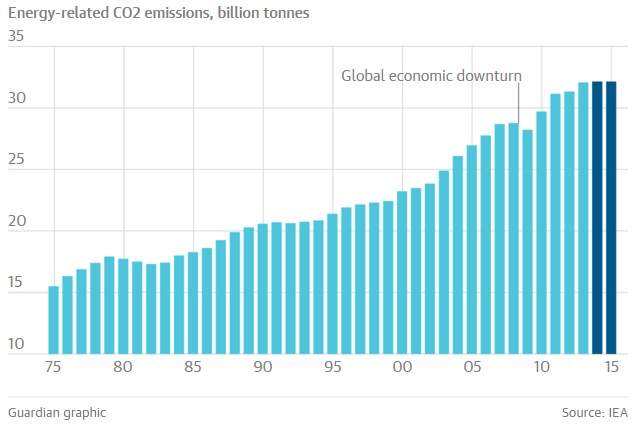
The bad news is that we are still at record high levels of GHG emissions but the good news is they haven’t increased. This may well indicate that the tide is finally turning away from fossil-fuel-derived energy and towards renewables and energy conservation.
‘The figures are significant because they prove to traditionally sceptical treasuries that it is possible to grow economies without increasing climate emissions… The new figures confirm last year’s surprising but welcome news: we now have seen two straight years of greenhouse gas emissions decoupling from economic growth’.
At the risk of sounding like a broken record, I firmly believe that we won’t find a true solution until we move away from the current economic model that requires perpetual growth at all costs. Only when we work within a system that strives for balance in all things will we truly be on track to nurture the environment that nurtures us.
Arch Criminals
A friend in the States just sent me this shocking article from the Sightline Institute which describes how the executives of the huge Arch Coal Company paid themselves an 8 Million dollar bonus ONE BUSINESS DAY before the company filed for bankruptcy. Apparently they paid themselves more than $29 Million in bonuses in the year leading up to the bankruptcy. Unfortunately this sort of unbridled greed and corruption seems to be rife in the upper management of corporations and governments around the world. I’ll be amazed if anyone is ever brought to justice over it but the backlash might take America in an even scarier direction. Donald Trump’s popularity is largely due to ordinary Americans being sick to death of Wall Street cronies making insane fortunes while everyone else struggles to keep their head above water. How this mad Billionaire has managed to convince America that he is somehow different from all the other super-rich blood suckers is beyond me. Meanwhile I try not to image what it could mean for the world if he actually became President and Commander-in-Chief.
The silver lining to this cloud is the news that nearly fifty of the major American coal companies have gone into liquidation (as reported in the Sightline Article). Hopefully this marks the beginning of the end for Big Coal and hopefully it won’t take too long before Australia’s politicians realise that coal is not the answer to all their prayers and they’ll stop given Korean companies permission to open new coal mines near historic villages like Berrima or loading docks near the Great Barrier Reef.
In last week’s newsletter I wrote about how Australian ‘standard practices’ for the insulation and air-sealing of buildings leave a lot to be desired. This clearly touched a chord with readers and I received a number of affirmative responses.
Architect Mary Bowe of Coolfield Pty Ltd made the following comments:
Thanks for sharing your thoughts on ‘standard practices’. It really is appalling what is continuing to happen in the building industry and how much vigilance it requires to get a job well done.
I do not know the answers.
In 2011 from Darwin I project managed our Brisbane house rebuild after the floods. The house was stripped down to the internal framework, and there were a number of occasions when I had to stand my ground to stop shoddy practises happening. A couple of examples – the house ended up with far less insulation than previously, and incurred costs down the track to bring it back up to speed, there was no consideration in the electrical fitout that the house was solar powered, and we had to replace all of the fittings to return to the previous energy efficiencies, and there were a number of disagreements over whose responsibility it was to rectify work, eg, the builder, the plumber, the tiler…. Wasn’t too great to find one of the showers had not been connected back to the drainage system, and was pouring out under the house etc etc.
In a later renovation trying to specify “green” products often ended in the “too hard basket”and a reversion to known products when time constraints did not allow for research of alternatives. Frequently sub-contractors had no idea of how to work with ESD products, felt threatened by the requests, and certainly did not read the instructions let alone keep up to date with new products and processes on the market.
This year I have made the decision to study building certification through UniSA to meet the academic requirements of a building surveyor. (Grad Dip in Built Env – Building Surveying). This ties my architectural degree and my compliance background together. I think there is great scope to be a “green certifier”. With a return to Queensland on the horizon, and the imminent need to work with NSW building surveyors to gain experience, straight away the different legislative requirements and building practises between states and territories becomes apparent. With one foot in NSW and the other in Qld it is very apparent we need to continue pushing for national regulation. It will be a challenging course for me, with many of the other uni participants having extensive experience in building certification, but it really is all part of the change we need to have.
I am a great believer in simplifying regulations. Coming back to Australia after a long stint in America I was stunned by how much red tape we have to wade through to get anything built around here. It doesn’t help that every state has different rules and different ways of measuring performance. As I wrote in last week’s newsletter, I firmly believe that we need higher standards for energy efficiency and I agree with Mary that we need consistency across state borders. An old boss of mine in the States once said that ‘ a house that complies with all of the building codes and standards is the WORST house that you are legally allowed to build‘. This is completely true and is a very eye-opening way to look at building codes. In our own projects we always aim for much higher energy performance than the minimum allowed. Unfortunately the big builders are always aiming to get away with the minimum possible in order to maximise their profit. This is why Australia will have to raise the standards in order to see a significant reduction in carbon emissions from our buildings.
Another reader, Leon, wrote:We bought an existing house down the road from you in Braemar last year. One issue we’ve had is that every electrician and cabler we’ve had has moved ceiling insulation to fit new lights and wiring, and has NOT put the batts back. I found this out after winter when I had to go into the roof space and found about 10% not insulated and the batts just pushed aside.
This is not a case of they had to keep them away from downlights but rather just laziness. I am sure this practice is extremely widespread. Our last house was about 12 years old and had to have wall insulation when it was built. When we had the kitchen renovated the Gyprock had to come off and half was not insulated and huge gaps exisited. As you mentioned, there is no checking of this and how would anyone know what has been insulated or not?
Leon is spot on. I worked for a number of years doing energy audits on homes in Montana and I can honestly say that I can’t remember EVER going into an attic and finding all of the insulation in its proper place. Electricians, plumbers and heating contractors are all notorious for moving insulation out of the way in order to install or repair something and NOT putting it back. It is certainly laziness combined with a lack of awareness about the importance of proper insulation and air sealing. And these are just two of the ten factors that all have to work together to maximise energy efficiency. As Leon reiterates, the fact that Australian building codes do not require any sort of third-party verification of the insulation and air sealing means that builders can and do get away with a lot of shoddy work and home-owners end up paying the price over the long-term with higher-than-necessary energy bills.
Issues with Lithium Batteries
 A Lithium battery that exploded recently A friend of mine, Manuel Cilla of Ciletric Pty Ltd, specialises in off-grid solar power systems and sent me the above photo a few days ago with the warning, ‘Never, never install Lithium batteries inside‘. I had read about the danger of Lithium batteries catching fire or exploding but this is the first time I’ve seen first-hand evidence of the problem.
Another friend who is very knowledgeable about battery storage systems added that: ‘It is worth pointing out that the manufacturer is a company called Growatt. This is a Chinese manufacturer, who I suspect is at the very low end of manufacturing quality. I have certainly never heard of them before. I would definitely never consider buying a battery from a cheap Chinese supplier.
They say that this model (SP2000 I think) has a lithium iron (LiFe) battery chemistry, i.e. not Lithium Phosphate. Tesla uses Nickel, Manganese Cobalt. Panasonic uses something else, I think. If I recall correctly LiFe is at the higher fire risk end.‘
It does seem to me that fires caused by Lithium batteries are a fairly rare occurrence but I learned something even more troubling about Lithium batteries at a talk I attended last night. The talk was about a new type of battery called the Ultrabattery which is a cross between a Lead-acid battery and a supercapacitor. This technology was developed by the CSIRO and then sold to an American company who are now marketing it through Ecoult. Some of the presentation was over my head but it does seem that the Ultrabattery has some definite advantages in certain situations. One of the many benefits that the presenter listed is that Lead-acid batteries are readily recyclable and that something like 95% of them are actually recycled. By contrast, according to him, Lithium batteries are extremely difficult and expensive to recycle so most of them are simply incinerated. I have not yet been able to find reliable information to confirm or deny this assertion so if any readers know more about it please let me know. With Tesla on the verge of opening its Gigafactory to produce a massive amount of Lithium batteries and with the huge surge globally in interest in battery storage systems it would be very useful to understand the full list of pros and cons of Lithium battery technology.
For the last nine months or so I’ve been helping a friend who is trying to get her dream home built not far from the Greeny Flat. She started with a vacant lot and I’ve been consulting to her on the design, permitting, choosing a builder and attempting to ensure that the project gets completed to a high standard of energy efficiency. This is proving to be an interesting challenge and I’m discovering that builders here are generally not used to insulating and air-sealing homes very well. In fact, after twenty years of designing, building and testing homes in America, I’m finding that the ‘Standard Practices’ for Australian home builders leave a great deal to be desired in terms of energy efficiency.
 Insulation left out behind the electrical outlets and switches. To his credit, the builder on this project has been open to suggestions on how the air-sealing and insulation could be done better, but I’m finding that I have to watch things very closely or they just get done the way they have always been done. For example, as you can see in the photo above, I found that the insulation had been left out behind all of the electrical powerpoints and switches. When I asked the builder why, the answer was that ‘this is the way we always do it’. Apparently the electrician is concerned that, if there was a spark from an electrical connection, it could catch the insulation on fire. I pointed out that fibreglass insulation doesn’t burn but was told that it was a ‘code issue’.
So I sent emails to some code officials I know and asked whether there was anything written in the building code or Australian standards that requires you to not insulate behind electrical outlets. The answer was a resounding ‘No!’. in fact it is a legal requirement that the insulation be installed to the proper standard to meet BASIX in NSW. This means that the insulation has to be continuous without holes, gaps or folds. Unfortunately there is no requirement for building certifiers to inspect the insulation. It is up to the builder to sign an affidavit saying that the insulation was installed correctly, which is not very satisfactory if builders don’t know how it should be done properly.
All this makes me wonder how many homes in Australia are built with shoddy insulation. If you read the installation instructions for Knauf ‘Earthwool’ batts you’ll find the following; ‘Make sure all areas are insulated, behind electrical outlets, plumbing and services’. It also says, ‘When installing insulation between framing members, ensure that you achieve a snug fit avoiding any gaps, tucks and folds’. Clearly the builder on this project didn’t read those instructions (he has used some Knauf batts and some from another company) and simply followed ‘Standard Practices’ which clearly leave a lot to be desired as shown in the photo below.
 Gaps, folds and holes in the insulation. The really sad thing is that this builder actually did a much better job of insulating than many I have seen. After spending some time pointing out the deficiencies in the job, he has assured me that they will be corrected before the gyprock goes up. I expect it won’t be perfect but it will be a lot better insulated and air-sealed than most Australian homes.
Another insulation issue that we ran into last week relates to the SIPS panels on the roof. Like the Greeny Flat, this project is roofed with Structural Insulated Panels (SIPS) which comprise a foam core clad with corrugated Colourbond on the top surface and smooth Colourbond steel on the underside. Unlike the Greeny Flat however, these panels (which are from a different company than ours) have gaps between the foam cores when they are installed. On the Greeny Flat, when the panels were snapped together the foam cores ended up tight against each other so that no air, heat or cold could move through the panel joints. On my friend’s project, as you can see from the photos below, even though these panels are snapped together as tightly as possible there is still a gap of almost 20mm between the foam cores and this was the same for all of the panels.
 Gap between the foam cores of the SIPS roof panels  Close up of showing the size of the gaps in the roof panels These gaps run all the way from the eave up to the ridge and constitute a major flaw in the insulation of the roof. In fact a quick calculation reveals that, added together, they total an area of at least one square meter that is completely uninsulated. The tricky thing is going to be figuring out how to insulate and air seal these gaps. We’re hoping that it will be possible to insert a hose into the gaps and fill them from top to bottom with spray foam but we’re yet to discover if anyone nearby has the equipment to do that or how much it might cost.
Sadly, if the builder had been more aware of good insulation and air-sealing practices, he could have quite easily solved the problem by inserting a strip of insulation into the gaps as the panels for snapped together. But clearly we have a long way to go before a high standard of energy efficiency becomes ‘Standard Practice’ in Australia. Meanwhile it seems like it would be a very good idea to have someone other than the builder inspect and certify that the insulation meets the requirements of the building codes and standards.

In our Newsletter three weeks ago I mentioned that President Obama had proposed a $10/barrel tax on crude oil as a way to fund a $300 billion plan to make America’s transportation system more sustainable. As I said at the time, there is zero chance of this plan being approved by the US Congress, largely due to the power that the fossil fuel industry wields via political “donations” (i.e. bribes) and campaign contributions. For a long time I’ve been saying that there are two things which need to happen in order to drive a major shift away from fossil fuels towards renewable energy sources; 1) the price of fossil fuels needs to be higher and 2) the cost of renewable energy needs to be lower.
Technological innovation and the growing uptake of solar and wind power have helped to bring the cost of renewable energy down to where it can already compete with fossil fuels in certain situations. For example, it can be cheaper to build a new solar farm than a new, equivalently-sized, coal-fired power plant. However the cost of energy storage has not yet fallen enough for the solar farm to be capable of economically providing power when the sun isn’t shining. Which means we still need other forms of electricity generation to fill the gaps. Until someone can prove to me that we can safely deal with nuclear waste (or they develop a technology that doesn’t produce toxic waste) I think the nuclear option is completely out of the question. There are certainly a lot of very promising new technologies under development but for now fossil fuels are still providing most of the world’s energy.
This is largely because fossil fuels are too cheap. The price of fossil fuels does not reflect the true cost to society and the planet of burning them. If fossil fuel prices included the cost of mitigating the climate damage, health problems, pollution, water-contamination and general environmental havoc they cause, renewable energy would be a much more cost-competitive option.
Right now we are seeing extremely low fossil fuel prices due largely to over-supply and slowing demand. To make matters worse, governments the world over are pouring billions of tax-payer dollars into subsidising fossil fuels. According to this recent article from Energy Matters, GoFossilFree.org.au estimates that the Australian government will hand out $7.7 billion in subsidies to the fossil fuel industry in the next financial year.
Are Our Politicians Corrupt?
According to GoFossilFree.org.au fossil fuel interests have donated $3.7 million dollars to Australia’s major political parties since the last election. This means that… “for every dollar donated to the major parties over the past 3 years, the fossil fuel industry will receive over $2000 in Government hand-outs from our politicians this year”.
GoFossilFree.org.au is applying pressure on all MP’s to sign a pledge calling for a ban on donations from fossil fuel industries and a ban on subsidies to fossil fuel companies. So far a few have signed and 27 have refused to sign, including Barnaby Joyce, Greg Hunt, Tony Abbott, Andrew Robb, and Mathias Cormann. As in America with President Obama’s plan to tax oil, this movement to end political bribes from, and tax-payer handouts to, fossil fuel companies may well be doomed to failure but at least it is helping to bring the issue to light. Hopefully it will expose and embarrass the pollies who are the most firmly in bed with polluting industries and help make Australians tax-payers aware of just how much of our own money is being used to ruin our children’s future.
It begs the question, who are the real “Fossil Fools”? The corrupt politicians who make a fortune selling influence to the highest bidder regardless of the the financial, social and environmental cost to the people who elected them? Or us bozos who keep working and voting and paying our taxes and letting them get away with it.
In last week’s Newsletter we featured a couple of small, affordable, relocatable homes. This week we look at
 The Community Garden at Moss Vale Moss Vale Community Garden is located on Railway St between the tennis courts and the old bowling club. It has been in operation for over ten years providing food growing opportunities, skills training, education and delicious produce to the Moss Vale community. Soon it will be getting a big boost in the form of an off-grid solar power and battery storage system. The 3.7kW PV system has been made possible by the great generosity of Manuel Cilla of Cilectric Pty Ltd along with a grant from the Corena Fund.
 Manuel Cilla of Cilectric finds shade under the new solar power system. Manuel, through his company Cilectric, specialises in off-grid and large scale commercial solar power systems. He has very kindly donated a great deal of time along with a lot of materials and equipment to provide the gardens with an uninterruptible power system for pumping water and running lights, stoves, etc in their straw-bale kitchen.
 The inner workings of the soon-to-be-operational off-grid renewable energy system. The photo above shows the battery storage and control boxes for the off-grid power system. The box on the top left houses the main switches and circuit breaker board. The yellow box top right is the SMA “Sunny Island” controller. This is the brains of the system and decides when and where power is sent to the loads or stored in the battery. The silver box below it is the battery, a 6.4kWh LG unit that offers more storage and a higher peak output for the same price as the Tesla Powerwall (and in a smaller unit). And the red box next to it is the SMA “Sunny Boy” inverter which changes the solar power from DC to 240V AC.
On the subject of solar power, anyone who is currently enjoying the 60c/kWh Feed In Tariff will want to read this article from Roof Juice. It explains why it is completely unnecessary for people who are on the 60c FIT scheme and using gross metering to have to pay $600 to $1000 to replace their meters when the scheme runs out. Net metering can easily be done with the meters you already have and their is talk of a class action suit to protect home owners from being forced to pay for unnecessary equipment.
Meanwhile, local readers who are interested in community gardening, organic food, cooking, eating, off-grid renewable energy or electric vehicles might want to come along to the Grow, Cook, Eat Festival in Moss Vale on March 20th (see below for more details). I will be displaying the PHEV which will be charging from the solar power system which Manuel will be on hand to explain, and the Community Garden will be open for viewing as well. I hope to see you there.
Sunday March 20th marks the date for the annual Southern Highlands ‘Grow, Cook, Eat Festival‘. This year the event will be held at the old Moss Vale Bowling Club on Railway St (right next to the Community Garden). The event is billed as
‘A community event providing delicious local food, market stalls, talks and demonstrations, children’s activities, wood fired pizza, live music and local arts.’
As mentioned above, I will be helping with one of the talks and demonstrations about off-grid power and electric vehicles. I haven’t been to one of these festivals before so I’m not sure what else will be on show apart from lots of yummy food, local wine, arts and music. It sounds like a lot of fun. For those readers who can’t make it I will let you know how it goes after the event.
The Latest in Welsh Hydrogen/Electric Vehicles
 The Rasa hydrogen fuel-cell electric vehicle during road testing. Source: Gizmag.com When I read this Gizmag article about The Rasa hydrogen fuel-cell electric vehicle I thought, ‘Wow, this looks like a real game-changer’. So you can imagine my surprise when I learned that it was being developed in Wales of all places. Who would have thought it would be the Welsh to come out with the first small, practical, hydrogen-powered electric vehicle? Wales is not exactly famous for producing world-beating high-tech automobiles. But I have to say, this one looks very promising. It’s not commercially available yet and the article gives no indication of the expected price but a full production model is scheduled for some time in 2018.
The design brief for the road-legal two-seater was for ‘lightness, strength, affordability and safety as well as the maximisation of fuel-economy and the minimisation of pollution’. Water is the only tailpipe emission and, even if the hydrogen is sourced from petroleum, the carbon emissions are claimed to be the lowest of any car yet made. That’s a pretty impressive claim and is achieved by the use of such technologies as:
- In-wheel electric motors
- Carbon-fibre shell
- Regenerative braking which stores energy in a bank of super-capacitors
- Faired rear wheels
- Gull-wing doors
- Total weight of 580kg
- Top speed of 100km/h
- And a fuel economy of 0.9L/100km.
Another interesting development with this car is that the company intends not to sell but to offer it to customers for a monthly fee that will include a distance allowance plus all repairs, maintenance, insurance and fuel costs. If anything goes wrong with the car, the owner will not have it repaired, they will simply swap it for a new one. The company describes this as ‘a lightness of ownership that neither places a burden on the pockets of motorists or the surrounding environment’.
It sounds great to me. I just wish it were available now in Australia. Unfortunately, with current government policy and manufacturers apparent reluctance to advance electric vehicle uptake here, it might be a VERY long time before we see The Rasa on the streets of Sydney.
By the way, on the subject of hydrogen vehicles, I was also quite fascinated by this other Gizmag article which describes a drone plane powered by hydrogen fuel pellets. Liquid hydrogen typically has to be stored in large, heavy pressurised tanks which makes it a tricky fuel to use, especially for planes. The drone in this article was flown using a new type of fuel pellet made by Cella Energy in Britain which can be stored in an unpressurised container and which releases hydrogen when heat is applied. This is converted to electricity by a fuel cell to power the electric motor which drives the prop. The combined weight of the pellets and the fuel cell are reportedly less than the weight of the Lithium-ion battery that was previously used to power the drone. The idea of using hydrogen pellets instead of pressurised hydrogen could potentially solve some of the major problems that have limited the usability of hydrogen as a an energy storage medium and a replacement fuel for petroleum. It will be very interesting to see how this technology develops.
Petition for Compulsory Solar Panels
Finally for this week… this article from the Energy Matters Newsletter describes a petition that has been started ‘calling on the Australian Federal Government and all state premiers to make solar panels mandatory on new houses’.
13,286 people have already signed the petition which you can find here... including yours truly. As the wording of the petition puts it…
‘We don’t want to sit back and do nothing and leave a world not worth living in for our grandchildren.’
Hmmm… perhaps I’ll start another petition calling on our governments to introduce higher energy-efficiency standards for buildings in Australia too.
Well it’s Valentine’s Day. I’ll let Cintia choose whether I cook her dinner or we go out to a restaurant… either way this will have to be a quick Newsletter so I thought I’d share a couple of exciting little houses that readers have told me about.
Now THIS Is Affordable Housing!
 Modular 5-star TransPack Granny Flat Back in September 2014 Domain.com.au ran an article about Granny Flats for under $10,000. The company is called TransPack and they claim that their modular cabins
- Are built in China and shipped in a container
- Take four hours to assemble
- Have a 5-star energy efficiency rating
- Are cyclone proof
- Meet all Australian building standards
- And can cost as little as $10,000.
A quick check of TransPack’s website reveals that prices have gone up due to the fall in the Australian dollar since 2014 however they are still offering a 15sqm, one-bedrooom, one bathroom cabin for $14,800 and a 60sqm, two bedroom, one bathroom home for $49,900. I haven’t checked whether those prices are all inclusive or what other costs might be expected. But for anyone looking for a VERY low-cost option for a granny flat or small home (assuming you don’t have philosophical objections to buying a home that is made in China and shipped halfway around the world at who-knows-what environmental cost) TansPack might be something to consider.
18 sqm of Design Excellence
 Tiny on the outside but this little beauty is big on the inside. This wonderful little house design comes via a website called brightside.me. Designed by American architect, Chris Heininge, this is the best tiny house design that I have seen yet. At only 18 sqm it is less than a third the size of the Greeny Flat yet it manages to comfortably fit a kitchen, living room, bathroom (with jacuzzi) and loft bedroom.
 Masterful design and efficient use of space For anyone interested in efficient use of space it is well worth checking out this article that shows more pictures of the house as well as floor plans. I particularly like the way the roof can be removed so that the whole house can easily be transported. It’s the idea to turn the gable roof 90 degrees from your typical little cabin roof that creates the space necessary for the loft bedroom to function. It’s beautifully conceived, planned and built and we love it!
|
We will not share your information with anyone else and you can unsubscribe at any time.
Recent Newsletters
-
Apr 6, 2024: Open for Sustainable House Day
-
Apr 1, 2022: These floods are no joke
-
Mar 4, 2022: Disasters of Our Own Design
-
Nov 12, 2021: Free Zoom Screening of ‘Now’ Movie on Sunday
-
Nov 5, 2021: The Times They Are A-Changing
-
Oct 14, 2021: Sustainable House Day is Back… virtually
-
Sep 24, 2021: Two Years In the Cottage
-
Jun 25, 2021: Cheap and Simple EV
-
May 14, 2021: 3D Printed Earth Home
-
Feb 26, 2021: Doing Something About It
-
Feb 12, 2021: Barangarooted
-
Jan 29, 2021: Our House on the ABC
-
Jan 8, 2021: Electric Vehicle Madness
-
Dec 12, 2020: Water Works and Solar Cars
-
Nov 13, 2020: Arts Trail Open House
-
Oct 2, 2020: Another Year of Living Positively
-
Sept 18, 2020: Virtual Sustainable House Day on Sunday
-
Sept 11, 2020: Back in Mittagong
-
Aug 28, 2020: One More Week in Port Macquarie
-
August 21, 2020: Progress Report
-
August 14, 2020: This week’s progress report
-
August 7, 2020: Port Project Photos
-
July 17, 2020: Port Macquarie Project Progress
-
June 26, 2020: All Electric Workhorses.
-
June 19, 2020: Port Macquarie Project
-
June 5, 2020: Mount Gibraltar Stone Stairway
-
May 22, 2020: Morrison Wants To Give $11M To A Coal Baron
-
April 22, 2020: Happy Earth Day
-
Mar 13, 2020: Coronavirus makes me feel lucky
-
Feb 20, 2020: Kitchen finished
-
Jan 31, 2020: How To Build a Fire-proof House
-
Jan 24, 2020: Back To Work
-
Jan 3, 2020: Childhood Beach Devastated By Fire
-
Nov 22, 2019: Energy Positive Success
-
Nov 1, 2019: Art Studio Trail This Weekend
-
Oct 18, 2019: Solar Monitoring and Upcoming Events
-
Oct 11, 2019: Queen St Renovations
-
Sept 28, 2019: Greta vs Growth
-
Sept 6, 2019: Sustainable House Day 2019 next weekend.
-
Aug 30, 2019: Solar Installed
-
Aug 23rd, 2019: Solar System Ordered and Other Notable Stuff
-
Aug 16, 2019: Two Projects Finished and Sustainable House Day Coming Up.
-
July 12, 2019: The Beauty of Bamboo
-
July 5, 2019: Back To Russell Island
-
June 28, 2019: Kitchen Upgrade
-
June 21, 2019: What’s Your 2040?
-
May 24, 2019: Public Meeting in Bowral on Friday 31st of May
-
April 26, 2019: Reader Feedback on Granny Flat Economics
-
April 12, 2019: The Economics of Granny Flats
-
Feb 20, 2019: Russell Island Home Tour
-
Feb 8, 2019: Russell Island Nearly Finished
-
Jan 25, 2019: Progress and Other Good Stuff
-
Jan 18, 2019: New Leaf and Progress Photos
-
Jan 4, 2019: Doors and Architraves
-
Dec 28, 2018: Russell Island house progress.
-
Dec 12, 2018: Back on Russell Island
-
Nov 16, 2018: Greeny Flat For Rent
-
Nov 9, 2018: A Tale of Two Houses
-
Oct 2018: Is The Housing Market Starting to See the Light?
-
Sept 16, 2018: Greeny Flat Testimonial.
-
Sept 7, 2018: Lighter Roofs and Cheaper PHEVs
-
August 31, 2018: Windows and Cladding
-
August 17, 2018: Adamant About Eaves
-
August 3rd, 2018: Raising the Roof
-
July 27, 2018: Progress Photos
-
July 13, 2018: Project Progress
-
July 7, 2018: Affordable Housing Project in QLD
-
May 11, 2018: DIY Retrofit Double-Glazing
-
May 4th, 2018: Greeny Flat Available to Rent – Jun/Jul/Aug
-
April 20, 2018: Why you MUST monitor your solar system.
-
April 6, 2018: 4th Earth Day Party – April 22
-
March 30, 2018: It’s a Great Time For Solar
-
March 23, 2018: Beware of Tradies In Your Attic
-
March 16, 2018: More Sustainable Subdivisions
-
March 2, 2018: More Solar For Landlords and Renters
-
Feb 23, 2018: The Reroofing Begins
-
Feb 16, 2018: Record Year for Rooftop Solar
-
Feb 9, 2018: Cooking With Compost
-
Feb 2, 2018: Waste-to-Energy Systems
-
Jan 16, 2018: Should I Replace My Tile Roof
-
Dec 12, 2018: More About Keeping Cool
-
Jan 5, 2018: Keeping Your Cool
-
Dec 29, 2017: Happy New Year
-
Dec 22, 2017: Upside-down Season
-
Dec 8, 2017: Bitcoin Climate Disruption
-
Dec 1, 2017: The Coming Disruption
-
Nov 24, 2017: Suncrowd Review – 0 Stars
-
Nov 17, 2017: Tesla Tiny House Here Next Week
-
Nov 2, 2017: Montana Off-grid Eco Tiny House
-
Oct 27, 2017: Glorious Rain and Good Results
-
Oct 20, 2017: Cattle… Good or Bad?
-
Oct 13, 2017: The Snow Shows Where the Heat Goes
-
Sept 6, 2017: Tesla Tiny House coming to Bowral
-
Sept 29, 2017: Home Solar and Double-dipping on Carbon Emissions
-
Sept 22, 2017: Time to Load Up On Solar
-
Sept 15, 2017: Sustainable House Day This Sunday.
-
Sept 8, 2017: Project Progress, Yellowstone, Etc
-
August 31, 2017: Day Tripping in Montana
-
August 25, 2016: Electric Vehicle Update
-
August 18, 2017: State of The States
-
August 11, 2017: Cool Stuff
-
August 4, 2017: Going to Montana
-
July 28, 2017: Episode 13 – West Side Shade Awning and Deck
-
July 21, 2017: Now That’s True Sustainability!
-
July 14, 2017: How To Choose The Best Electricity Retailer
-
July 7, 2017: A Year of PHEVing It.
-
June 30, 2017: Case Study – Holiday House Energy Upgrade
-
June 23, 2017: In The News This Week
-
June 16, 2017: Grow Your Bricks and Monitor Your Energy
-
June 9, 2016: A New Ethical Energy Retailer
-
June 2, 2017: Dark Days and Bright Spots
-
May 19, 2017: Things That Caught My Eye
-
May 12, 2017: The Sublime and the Ridiculous
-
May 4, 2017: Episode 12 – Replacing the Sewer Lines
-
April 28, 2017: Doing the Dirty Work
-
April 21, 2017: Ban the Bag
-
April 14, 2017: One Down, One Billion to Go.
-
April 7, 2017: 3RD EARTH DAY PARTY – April 22
-
March 30, 2017: Electric Shocks
-
March 17, 2017: Big Changes Coming
-
March3, 2017: Massive Erections
-
Feb 24, 2017: PHEV Love
-
Feb 2, 2017: Every Home Needs This!
-
Feb 3, 2017: Episode 11 – How To Make a Solar Air Heating Wall
-
Jan 20, 2017: Episode 10 – Why Build a Solar Air Heating Wall?
-
Jan 13, 2017: Agents of Change and a New Local Brew
-
Jan 6, 2017: Starfish and the Cost of Australia’s Poor Quality Houses
-
Dec 23, 2016: Episode 9 – What’s a Trombe Wall?
-
Dec 16, 2016: Episode 8 – Retrofitting Passive Solar
-
Dec 11, 2016: Episode 7 – New Windows in Old Walls
-
Nov 25, 2016: Repower Excitement and Episode 6
-
Nov 18, 2016: Community Renewable Energy Investment Opportunity
-
Nov 4, 2016: Window Replacement and Tesla’s New Battery
-
Oct 28, 2016: Suncrowd! What a Buzz!
-
Oct 20, 2016: Episode 4 and Catchpower Answers
-
Oct 14, 2016: Episode 3 – Borers, Rot and Underfloor Ventilation
-
Oct 7, 2016: Episode 2 and SunCrowd Invitation
-
Sept 30, 2016: Home Energy Retrofit Video 1
-
Sept 23, 2016: Catch Power – So What’s The Catch?
-
Sept 16, 2016: What To Do at the End of the 60c Feed-in Tariff
-
Sept 9, 2016: Happy Sustainable House Day!
-
Sept 2, 2016: The Beginning of the End of Solar Subsidies in NSW
-
August 25th, 2016: Lessons from an Infrared Camera
-
Aug 19, 2016: Open Source Tiny Homes
-
August 12, 2016: Sustainable House Day 2016
-
Aug 4, 2016: Solar Bulk-buy with SunCrowd
-
July 29, 2016: ‘Free’ Power with Repower
-
July 21, 2016: Fibro Cottage Energy Retrofit
-
July 15, 2016: Science With a Conscience
-
July 8, 2016: Election Day – Droning On
-
June 25, 2016: ‘Renewable Electricity’ is NOT ‘Renewable Energy’
-
June 19, 2016: The Power of TV and The Rise of The Machines
-
June 12, 2016: Magnetite, Drones and Climate Action
-
June 4, 2016: Stools to Fuels
-
May 29th, 2016: The Future of Energy?
-
May 21, 2016: Concrete Alternatives and PCM’s
-
May 15, 2016: First the Good News
-
May 8, 2016: Underslab Insulation
-
May 1, 2016: Counting Comfort and Costs
-
April 24, 2016: Celebrating Two Years of Energy Positive Living
-
April 17, 2016: Gimme Three Reasons
-
Apr 10, 2016: Second Earth Day Party, 4-7pm April 22nd.
-
April 3, 2016: Home Battery Updates
-
Mar 26, 2016: An Electric Transportation Revolution
-
Mar 18, 2016: Mould and Other Fun Stuff
-
Mar 12, 2016: Reader Feedback and Lithium Issues
-
Mar 6, 2016: Beware of ‘Standard Practices’
-
Feb 28, 2016: Fossil Fools
-
Feb 20, 2016: Grow, Cook, Eat – Offgrid Power – and Welsh Cars
-
Feb 14th, 2016: Gotta Love These Little Houses
-
Feb 7, 2016: Renewable Energy Prepares For Take Off
-
Jan 24, 2016: PHEV Goes Bush
-
Jan 17, 2016: 1.5L/100km
-
Jan 10, 2016: How To Reduce Our Carbon Footprint
-
Jan 3, 2016: PHEV Goes Camping
-
Dec 27, 2015: Electric Driving Less Than Half The Cost of Petrol
-
Dec 20, 2015: Our First Week With an Electric Vehicle
-
Dec 13, 2015: Putting My Money Where My Mouth Is.
-
Dec 13, 2015: Paris Talks Waffle?
-
Nov 29, 2015: Walking for Climate Action and Driving Electric Vehicles
-
Nov 15, 2015: Battery Storage Options
-
Oct 8, 2015: The Big Disconnect?
-
Nov 11, 2015: 7,377,870,064 Elephants in the Room
-
Oct 25, 2015: Pros and Cons of Granny Flats
-
Oct 16, 2015: Greeny Flat Wins Green Globe Award!
-
Oct 11, 2015: What’s Wrong With This Picture?
-
Sep 27, 2015: Build Tight, Vent Right
-
Sep 20, 2015: Driving Sustainability
-
Sept 12, 2015: Greeny Flat Named 2015 Green Globe Awards Finalist
-
Sept 6, 2015: Sustainable House Day
-
August 27, 2015: Water, Water Everywhere!
-
August 23, 2015: Back in Brazil
-
August 14, 2015: Ranch Life and Sustainable House Day
-
August 7, 2015: Greetings From Montana
-
August 8, 2015: Renewable Choice for Oz Voters
-
July18, 2015: Whoops, I Spoke Too Soon
-
Jul 12, 2015: Nice Weather for Eskimos
-
Jul 5, 2015: Solar Planes, Trains and Automobiles
-
Jun 28, 2015: Greeny Flat Welcomes Sustainable Lifestyle
-
Jun 21, 2015: Happy Winter Solstice!
-
Jun 14, 2015: Test Drive the Greeny Flat
-
Jun 7, 2015: Visit to a Local Food Forest
-
May 31, 2015: Exciting Times!
-
May 24, 2015: The Heat Goes On
-
May 17, 2015: DIY Solar Air Heater Prototype
-
May 10, 2015: K.I.S.S. My House
-
May 3rd, 2015: Tesla Reinvents Electicity
-
Apr 26, 2015: Party Pics and Random Bits.
-
Apr 22, 2015: Experiment Declared Resounding Success!
-
Apr 19, 2015: Greeny Flat’s 1st Earth Day Party this week
-
Apr 12, 2015: Sand Wars, Floating Solar Farms and other Fun Stuff.
-
Apr 5, 2015: Invitation to a Party
-
Apr 4, 2015: UK’s First Carbon Neutral Town
-
Mar 21, 2015: Latest Results and Reader Feedback
-
Mar 16, 2015: Our Double-glazed Windows
-
Mar 8, 2015: Form Follows Function
-
Mar 8, 2015: Reader Feedback
-
Mar 1, 2015: Some Fun Stuff
-
Feb 22, 2015: Proof Positive
-
Feb 15, 2015: Case Studies – Heat Doesn’t Rise
-
Feb 8, 2015: In all sorts of hot water
-
Feb 2, 2015: Rethinking the way we design and build
-
Jan 25, 2015: Latest Results and Electric Vehicles.
-
Jan 20, 2015: The GreenPower plot thickens
-
Jan 18, 2015: Switching to Green Power
-
Jan 11, 2015: Our surface-mounted electrical system
-
Jan 4, 2015: Our Solar Power System
-
Dec 28, 2014: Sandwiches for Cathedrals
-
Dec 24, 2014: December Results
-
Dec 16, 2014: Eco-home Display Village Concept
-
Dec 14, 2014: All New Homes to be Energy Positive by 2016.
-
Dec 7, 2014: $41 Energy Bill for last three months
-
Nov 25, 2014: Think light for a cooler roof
-
Nov 22, 2014: Staying cool in the heat
-
Nov 9, 2014: The benefits of a small home.
-
Oct 26, 2014: Last Sunday the Greeny Flat made 4 TIMES as much energy as it used!
-
Oct 12, 2014: Lessons learned so far
-
Oct 10, 2014: Why an all electric house?
-
Sept 22, 2014: Great Day for Renewable Energy
-
Sept 21, 2014: Greeny Flat Cost Analysis
-
Sept 11, 2014: $10.63 worth of energy in 3 months.
-
August 30, 2014: Greeny Flat open for Sustainable House Day
-
August 22, 2014: Four months and going strong.
-
July 22, 2014: Three month’s results… All Positive!
-
July 4, 2014: Energy Independence Day!
-
June 11, 2014: Cintia’s winter
-
May 27, 2014: Greeny Flat on ABC
-
May 27, 2014: Cool Fridge Wins Energy Star Wars
-
May 23, 2014: Testing the air-tightness
-
May 19, 2014: First month’s results… VERY promising!
-
Apr 22, 2014: Earth Day marks the start of one year of monitoring
-
Mar 24, 2014: start of a big week
-
Mar 7, 2014: BASIX is a JOKE!
-
Mar 6, 2014: starting on the kitchen
-
Mar 1, 2014: Pumps and Solar Hot Water: decisions, Decision, DECISIONS!
-
Feb 24, 2014: Greeny Flat in the news
-
Feb 20, 2014: surface mounted electrical system
-
Feb 19, 2014: end in sight for the construction phase.
|


